


The single product most people should build a routine around is a clinically dosed treatment serum, not a moisturizer or a cleanser alone. A focused serum delivers active ingredients at concentrations shown to change skin structure, while still supporting the barrier that every other product depends on. Give it a few weeks before judging results, and track progress with photos rather than how your skin feels on any given day.
TL;DR:
- A single product with clinically proven, properly dosed active ingredients, like peptides or retinoids, provides the best chance for measurable skin improvements.
- Moisturizers mainly aid adherence to active treatments, while sunscreens are essential for preventing further damage but do not reverse existing issues.
- Introducing a targeted serum gradually over eight to twelve weeks with consistent application yields better results than frequent switching or over-application.
- Effective one-product routines rely on ingredients supported by research, with the right vehicle for your skin type, and are not substitutes for active treatments for serious skin conditions.
- Proper use involves starting with a simplified routine, patch-testing new actives, applying on clean skin, and tracking progress via photos over the recommended treatment window.
Table of Contents
- What Type of One Product Skincare Actually Delivers Results?
- Does the Evidence Actually Support a Minimalist Routine?
- How Do You Actually Use One Product the Right Way?
- When Is a Single Product Not Enough?
- Why Alloi Skin Builds One Formula Instead of Ten
- How Do You Choose Based on Your Skin Type?
- What Mistakes Undermine a One-Product Routine?
- How Do Popular One-Product Approaches Compare?
- Why We Think Less Is Actually More
- Try VitalCopper Renewal Face Serum for Yourself
- Sources
- FAQ
What Type of One Product Skincare Actually Delivers Results?
Not every “one product” claim holds up the same way. Cleansers mostly remove what’s on the skin’s surface. Moisturizers hydrate and support the barrier, but they rarely change the skin’s underlying structure on their own. Sunscreen prevents damage rather than reversing it. A well-formulated serum sits in a different category: it’s built to deliver a concentrated active deep enough to influence collagen production, pigmentation, or barrier repair over time.
That’s why a targeted treatment serum tends to produce the most measurable change for people trying to address a specific concern, whether that’s fine lines, dullness, or a compromised barrier from over-exfoliation. Single-ingredient and multitasking formulas have grown in popularity precisely because shoppers want fewer decisions and more predictable outcomes. But the category matters less than what’s actually inside the bottle and at what dose.
Before choosing a single product, run through a short checklist:
- What’s the primary goal? Firmness, tone, hydration, and acne all call for different active ingredients.
- What vehicle suits your skin? Gel serums suit oily or acne-prone skin; cream-based formulas suit dry or mature skin.
- How reactive is your skin? Sensitive skin needs a gentler entry point and a longer patch-test window.
- Does it need SPF paired with it? Most treatment serums are not sun protection and need a separate sunscreen during the day.
Alloi Skin’s VitalCopper Renewal Face Serum was built around this exact logic. It combines copper tripeptide-1 (GHK-Cu) and Matrixyl 3000, two peptides studied for their role in supporting collagen synthesis and skin repair, at doses in line with published research rather than trace amounts. Panthenol, betaine, and hyaluronic acid round out the formula to calm and hydrate the barrier while the peptides do their work. The intent isn’t to stack ten actives and hope one works. It’s to include what’s proven, at a dose that matters, and nothing else.
Pro Tip: If you’re not sure whether your skin needs a treatment serum or just better basics, spend two weeks on cleanser, moisturizer, and sunscreen alone first. If your skin still looks dull or textured after that baseline, a targeted serum is worth adding.
Does the Evidence Actually Support a Minimalist Routine?
Dermatologists who talk about skinimalism aren’t arguing for a single bottle to rule them all. They’re describing a shift toward a small number of genuinely effective products that someone will actually use every day, instead of a ten-step routine that gets abandoned by week three. Skincare frames this as a consistency problem as much as a formulation one: the best routine is the one you keep doing.
The evidence backing this varies a lot depending on which “one product” you’re talking about. Sunscreen has decades of long-term outcome data tied to it. Moisturizer has a more specific and often overlooked function: it improves adherence to other treatments. One trial cited by DermApproved found that people using a moisturizer alongside an active treatment stayed on that treatment at higher rates after several weeks than those who skipped it. The moisturizer isn’t doing the heavy lifting. It’s keeping people in the game long enough for the active ingredient to work.
A 2025 systematic review pooling eight randomized controlled trials found that tretinoin produced statistically significant improvement in both fine and coarse wrinkles compared to a vehicle control, one of the clearer examples of a single dosed active changing measurable skin structure over time.
That’s the standard a one-product strategy should be held to: a specific active, at a studied dose, with data behind it. Most standalone serums on the market don’t have trial data anywhere close to that. Many contain a long list of trending ingredients at fractional doses, more marketing than mechanism.
A few things the evidence consistently supports:
- Sunscreen has the strongest long-term outcome data of any single product category.
- Moisturizer’s biggest measurable benefit may be adherence, not hydration alone.
- A minimalist approach reduces the risk of ingredient conflict and barrier irritation that comes from layering too many actives at once.
- Editorial claims that “one product replaces your whole routine” often overstate what a single multitasking moisturizer can do compared to a dermatologist-recommended three-step foundation.
None of this means serums are interchangeable with sunscreen or moisturizer. It means a one-product strategy works best when that product is doing a job with real evidence behind it, layered on top of basics that already have the strongest data of all.
How Do You Actually Use One Product the Right Way?
Buying the right serum is only half the job. How you introduce it determines whether you get results or just irritation.
- Confirm your baseline. If you’re currently using five or more products, stop and simplify to cleanser, moisturizer, and sunscreen for two weeks. This clears out variables so you know what your skin looks like without interference.
- Introduce the single product slowly. Start three to four nights a week rather than nightly, especially with peptide or acid-based actives. This gives your barrier time to adjust.
- Apply on clean, dry skin. Most treatment serums, including peptide formulas, work best applied directly after cleansing and before moisturizer, so the active isn’t diluted or blocked.
- Keep the supporting cast minimal. A moisturizer to lock in hydration and a sunscreen during the day are the only additions that make sense alongside a single treatment serum. Layering order matters more than most people assume.
- Document, don’t guess. Take a photo in the same lighting once a week. Keep a short note on texture, breakouts, or sensitivity. Memory is unreliable; a photo log is not.
- Give it the full window. Cellular turnover and collagen remodeling take time. Eight to twelve weeks is the window most practitioners recommend before judging whether a product is working.
- Reassess at the eight-week mark. If you’re seeing gradual improvement, stay the course. If nothing has changed by week twelve, or if irritation shows up early, that’s your signal to escalate to a targeted treatment or consult a dermatologist.
Pro Tip: Patch-test any new active on your inner forearm for 48 hours before applying it to your face, even if the label says “gentle.” A serum with a dosed peptide complex behaves differently on facial skin than on paper.
One detail people skip: consistency beats intensity. Applying a well-dosed serum four nights a week for twelve weeks will outperform applying it every night for two weeks and then quitting out of frustration. Simplifying a routine often reveals that the real problem wasn’t the products. It was inconsistency disguised as a routine.
When Is a Single Product Not Enough?
A one-product approach is a maintenance and improvement strategy, not a treatment protocol for active skin disease. Certain conditions need targeted, often prescription-strength intervention that no single over-the-counter serum will match.
- Moderate to severe acne, especially cystic or inflammatory breakouts, usually needs a dermatologist-guided combination approach.
- Rosacea flareups often require trigger identification and prescription anti-inflammatory treatment, not just a calming serum.
- Melasma typically needs a targeted, often multi-ingredient prescription approach layered under strict sun protection.
- Actinic keratoses or any suspicious, changing, or non-healing lesion needs medical evaluation, not skincare.
Stop and see a clinician if skin worsens rapidly after starting a new product, if you develop open sores or persistent burning, or if a lesion changes shape, color, or size. And always patch-test before full use. A minimalist routine still means proceeding carefully with anything new on your skin, according to dermatologist-backed guidance on personalized, supervised formulations.
Why Alloi Skin Builds One Formula Instead of Ten
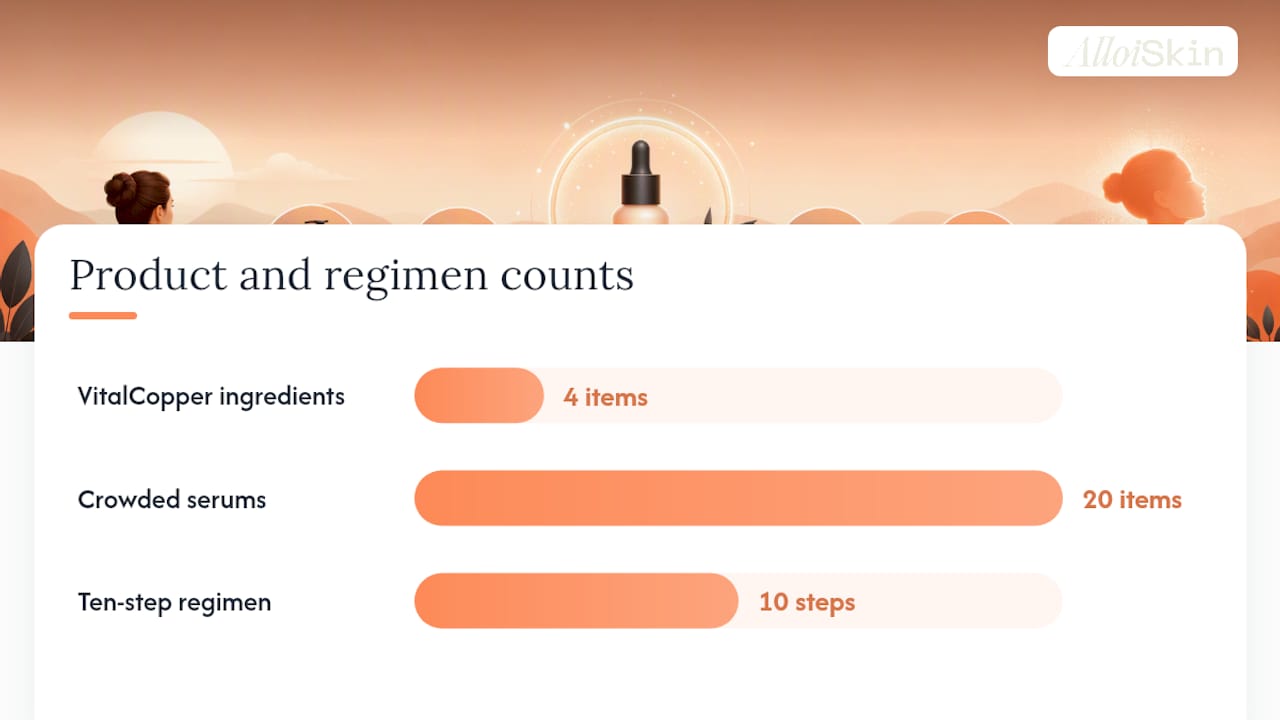
Alloi Skin’s entire formulation philosophy rests on a simple standard: include what’s clinically dosed and proven, and leave out what’s there for the ingredient list alone. That’s the opposite of the crowded, twenty-ingredient serums that list impressive actives at concentrations too low to do much of anything.
VitalCopper Renewal Face Serum reflects that standard directly:
- Copper tripeptide-1 (GHK-Cu) at a studied dose, researched for its role in supporting skin repair and collagen activity.
- Matrixyl 3000, a peptide complex studied for supporting the skin’s structural proteins.
- Panthenol and betaine, included to soothe and support the barrier rather than compete with the peptides for attention.
- Hyaluronic acid, added to maintain hydration without diluting the formula’s active focus.
Full clinical data, ingredient percentages, and study citations for VitalCopper Renewal Face Serum are detailed on the product page, along with documented before-and-after timelines from real usage windows. That transparency is the point: fewer ingredients, correctly dosed, tend to outperform long lists of actives included at levels too low to register with your skin. It’s also why Alloi Skin doesn’t publish a ten-step regimen. One formulation, used consistently, is easier to evaluate and easier to trust.
How Do You Choose Based on Your Skin Type?
Oily or acne-prone skin generally does better with a lightweight gel or serum vehicle rather than a rich cream, since heavier occlusive bases can trap oil and contribute to congestion. Dry or mature skin tolerates and benefits from richer, cream-based single products that combine active ingredients with more emollient support.
Sensitive or reactive skin needs the most caution of all. Look for formulas that pair an active with soothing ingredients like panthenol or betaine built into the same product, rather than adding a separate calming step. Combination skin often does best with a serum applied evenly, since spot-treating oily zones differently than dry ones defeats the point of simplifying in the first place.
Skin tone and sun sensitivity matter, too. If pigmentation or uneven tone is the primary concern, a single product won’t get far without consistent daily SPF layered on top, since new pigmentation forms faster than existing pigmentation fades. And age matters less than most people assume. What matters more is how long you’ve had a specific concern and how consistently you’ve addressed it, since a decade of untreated sun damage responds differently than a few months of stress-related breakouts.
What Mistakes Undermine a One-Product Routine?
The most common mistake is switching products too soon. Skin needs time to adjust to a new active, and judging results at two weeks instead of eight almost guarantees disappointment, followed by an unnecessary product switch that resets the clock entirely.
A close second: layering a single treatment serum over a routine that’s still crowded with five other actives. That defeats the purpose of simplifying and makes it nearly impossible to tell which ingredient is helping or causing irritation. Skipping sunscreen is another frequent error. No treatment serum, however well formulated, can outpace daily unprotected sun exposure.
Applying too much product too fast is a subtler mistake. More serum does not mean faster results. It usually means more irritation. And relying on how skin feels rather than how it looks in consistent photos leads people to abandon products that were actually working, simply because a temporary breakout or dry patch made the routine feel like a failure.
How Do Popular One-Product Approaches Compare?
Broadly, single-product options on the market fall into three categories, each with real tradeoffs.
Multi-active “everything” serums pack in a dozen or more trending ingredients. The appeal is obvious: one bottle, many buzzwords. The drawback is that with a finite formulation budget, doses of any individual active are often diluted to the point of doing little.
Single-active concentrates isolate one ingredient, like a pure retinoid or a vitamin C serum, at a meaningfully high dose. These can produce strong, well-documented results for a specific concern, but they don’t address barrier support or hydration, which means they can be harsher on sensitive skin without a moisturizer layered underneath.
Dosed multi-peptide formulations, the category VitalCopper Renewal Face Serum falls into, sit between those two extremes. They combine a small number of actives, each backed by its own research, at concentrations closer to what’s been studied, alongside supportive ingredients meant to protect the barrier rather than distract from it. The tradeoff is that they’re rarely the cheapest option on the shelf, since dosing ingredients properly costs more than including them at trace levels.
The right pick depends on your goal: broad-spectrum “hope something works” formulas rarely outperform a well-dosed, purpose-built one.
Why We Think Less Is Actually More
We built Alloi Skin around a bet that most skincare routines fail not from a lack of good ingredients, but from too many of them competing for attention. A routine you can maintain for twelve weeks straight will outperform an eleven-step regimen you abandon in eleven days. That’s not a marketing angle. It’s basic adherence, the same principle that shows up in research on why moisturizers improve treatment outcomes: consistency, not complexity, drives results.
We’d rather ship one formula with two studied peptides at real doses than ten actives at doses too low to matter. That means asking readers to be patient. Eight to twelve weeks is a real commitment, not an instant fix. If you have questions about whether a single-product approach fits your skin, reach out to Alloi Skin directly. We’d rather answer honestly than oversell.
— Alloi Skin
Try VitalCopper Renewal Face Serum for Yourself
If you’ve read this far, you already understand what makes a single product worth trusting: a small number of studied actives, at real doses, built to work with your skin’s own repair process instead of overwhelming it. VitalCopper Renewal Face Serum was formulated on exactly that principle, pairing copper tripeptide-1 and Matrixyl 3000 with panthenol, betaine, and hyaluronic acid to support barrier repair and clarity.
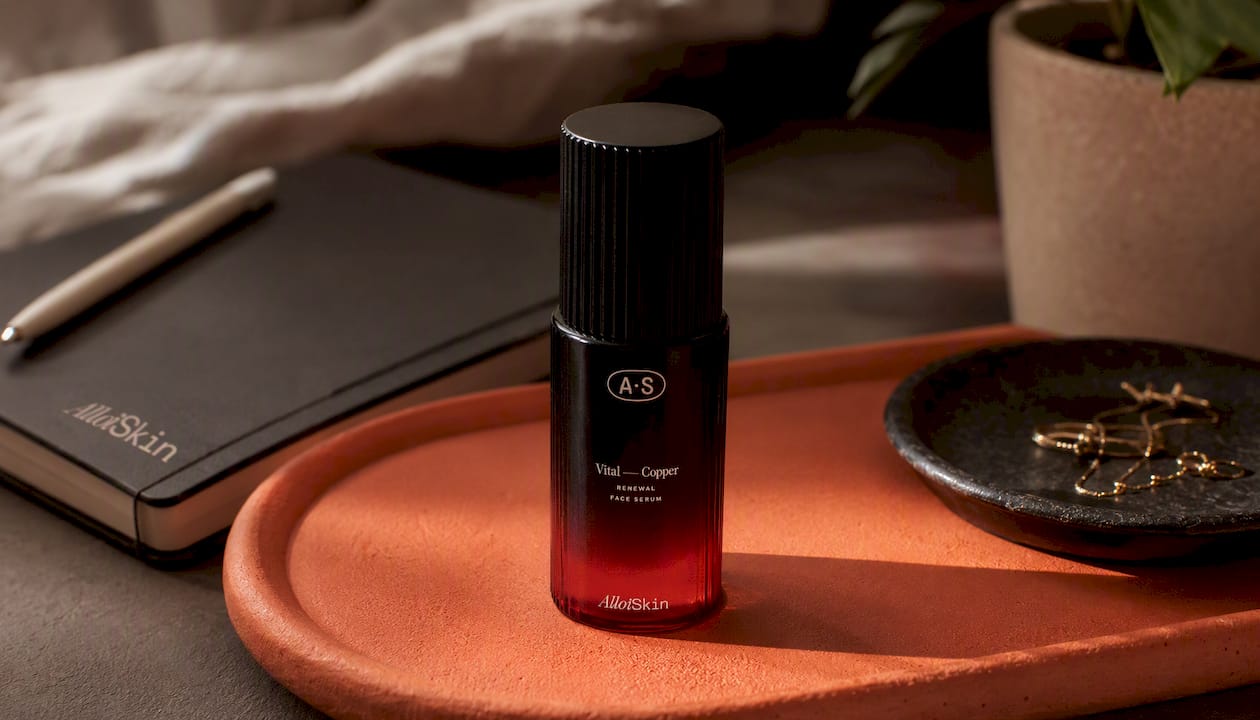
Using it is simple by design: apply a few drops to clean, dry skin at night, layer a moisturizer over it if your skin runs dry, and add sunscreen every morning. Patch-test on your inner arm for 48 hours before your first full application, and commit to the eight to twelve week window before judging results. Skin changes gradually, not overnight, and a photo log will tell you more than a mirror check ever will.
Ready to simplify your routine down to what actually works? Explore VitalCopper Renewal Face Serum and see the full ingredient breakdown, dosing details, and usage guide on the product page.
Sources
FAQ
Does a One-Product Skincare Routine Really Work?
Yes, for many general concerns, if the product contains a studied active at an effective dose and is used consistently for eight to twelve weeks; it works best layered on top of sunscreen and basic hydration rather than replacing them entirely.
Where Can You Buy VitalCopper Renewal Face Serum?
VitalCopper Renewal Face Serum is available directly through Alloi Skin’s product page, where full ingredient and dosing details are listed.
What Do Experts Say About Multitasking Skincare Products?
Dermatologists generally support simplified routines but caution that a product’s effectiveness depends on the dose and quality of its actives, not just the number of ingredients listed on the label.
Is a Clinically Formulated Serum Worth the Cost Compared to Basic Products?
A serum with studied actives at meaningful doses, like copper tripeptide-1 or Matrixyl 3000, typically costs more to formulate correctly than budget alternatives that list similar ingredients at trace amounts, which is often reflected in the price.
How Long Before You See Results From One Skincare Product?
Most practitioners recommend an eight to twelve week trial period, since skin cell turnover and structural changes like collagen support happen gradually rather than overnight.


