


Pause every active ingredient, switch to a gentle low pH cleanser once or twice a day, and apply a ceramide-dominant moisturizer over a hydrating serum twice daily, finishing mornings with mineral sunscreen. Most mild barrier damage responds to this within 2 to 4 weeks. A peptide serum can support repair alongside this plan, but the lipid-focused moisturizer does the heavy lifting.
TL;DR:
- A gentle, low pH cleanser and ceramide-dominant moisturizer should be used consistently within a 2 to 4-week period to see significant barrier improvement.
- Applying a humectant serum to damp skin before sealing with lipids enhances moisture retention and supports barrier repair efforts.
- Occlusives like petrolatum are best limited to dry patches and not used as a universal final step to avoid slowing overall skin healing.
- Reintroduce active ingredients gradually, starting with mild retinoids or AHAs after signs of healing like reduced redness, flaking, and absence of stinging appear.
- Most skincare routines fail because they layer too many actives or follow rigid timelines, rather than focusing on slow, observable progression and proper product order.
Table of Contents
- What Should a Morning Barrier Repair Routine Look Like?
- How Should You Structure an Evening Barrier Repair Routine?
- What Should You Stop Using Immediately?
- Which Ingredients Actually Rebuild a Damaged Skin Barrier?
- How Long Does It Take to Reintroduce Actives Safely?
- Why VitalCopper Was Built Around Barrier Repair Principles
- What Most Skincare Advice Gets Wrong About Barrier Repair
- Where VitalCopper Fits Into Your Barrier Repair Plan
- Sources
- FAQ
What Should a Morning Barrier Repair Routine Look Like?
Mornings set the tone for how your skin handles the day’s stressors, from dry office air to pollution to whatever the weather decides to do. When the barrier is compromised, the goal shifts from “treat” to “protect.” That means fewer steps, each one chosen for a specific job, not layered on out of habit.
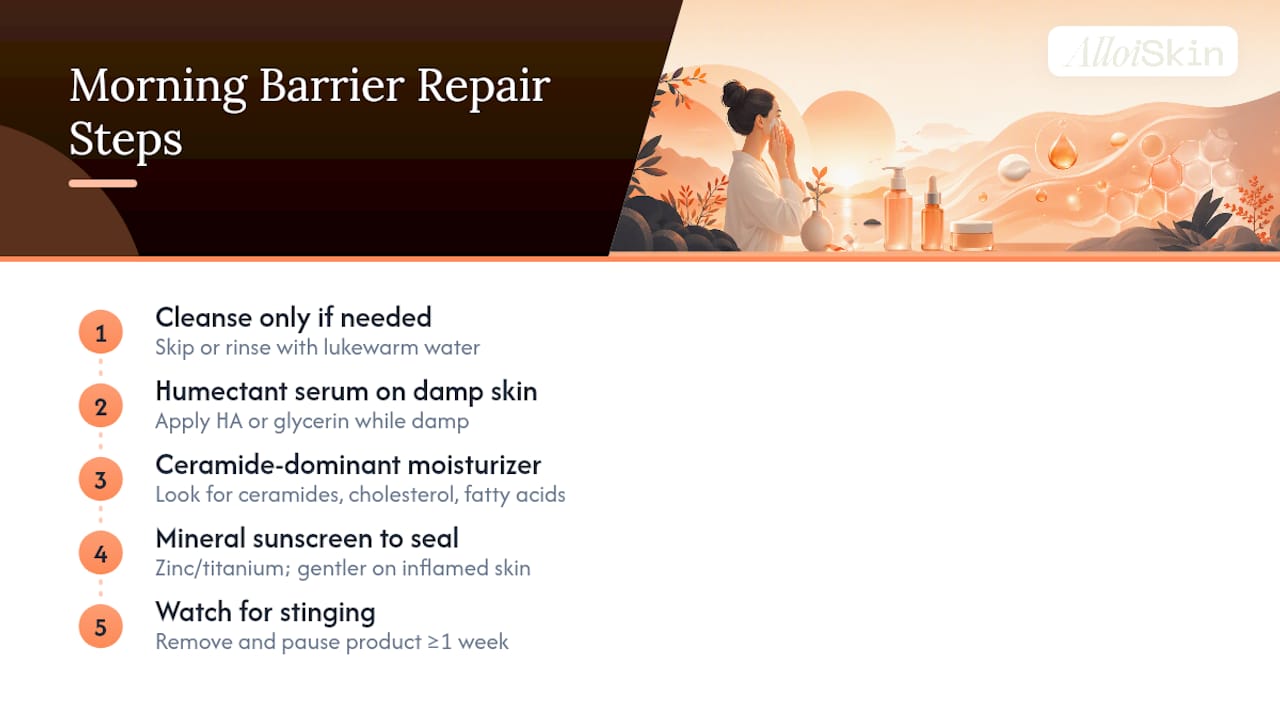
1. Cleanse only if you need to. If you slept without sunscreen or makeup on, skip the morning cleanse entirely and rinse with lukewarm water instead. When you do cleanse, reach for a low pH, non-foaming formula. Foaming surfactants strip lipids fast, and hot water makes it worse by accelerating that lipid loss. Clinical guidance on barrier repair consistently points to gentle, low pH cleansing and lukewarm water as the baseline for recovery. Never scrub. Pat, don’t rub, when drying off.
2. Apply a humectant serum to damp skin. Hyaluronic acid or a glycerin-based serum works here, and timing matters more than most people realize. Humectants pull water into the stratum corneum, but only if there’s water nearby to pull from. Apply while your face is still slightly damp from rinsing, not after it has fully air-dried.
3. Follow with a ceramide-dominant moisturizer. This is the step doing most of the structural repair. Look for ceramide NP, AP, or EOP on the ingredient list, ideally alongside cholesterol and fatty acids. A moisturizer built this way doesn’t just sit on top of skin. It works with the physical, chemical, and immunologic layers of your barrier, which is why reviews on moisturization and barrier function treat these formulations as functional repair tools rather than cosmetic finishers.
4. Seal the routine with mineral sunscreen. Zinc oxide and titanium dioxide sit on the skin’s surface and reflect UV rather than absorbing into it, which tends to make them gentler on skin that’s already inflamed. Research on sunscreen tolerance on compromised skin found mineral filters were less likely to sting than chemical alternatives, an important detail when every other product in your routine is already a question mark.
5. Watch for stinging, and act on it immediately. If a product stings on application, that’s not “purging” or “the skin adjusting.” Remove it, rinse with water, and delay reintroducing that product for at least a week. Stinging on undamaged skin is rare; stinging on compromised skin is the barrier telling you something is wrong.
Pro Tip: Keep your morning routine to four products or fewer while repairing. Every additional step is another chance to introduce fragrance, alcohol, or a preservative your compromised barrier can’t tolerate yet.
If your skin tolerates this sequence for a week with no stinging or new redness, you’re on the right track. If irritation shows up, the fix usually isn’t a different product. It’s removing a step, not adding one.
How Should You Structure an Evening Barrier Repair Routine?
Evenings carry more room for treatment because you’re not fighting UV exposure for the next eight hours, but “more room” doesn’t mean more steps. It means the right steps, applied in an order that actually helps lipids get where they need to go.
Start with removal, but keep it minimal. If you wore sunscreen or makeup, a single gentle cleanse is usually enough. Skip the double cleanse entirely during active repair. That first oil-based or balm cleanse that dermatology influencers love is fine on healthy skin, but a second surfactant-based pass on top of it is exactly the kind of over-cleansing that keeps a damaged barrier from closing up.
From there, the order matters:
- Apply your humectant serum to still-damp skin, same as in the morning.
- Follow immediately with your ceramide moisturizer while the humectant is still working to draw in moisture.
- On persistently dry or flaky patches only, such as around the nose or on the cheeks, add a thin layer of a petrolatum-based occlusive as the final step.
- Skip the occlusive on areas that already feel balanced. Occlusives slow everything under them, including any breakouts that might be brewing.
That occlusive layer deserves a closer look because it’s the step people either skip entirely or slather on everywhere out of anxiety. Petrolatum and dimethicone work by physically blocking water from evaporating off the skin’s surface, which gives your ceramide moisturizer time to actually integrate into the lipid matrix underneath instead of evaporating away with the water it’s trying to hold. Occlusives speed up measurable transepidermal water loss reduction almost immediately, but they don’t rebuild anything themselves. They just buy time for the ceramide-rich product underneath to do its job. That’s why they belong on dry patches specifically, not as a blanket final step across your whole face.
How do you know the night routine is working rather than just sitting there? Skin should feel calmer by morning, not tighter. If you wake up with more redness or a stronger stinging response to your morning cleanse than you had the week before, that’s a signal to strip back further, not push through. Persistent tightness after cleansing and unexplained morning redness are two of the most reliable signs your barrier is still compromised, and they should guide your next move more than any fixed schedule.
For a deeper walkthrough of this sequencing logic, a guide on dermatologist-backed barrier repair breaks down why order and timing matter as much as the products themselves.
What Should You Stop Using Immediately?
Barrier repair starts with subtraction. Dermatologists tend to frame it this way for a reason: adding a “repairing” serum on top of a routine that’s still actively injuring the skin is like patching a leak while the faucet’s still running.
Pause these immediately:
- Retinoids and retinol, in any strength or formulation.
- AHAs, BHAs, and PHAs, including toners and pads marketed as “gentle exfoliants.”
- High-strength vitamin C serums, especially L-ascorbic acid at low pH.
- Benzoyl peroxide, even if it’s your go-to for breakouts.
- Physical scrubs, cleansing brushes, and any tool with texture or bristles.
- Fragranced products and anything high in denatured alcohol.
Each of these works by disrupting the stratum corneum in some way, whether through chemical exfoliation, pH shifts, or mechanical friction. On healthy skin, that disruption is manageable and often the point. On a compromised barrier, it’s reinjury layered on top of injury that hasn’t healed yet.
If you’re pausing actives because of acne or pigment concerns, resist the urge to swap in something “gentler but still active.” Let the breakout or dark spot sit untreated for the repair window. Treating active damage takes priority, and most acne and pigment concerns don’t worsen meaningfully over two to four weeks of pause.
See a dermatologist if you notice signs of infection (spreading redness, warmth, pus), if transepidermal water loss symptoms like persistent stinging and tightness don’t improve after two weeks of a strict routine, or if the damage followed a specific trigger like a chemical burn or allergic reaction. Self-directed repair works for the common causes of barrier damage, but it isn’t a substitute for medical care when something looks abnormal.
Which Ingredients Actually Rebuild a Damaged Skin Barrier?
Not all “barrier repair” moisturizers are built the same, and the difference comes down to lipid ratio, not marketing language. Foundational research on physiologic lipid mixtures found that applying ceramides, cholesterol, and free fatty acids together in a 3:1:1 molar ratio, mirroring how these lipids naturally occur in healthy skin, restored the barrier and reduced transepidermal water loss faster than any single lipid applied alone.
The 3:1:1 principle: Skin’s natural barrier isn’t built from ceramides alone. It’s a mix of roughly three parts ceramide to one part cholesterol to one part free fatty acids. Products that replicate that ratio outperform ceramide-only formulas because they replace the barrier’s actual composition, not just one ingredient in it.
This matters because most drugstore “ceramide” moisturizers list a single ceramide type and call it a day. A formulation built on the 3:1:1 concept, by contrast, is designed the way skin is actually built. Broader clinical evidence backs this up: ceramide-dominant physiologic emollients improved disease severity scores and reduced TEWL across both randomized trials and cohort studies, giving lipid-based formulations some of the strongest clinical support of any moisturizer category.
Layering order affects whether these lipids even get incorporated. Humectants like glycerin and hyaluronic acid need to go on damp skin first, since they work by drawing in water from their surroundings. Applied to bone-dry skin, they can pull moisture from deeper skin layers instead, which backfires. Sealing that humectant immediately with your ceramide moisturizer traps the water where you want it and lets the lipids integrate into the barrier while it’s still hydrated.
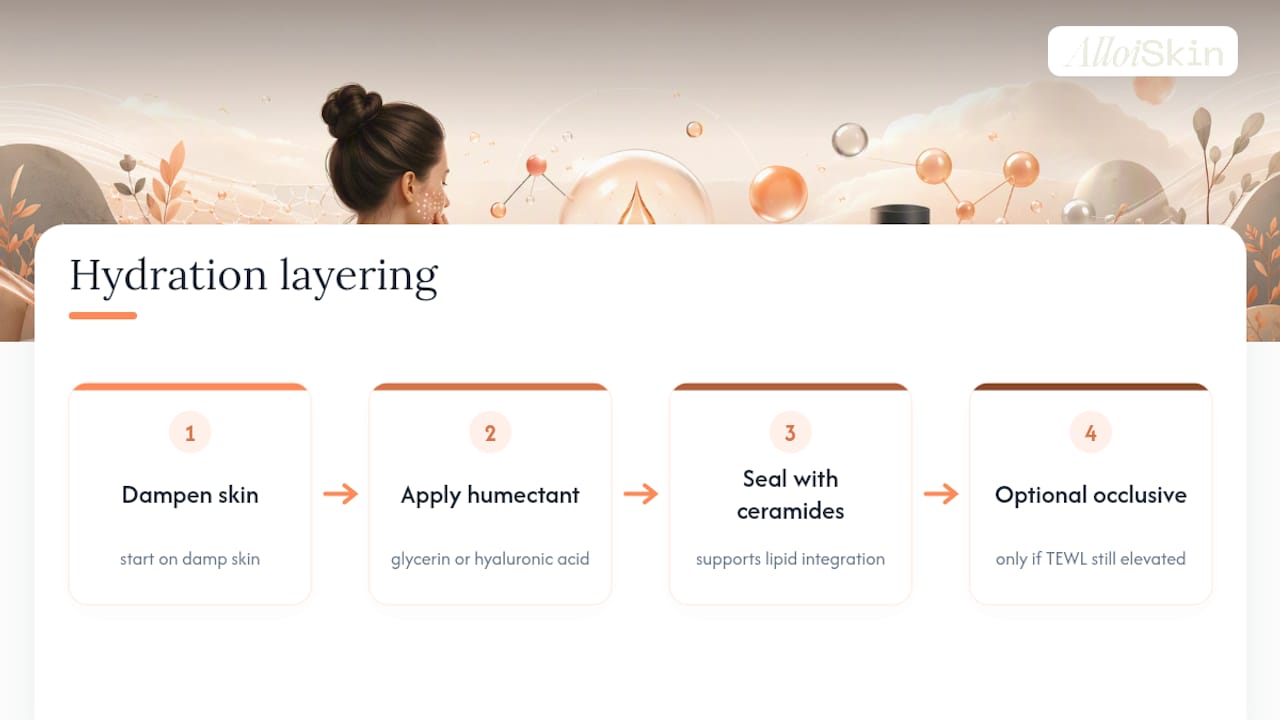
Occlusives like petrolatum and dimethicone earn a spot only when TEWL is still elevated, meaning skin feels persistently tight, flaky, or rough despite consistent moisturizing. They’re a support tool, not a daily default for every inch of your face.
Niacinamide deserves a specific caution here. At low concentrations, roughly 2 percent to 5 percent, it supports barrier function and can calm redness. But the high-strength serums that flooded the market in recent years, often 10 percent or higher, can be a hidden source of irritation precisely when your skin can least afford it. If your current niacinamide product doesn’t list a concentration, that’s reason enough to set it aside during active repair. Alloi Skin’s breakdown of niacinamide dosing covers this concentration issue in more detail.
When you’re reading a label, check for these five things: a named ceramide type (not just “ceramide complex”), cholesterol, linoleic or palmitic acid, a humectant like glycerin or hyaluronic acid, and the absence of fragrance or high concentrations of drying alcohols like alcohol denat.
How Long Does It Take to Reintroduce Actives Safely?
Recovery timelines depend on how far the damage has progressed, and rushing this stage is the single most common reason people end up back at square one.
Mild damage, the kind from over-exfoliating or a run of hot showers, typically resolves in 2 to 4 weeks of consistent, simplified care. Moderate damage, where you’ve got persistent flaking and reactive breakouts on top of the tightness, tends to run 4 to 8 weeks. Severe damage, marked by cracking, oozing, or spreading redness, calls for a dermatologist rather than a longer wait.
You’ll know you’re ready to reintroduce actives when you hit these markers, not by counting days on a calendar:
- No stinging on application of your current gentle products for at least a week straight.
- Reduced flaking, particularly around the nose, brows, and jawline where barrier damage tends to show first.
- Fewer reactive breakouts, since a repaired barrier lets fewer irritants and bacteria trigger inflammation.
- Normalized tolerance, meaning a product that used to sting no longer does.
Once those four boxes are checked, bring back one active at a time. Start with the mildest option, usually a low-strength retinoid or a gentle AHA, at once per week. Watch for two full weeks before adding anything else. If it’s tolerated, you can increase frequency gradually or introduce a second active, but never add two new products in the same week.
For acne-prone skin, benzoyl peroxide and salicylic acid tend to be safe reintroductions after retinoids, since they target inflammation directly. For drier skin types, AHAs like lactic acid are usually better tolerated than BHAs, since lactic acid brings some humectant properties along with its exfoliation. Sensitive skin should extend every stage by roughly 50 percent and consider stopping at a single weekly active rather than building toward daily use.
Why VitalCopper Was Built Around Barrier Repair Principles
Alloi Skin’s formulation philosophy starts from a simple premise: most damaged-skin routines fail not because they lack ingredients, but because they have too many of them, at doses too low to matter. That’s the thinking behind Alloi Skin’s formulation standard, which prioritizes fewer actives at clinically studied concentrations over long ingredient decks designed to look impressive on a label.
VitalCopper Renewal Face Serum reflects that same discipline. It’s not positioned as a barrier moisturizer replacement, and it shouldn’t be treated as one. It’s a peptide serum, meant to support skin structure and clarity through copper tripeptide-1 (GHK-Cu) and Matrixyl 3000, alongside panthenol, betaine, and hyaluronic acid to keep the skin comfortable while those peptides work. In a barrier repair routine, it slots in after cleansing and before a ceramide moisturizer, layering structural support underneath lipid-focused repair rather than competing with it.
That distinction between “peptide serum” and “barrier moisturizer” matters more than most routines acknowledge. GHK-Cu doesn’t rebuild lipids, and it isn’t designed to. It supports the skin’s structural response while a ceramide-dominant moisturizer handles the actual lipid replacement. Used together, in the right order, they address different parts of the same problem. Alloi Skin’s formulation method walks through how each active is dosed to match published research rather than marketing convention.
As with every product in this routine, if VitalCopper stings on application, stop. That’s true of any active during active repair, and it’s a rule worth repeating regardless of how well-formulated a product claims to be. When symptoms persist or worsen despite a stripped-back routine, a dermatologist consultation is the right next move, not a stronger product.
What Most Skincare Advice Gets Wrong About Barrier Repair
Most barrier repair content treats every recommendation as equally urgent, which leaves readers doing seven things reasonably well instead of two things exactly right. The research doesn’t support that approach. A ceramide-dominant moisturizer applied correctly, twice daily, outperforms a ten-step routine where the moisturizer is an afterthought.
The bigger miss is pacing. Reintroduction advice online tends to either ignore timelines entirely or offer a rigid one-size-fits-all schedule. Real recovery is driven by observable signs, not a countdown. Skin that’s still tight and flaky at week three isn’t ready for a retinoid just because a calendar says so.
If there’s one thing worth prioritizing above everything else in this guide, it’s the humectant-then-ceramide layering order on damp skin. It’s the step people skip most often, and it’s the one with the clearest mechanism behind why it works. Get that right, be patient with the timeline, and the rest of the routine mostly takes care of itself.
— Alloi Skin
Where VitalCopper Fits Into Your Barrier Repair Plan
If your barrier repair routine already has the ceramide moisturizer and mineral SPF covered, a peptide serum is worth considering as the layer that adds structural support without adding complexity. It’s built around copper tripeptide-1 and Matrixyl 3000 at studied concentrations, paired with panthenol, betaine, and hyaluronic acid to keep the formula comfortable on skin that’s still healing.

Use it once daily to start, applied after cleansing and before your ceramide moisturizer, whether that’s in your morning or evening routine. Give it a week before judging results, and if you notice any stinging, drop back to your bare minimum: cleanse, moisturize, SPF, and reintroduce it later once your barrier has more tolerance built up. You can find full ingredient details and subscription options on the VitalCopper Renewal Face Serum product page, including auto-delivery if you’d rather not think about reordering once your repair phase turns into a maintenance routine.
Sources
For readers who want the primary research behind this routine, the foundational lipid-ratio study is available through PubMed, with broader clinical context from the Cleveland Clinic’s barrier guide. Others sourcing supplies can also reference NexGen Clinic Cambridge for professional-grade product context.
- Research demonstrating physiological lipid ratios accelerate barrier restoration
- Review on moisturization and skin barrier function (2023)
- Good Housekeeping: Signs of skin barrier damage and repair tips
FAQ
What Is a Good Routine for Repairing a Damaged Skin Barrier?
Pause all actives, cleanse gently with a low pH formula once or twice daily, and apply a humectant serum followed by a ceramide-dominant moisturizer morning and night, finishing mornings with mineral SPF. Most people see improvement within 2 to 4 weeks of staying consistent.
What Is the Fastest Way to Heal a Skin Barrier?
There’s no shortcut faster than removing irritants and applying a moisturizer built on the 3:1:1 ceramide, cholesterol, and fatty acid ratio, since that combination replaces the barrier’s natural lipid composition rather than a single lipid type. Adding an occlusive like petrolatum over dry patches at night can speed visible results, but it supports the process rather than replacing it.
What Is the 4 2 4 Rule in Skincare?
Definitions of this rule vary across sources and aren’t tied to a specific clinical standard, so treat any version you see with some caution. The barrier repair principles in this guide, gentle cleansing, lipid replacement, and staged reintroduction, are grounded in published research rather than a fixed numeric formula.
How Do I Tell If My Skin Barrier Is Broken?
Watch for stinging when you apply products, tightness after cleansing, unexplained redness, flaking that exfoliation doesn’t fix, and new breakouts that show up without an obvious trigger. Alloi Skin’s guide to damaged skin barrier signs walks through how to distinguish these from ordinary dryness.
Can I Use a Peptide Serum Like VitalCopper While My Barrier Is Healing?
Yes, a peptide serum can be layered into a barrier repair routine as long as it’s applied before your ceramide moisturizer and doesn’t sting on application. VitalCopper Renewal Face Serum is formulated to support skin structure alongside, not instead of, lipid replacement.


