


Evidence-based skincare means choosing products and routines based on ingredients tested in randomized controlled trials and backed by dermatologist consensus, not marketing copy or influencer trends. If you want the fast answer: wear a broad-spectrum sunscreen every single day, introduce a retinoid once your skin tolerates it, and support your barrier with a ceramide-rich moisturizer. Everything else in skincare is negotiable. Those three things are not.
That’s not our opinion. It’s what a consensus of 80 U.S. dermatologists recommended after ranking ingredients by strength of evidence: mineral sunscreens and retinoids were each endorsed by 96.8% of dermatologists surveyed, with vitamin C close behind at 88.7%. When nearly every dermatologist in a panel agrees on something, that’s a signal worth paying attention to.
Here’s why these three come first, ahead of the dozens of other ingredients you’ll see marketed to you:
- Sunscreen has outcome data, not just skin-appearance data. Daily use of SPF 15 or higher is linked to roughly a 40% reduction in squamous cell carcinoma risk and a 50% reduction in melanoma risk. No other skincare category comes close to that level of proof.
- Retinoids have the deepest research history of any anti-aging active, with decades of RCTs behind their effects on collagen production and cell turnover.
- Ceramides address the mechanism, not just the symptom. Dry, irritated, or reactive skin usually means a damaged barrier, and ceramides replace the lipids that barrier depends on.
Pro Tip: Never start a retinoid and a new acid exfoliant in the same week. Introduce one active at a time, wait two to three weeks, and watch how your skin responds before adding the next. Irritation compounds fast when actives stack before your skin adjusts.
Key Takeaways
Evidence-based skincare works because it prioritizes ingredients with RCT and dermatologist-consensus support over marketing claims, and simpler routines outperform complex ones for both results and adherence.
| Point | Details |
|---|---|
| Sunscreen comes first | Daily broad-spectrum SPF cuts melanoma risk by roughly 50% and squamous cell carcinoma risk by 40%. |
| Retinoids and vitamin C have the deepest support | Both were recommended by 96.8% and 88.7% of surveyed dermatologists, respectively. |
| Give actives 8 to 12 weeks | Judging an ingredient before the trial period ends is the most common reason people quit ones that would have worked. |
| Be skeptical of undisclosed concentrations | A claim without a percentage, study duration, or comparator group is marketing, not evidence. |
| Alloi builds on this same principle | The VitalCopper Renewal Face Serum uses a single purposeful copper peptide active instead of a crowded ingredient list. |
Table of Contents
- What Counts as Evidence-Based Skincare?
- Which Skincare Ingredients Have the Strongest Clinical Evidence?
- How Do You Build a Simple, Evidence-Based Routine?
- Which Skincare Trends Lack Strong Evidence?
- What Safety Precautions Matter Most in Skincare?
- How Do You Judge a Skincare Product Before Buying It?
- Why Simpler Routines Outperform Complex Ones
- Where Alloi Fits Into an Evidence-First Approach
- Sources
What Counts as Evidence-Based Skincare?
Good evidence in skincare follows the same hierarchy used in the rest of medicine: randomized controlled trials at the top, meta-analyses and systematic reviews close behind, and expert consensus statements filling gaps where large trials don’t exist yet. A claim earns real weight when it’s been tested against a placebo, replicated by more than one research group, and measured with a validated tool, like a wrinkle scale or a melanin index, rather than a vague “improved glow” survey.
Weaker evidence looks different, and it’s worth learning to spot it:
- Small open-label trials with no control group and a handful of participants.
- Before-and-after photos with no blinding, no measurement tool, and convenient lighting.
- Preclinical or in-vitro data (“shown to boost collagen in lab tests”) presented as if it applies directly to human skin.
- Influencer testimonials and single-person anecdotes dressed up as “proof.”
The consensus of 80 U.S. dermatologists mentioned earlier is a strong example of the top tier: a structured expert panel identifying 23 ingredients with genuine support, rather than a single brand’s internal testing. That kind of agreement across dozens of independent practitioners is much harder to manufacture than a cherry-picked customer survey.
Regulatory context matters here too. In the United States, cosmetic products don’t go through the premarket approval process that drugs do, so a “clinically proven” claim on a serum label doesn’t carry the same weight as an FDA drug approval. That gap is exactly why learning to read a study yourself, rather than trusting the label’s summary of it, is worth the effort.
Before you trust a clinical claim on any product page, check for these four things:
- Sample size. A trial with 8 participants over 5 days tells you very little. Look for at least 20 to 30 people over 8-12 weeks.
- A control or comparator. Was the active tested against a placebo, or just measured before and after with no comparison?
- Concentration disclosed. “Contains niacinamide” means nothing without a percentage attached.
- Duration matched to the claim. A wrinkle-reduction claim needs a study running at least 8 to 12 weeks, since collagen remodeling doesn’t happen overnight.
Which Skincare Ingredients Have the Strongest Clinical Evidence?
Not all “science backed skincare ingredients” carry equal proof. Some have decades of RCT data behind them; others have a single small study and a lot of marketing enthusiasm. Here’s how the most common actives stack up.
| Ingredient | What It Treats | Typical Effective Concentration | Time to Visible Effect |
|---|---|---|---|
| Broad-spectrum sunscreen | Photoaging, skin cancer prevention | SPF 15–50+ | Immediate protection; prevents damage rather than reversing it |
| Retinoids (retinol/tretinoin) | Fine lines, acne, texture, pigmentation | 1% depending on formulation | 8–12 weeks for visible texture change |
| Vitamin C (L-ascorbic acid) | Brightening, antioxidant defense, mild collagen support | 10%–20% | 8 weeks for improved skin parameters |
| Niacinamide | Hyperpigmentation, barrier support, redness | 4%–5%, twice daily | 4 weeks, with continued gains by 8 weeks |
| Ceramides | Barrier repair, dryness, sensitivity | Formulation-dependent, often blended with cholesterol and fatty acids | 2–4 weeks for improved hydration |
| AHAs (glycolic, lactic acid) | Texture, mild pigmentation, dullness | 5%–10% at home; higher in-office | 4–8 weeks |
| BHA (salicylic acid) | Acne, clogged pores, oil control | 2% | 4–8 weeks |
| Azelaic acid | Rosacea, post-inflammatory hyperpigmentation, mild acne | 10%–20% | 4–8 weeks |
| Benzoyl peroxide | Acne, bacterial control | 5% | 2–4 weeks |
| Peptides (select types) | Firmness support, mild anti-aging adjunct | Formulation-dependent | Evidence is more limited than for the actives above |
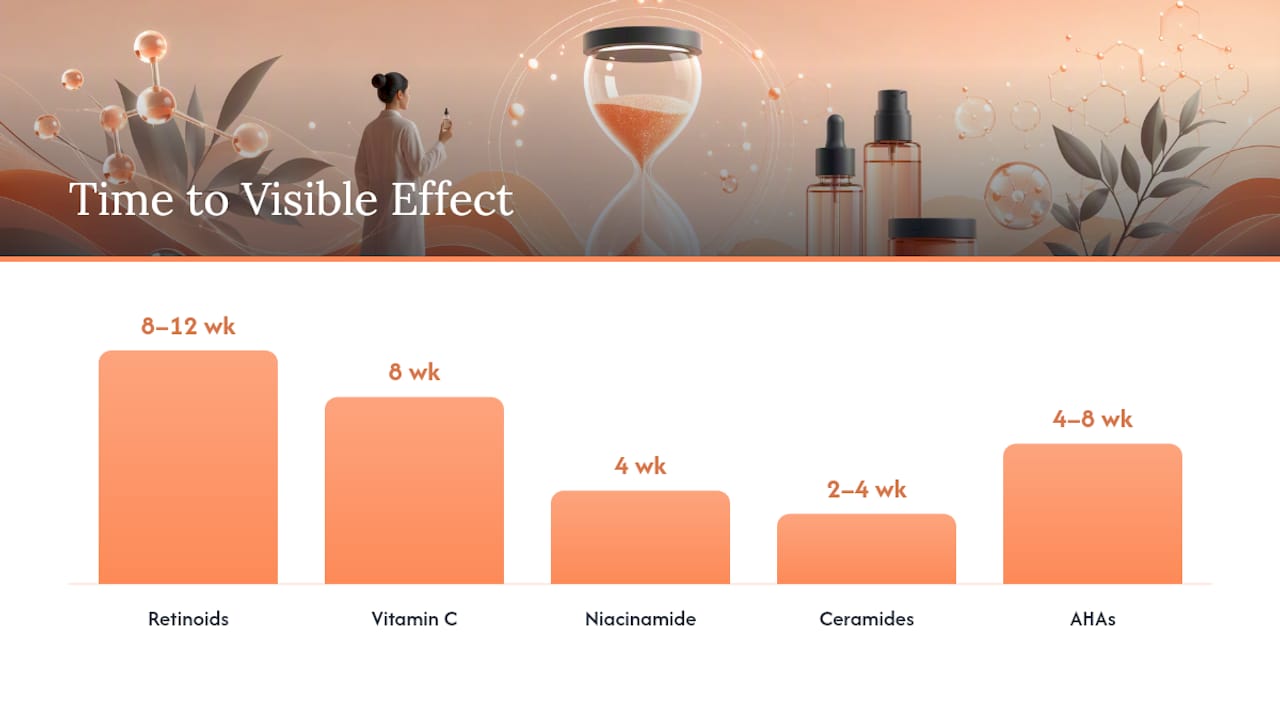
Table reflects ingredient and category-level evidence only; specific concentration ranges and timelines vary by formulation and by individual response.
The niacinamide data deserves a second look because it’s one of the cleanest timeline studies in the category: 5% niacinamide applied twice daily reduced freckles and sun spots within four weeks, with the improvement holding at the eight-week mark. It’s also one of the best-tolerated actives on this list, showing no irritation at 5% concentration in 21-day trials, which makes it a reasonable starting point if you’re new to actives.

Formulation stability matters as much as concentration. L-ascorbic acid, the most researched form of vitamin C, degrades quickly when exposed to light and air, and it only works at an acidic pH, roughly 3.5 or below, which is also what makes it sting on sensitive skin. Retinoid potency runs on a spectrum, too: retinol is gentler but slower, tretinoin is stronger but harsher, and jumping straight to a high-potency version because “stronger must be better” is the single fastest way to end up with a red, flaking face and a reason to quit retinoids altogether.
The international expert consensus on anti-aging dermocosmetics backs up much of this ranking, recommending high-factor broad-spectrum sunscreen, niacinamide, and topical antioxidants across nearly all skin types, while flagging retinoids and AHAs as ingredients that need more caution in sensitive or darker skin.
How Do You Build a Simple, Evidence-Based Routine?
A routine built on proven actives doesn’t need ten steps. It needs the right four or five, applied in the right order, at the right time of day.
Morning routine:
- Cleanse with a gentle, non-stripping cleanser.
- Apply an antioxidant serum, such as vitamin C, if you’re using one.
- Moisturize to lock in hydration and support the barrier.
- Apply broad-spectrum sunscreen as the final step, every day, regardless of weather.
Evening routine:
- Cleanse to remove sunscreen, oil, and the day’s buildup.
- Apply your treatment active, retinoid, or an acid exfoliant on alternating nights, never both the same night.
- Moisturize again, choosing a richer formula if your skin feels tight or dry.
Layering rules keep this simple in practice. Wait about a minute after a water-based treatment before applying the next layer, so it has time to absorb rather than sliding off on top of the previous one. Vitamin C and niacinamide can be used together despite what some outdated advice claims; the pH concerns are largely overstated at the concentrations found in most finished products. Retinoids and AHAs, on the other hand, genuinely shouldn’t be layered on the same night. That combination is the most common cause of the redness and peeling that send people running back to complicated ten-step routines that promise to “fix” damage the previous routine caused.
Expect a realistic timeline, not an overnight transformation. Niacinamide shows measurable change within four weeks. Retinoids typically need 8 to 12 weeks before texture and tone improvements become visible, and up to six months for their full effect on fine lines. Give any new active a full 8 to 12 week trial before deciding it doesn’t work. Judging a retinoid at the two-week mark, right when the classic “retinization” dryness and flaking often shows up, is the single biggest reason people quit an active that would have worked.
On cost: a well-formulated sunscreen or moisturizer doesn’t need to be expensive to be effective. What matters is the concentration of the active ingredient, the stability of the formula (is the vitamin C actually still active by the time it reaches you, or has it oxidized to a useless orange tint?), and the vehicle it’s delivered in. A $12 tube and a $90 jar can contain the identical active at the identical percentage. The price difference usually buys packaging, fragrance, and marketing, not better skin outcomes. Spend where formulation quality genuinely differs, like a well-stabilized vitamin C or a peptide serum built around a barrier-repair vehicle, and save money on basics like a fragrance-free moisturizer.
Pro Tip: Introduce one new active every two to three weeks, never all at once. If your skin reacts, you’ll know exactly which product caused it instead of guessing among four new additions.
For more on why fewer, well-chosen ingredients tend to outperform crowded routines, see why fewer ingredients build better skin.
Which Skincare Trends Lack Strong Evidence?
Social media has made skincare trends spread faster than the research that should back them. A 2025 Northwestern report documented real skin damage in teenagers following elaborate influencer routines, many of which stacked multiple actives with no regard for irritation thresholds or barrier tolerance.
A few categories deserve extra skepticism before you spend money on them:
- “Live” probiotic creams. Bacterial cultures generally can’t survive shelf storage in a jar, and the clinical evidence for topical probiotics remains thin compared to niacinamide or retinoids.
- Exotic plant extracts with a single small study behind them. A promising two-week trial with 15 participants is not the same evidence tier as decades of retinoid research.
- “Detox” and “toxin-flushing” claims. Skin doesn’t detoxify in the way these products imply; this is marketing language borrowed from wellness culture, not dermatology.
- Elaborate 10 to 12 step multi-product rituals. More steps means more opportunity for barrier disruption, and expert consensus increasingly favors simpler, targeted routines over layering everything at once.
Some ingredients genuinely fall in a gray zone rather than being outright hype. A broad review of anti-aging actives found promising signals for compounds like bakuchiol and astaxanthin, but noted the underlying trials often ran with small sample sizes and inconsistent measurement tools. That doesn’t mean these ingredients are useless. It means the evidence is early, not absent, and it’s reasonable to try them only after your foundation, sunscreen, a tolerated retinoid, and a barrier moisturizer, is already in place.
The best skepticism test is simple: does the brand disclose a concentration, a study duration, and a comparison group? If a page just says “clinically proven” with no numbers attached, treat that claim as marketing until proven otherwise.
What Safety Precautions Matter Most in Skincare?
Every active ingredient with real evidence behind it also carries real side effects. Knowing which precaution applies to which situation prevents most of the problems people run into.
- Retinoids and pregnancy. Prescription-strength retinoids are generally avoided during pregnancy due to potential fetal risk; discuss alternatives with an OB-GYN or dermatologist rather than guessing.
- AHAs/BHAs after in-office procedures. Freshly resurfaced or post-laser skin is more vulnerable to irritation and pigmentation changes from acids; wait until your provider clears you before resuming exfoliants.
- Benzoyl peroxide and fabric bleaching. It’s an effective acne treatment, but it will bleach towels, pillowcases, and dark clothing. Use white linens on treatment nights.
- Darker Fitzpatrick phototypes and post-inflammatory hyperpigmentation (PIH). Skin that pigments easily is more prone to dark marks from irritation, which is why international consensus guidance recommends more caution with retinoids and AHAs in these skin types, along with tinted, iron-oxide-containing sunscreens that also protect against visible light, a wavelength mineral-only sunscreens can miss.
Sunscreen remains the intervention with the clearest population-level safety data behind it. Daily use is tied to an approximate 40% drop in squamous cell carcinoma risk and 50% drop in melanoma risk, numbers that put it in a different category from nearly everything else on a skincare shelf.
See a dermatologist if you notice persistent inflammation that doesn’t respond to a simplified routine, acne that scars or resists over-the-counter treatment, or any new or changing mole. Self-diagnosis has limits, and a professional can rule out conditions, like rosacea, eczema, or a fungal issue, that look like “bad skin” but need a completely different treatment path than any serum can offer.
Pro Tip: If a retinoid irritates you, buffer it by applying moisturizer first, then the retinoid on top, or apply the retinoid every third night instead of nightly. Both approaches reduce irritation without abandoning the ingredient with the strongest evidence behind it.
How Do You Judge a Skincare Product Before Buying It?
Reading a label the right way is the single most useful skill in evidence-based skincare, more useful than memorizing any ingredient list. Before you buy, run through this checklist:
- Active name and concentration. “Contains retinol” without a percentage tells you almost nothing about strength.
- pH relevance for certain actives. Vitamin C and AHAs need an acidic pH to function; if a brand doesn’t disclose formulation pH for these actives, that’s a gap worth noting.
- Vehicle and interactions. An oil-based vehicle behaves differently on oily skin than a gel or lotion base does, and some actives (retinoids especially) perform better in specific vehicle types.
- Packaging and expiration. Light- and air-sensitive actives like vitamin C and retinoids need opaque, airless, or dark packaging to stay effective. A clear jar of vitamin C serum sitting on a sunlit shelf is often already degrading.
- Clinical references on the product page. Look for a linked study, a stated sample size, and a comparator group, not just the phrase “clinically tested.”
When a brand cites its own study, clinicians evaluating that data look for the same things you should: explicit concentration disclosure, a described vehicle, a real study design, and an endpoint that’s clinically meaningful, like a validated wrinkle scale or measured melanin index, rather than a vague “skin looked more radiant” survey response. For a closer look at how formulation choices show up on ingredient pages, Alloi’s breakdown of niacinamide’s mechanisms and effective strength walks through exactly this kind of detail.
Why Simpler Routines Outperform Complex Ones
The evidence keeps pointing to the same uncomfortable truth for anyone who enjoys a ten-step shelf: complexity is usually the enemy of results, not the path to them.
Every additional product in a routine is another variable that can irritate skin, interact poorly with another active, or simply go unused after week three because it’s exhausting to keep up with. Adherence data on skincare consistently shows the same pattern seen in every other area of health behavior: the treatment plan people can actually stick to beats the “perfect” plan they abandon after ten days. A routine built around three or four proven actives, applied consistently for months, will outperform a twelve-step routine followed inconsistently for two weeks and then abandoned out of fatigue.
This is also why barrier-first thinking matters more than most routines acknowledge. Skin that’s inflamed or barrier-compromised can’t absorb or tolerate actives properly, which means piling on more ingredients to “fix” irritated skin usually makes the underlying problem worse, not better. Get the barrier stable first. Everything else works better once it is.
If you want one practical habit to adopt from all of this: track your skin the same way a clinical trial would. Take a photo under consistent lighting once a week, and jot down any irritation, breakouts, or improvements you notice. Two months from now, memory alone won’t tell you whether an active is working. A simple photo timeline will.
Where Alloi Fits Into an Evidence-First Approach
Alloi was built around the same principle this entire guide argues for: fewer ingredients, chosen for evidence rather than trend, doing more for your skin than a crowded routine ever could. The VitalCopper Renewal Face Serum centers on a single purposeful active, a copper peptide complex, formulated to support barrier repair and skin clarity without the layering guesswork this article has spent so much time warning against.
That’s the same philosophy behind Alloi’s formulation standard: every ingredient earns its place through evidence, not marketing volume. If the idea of a barrier-first, minimal routine appealed to you while reading this guide, take a look at the VitalCopper serum’s product page for the concentration details and clinical rationale behind the formula, then decide if it’s the right addition to the routine you’re building.
Sources
The claims in this guide draw from a specific set of dermatological consensus statements, clinical trials, and reviews, each useful for a different kind of question.
- Drugstore skincare: Science-backed anti-aging ingredients that don’t break the bank
- International Consensus on Anti-Aging Dermocosmetics and Skin Care for Clinical Practice
When you read any of these directly, look for the same three things every time: the tested concentration, the study duration, and whether there was a control group. Those three details separate a real finding from a marketing footnote.
This article is general information, not a substitute for advice from a qualified doctor. Consult a qualified healthcare professional about your own circumstances before acting on anything here.


