


Yes, a damaged skin barrier can be repaired. Stop the aggressors, simplify to a ceramide-rich humectant and occlusive routine, protect with daily sunscreen, and give it time.
Start here today:
- Stop: harsh cleansers, exfoliation, and active treatments (retinoids, acids, benzoyl peroxide).
- Switch: to a gentle, low-pH cleanser and a moisturizer built around ceramides, hyaluronic acid, and an occlusive.
- Protect: with daily sunscreen, since compromised skin sunburns and inflames faster.
Most people see their first improvement within 2 to 4 weeks, with fuller recovery over 8 to 12 weeks or longer for severe cases. If skin is oozing, cracking, or spreading redness, see a dermatologist rather than waiting it out.
Pro Tip: When your skin is angry, less is genuinely more. Strip your routine down to cleanser, moisturizer, and sunscreen until stinging and tightness resolve, then add products back one at a time.
Key Takeaways
Barrier repair works because it removes the aggressors causing ongoing damage while resupplying the exact lipids, hydration, and protection the skin needs to rebuild itself.
| Point | Details |
|---|---|
| Stop the aggressors first | Pause exfoliants, retinoids, and harsh cleansers before adding any new repair product. |
| Follow the TLC framework | Target pH and lipids, lock in moisture, connect skin cells through consistent lipid replacement. |
| Expect a weeks-long timeline | Early improvement often appears in 2 to 4 weeks; full recovery can take 8 to 12 weeks or more. |
| Support repair beyond skincare | Diet, sleep, stress management, and microbiome balance all influence how fast skin heals. |
| Layer in targeted actives carefully | Alloi’s VitalCopper Renewal Face Serum can support the “Connect” phase once basic tolerance returns. |
Table of Contents
- What Is the Skin Barrier and Why Does It Matter?
- What Causes a Damaged Skin Barrier?
- How Do You Know If Your Skin Barrier Is Damaged?
- How Do You Repair a Damaged Skin Barrier?
- What Should You Avoid While Repairing Your Skin Barrier?
- How Long Does It Take to Repair a Damaged Skin Barrier?
- Why Do Ceramides, Humectants, and Occlusives Actually Work?
- Does Diet and Hydration Affect Skin Barrier Repair?
- Can Probiotics and Prebiotics Support Skin Barrier Health?
- Do Stress and Sleep Affect Your Skin Barrier?
- Where Does Alloi Skin Fit Into a Barrier-Repair Routine?
- Frequently Asked Questions
- Sources
What Is the Skin Barrier and Why Does It Matter?
Your skin barrier, technically the stratum corneum, is the outermost layer of skin, sitting on top of the acid mantle (a thin, slightly acidic film) and a living microbiome of bacteria that helps keep pathogens out. Think of it as brick and mortar: skin cells are the bricks, and lipids, ceramides, cholesterol, and fatty acids, are the mortar holding everything together, according to The Strategist’s breakdown of barrier repair. When that mortar breaks down, water escapes and irritants get in.
- Ceramides make up roughly half of the barrier’s lipid content.
- Cholesterol and fatty acids round out the mortar mix.
- pH and microbiome balance determine how well the barrier defends and repairs itself.
What Causes a Damaged Skin Barrier?
Barrier damage is almost always cumulative, not caused by one bad day. Over-cleansing, harsh surfactants, and hot showers strip lipids faster than skin can replace them. Over-exfoliation, whether physical scrubs or frequent chemical acids, does the same from the inside out.
- Over-cleansing, sulfate-heavy cleansers, and long hot showers
- Physical scrubs and frequent AHA/BHA use
- Alcohol-based toners, fragrance, and frequent hand sanitizer
- Low humidity, cold weather, UV exposure, and pollution
- Underlying conditions like eczema, plus poor sleep, chronic stress, and nutrient-poor diets
Repeated exposure to these irritants can actually override the skin’s own repair mechanisms, which are normally triggered by rising water loss and increased lipid production, according to research on skin barrier physiology. Keep stacking insults, and the skin simply cannot keep up.
How Do You Know If Your Skin Barrier Is Damaged?
Run through this checklist. If products that used to feel neutral now sting or burn on contact, that is often the clearest early sign.
- Stinging or burning with product application
- Persistent dryness, tightness, or flaking
- New sensitivity to products you previously tolerated
- Redness, rough patches, or a dull, uneven texture
- Increased breakouts or small infections
Spreading inflammation, oozing, crusting, fever, or symptoms that worsen quickly are not a “wait it out” situation. That combination points toward infection or a reaction that needs a dermatologist’s evaluation, not another product change.
How Do You Repair a Damaged Skin Barrier?
Repair works best as a sequence, not a shopping list. Cleanse gently, hydrate, replace lipids, seal, then protect.
- Cleanse gently. Choose an oil, cream, or micellar cleanser with a pH close to skin’s natural range. Low-pH cleansers support the enzymatic activity your skin needs to rebuild lipids, according to research on moisturization and barrier repair.
- Hydrate with a humectant. Apply a hyaluronic acid or glycerin serum to damp skin so it can pull in water.
- Replace lipids. Follow with a ceramide-rich moisturizer, ideally one that also contains phytoceramides, cholesterol, and fatty acids.
- Seal it in. On especially dry or flaking areas, layer an occlusive like petrolatum or squalane over the moisturizer.
- Protect every morning. Finish AM routines with sunscreen, since damaged skin burns and inflames more easily.
| Ingredient Role | Examples | What It Does |
|---|---|---|
| Humectant | Hyaluronic acid, glycerin | Draws water into the surface layer |
| Barrier lipid | Ceramides, cholesterol, fatty acids | Rebuilds the “mortar” between skin cells |
| Occlusive | Petrolatum, squalane | Seals in moisture and blocks water loss |
| Supportive active | Niacinamide, panthenol | Calms and supports barrier function without irritation |
For layering, a few rules keep things simple:
- Apply thinnest to thickest: serum before cream, cream before balm.
- Wait until skin feels calm and non-reactive before reintroducing any active.
- If you have oily skin, favor a lightweight ceramide lotion over heavy occlusives, using them only on flare spots.
- If you have dry or sensitive skin, layer a humectant and occlusive both morning and night.
- Combination skin often does best zoning products, richer where dry, lighter where oily.
What Should You Avoid While Repairing Your Skin Barrier?
While your barrier heals, treat your routine like a short medical leave for your skin. Anything that exfoliates, strips, or fragrances is off the table for now.
- Retinoids and retinol (pause until stinging resolves)
- Benzoyl peroxide and high-strength AHA/BHA acids
- Physical scrubs or exfoliating brushes
- Alcohol-based toners and heavily fragranced products
Each of these either strips remaining lipids, raises the skin’s pH, or physically injures the stratum corneum before it can rebuild, and dermatology guidance on exfoliation backs a conservative pause during this window. If you need a spot treatment for a breakout, a low-strength, fragrance-free option is safer than reaching for your usual acid.
How Long Does It Take to Repair a Damaged Skin Barrier?
Expect gradual, not overnight, results. Most people notice less stinging and improved texture within 2 to 4 weeks of consistent, conservative care, with clearer, more stable skin by 6 to 12 weeks. Full structural recovery, especially after months of over-exfoliation, can take longer.
Consistency matters more than any single product here. A ceramide-rich moisturizer used every day for eight weeks will outperform an expensive serum used sporadically for two.
See a dermatologist sooner if you notice signs of infection, a spreading rash, severe pain, or no improvement at all after several weeks of consistent, gentle care.
Why Do Ceramides, Humectants, and Occlusives Actually Work?
Dermatology researchers describe barrier repair through a framework called TLC: Target skin disruption by correcting pH and replenishing ceramides, Lock in moisture with humectants and occlusives, and Connect skin cells by restoring the lipid structure between them, per the TLC repair strategy.
- Moisturizers containing occlusives, humectants, and emollients measurably reduce water loss and support repair across the barrier’s physical, chemical, and immune layers.
- Formulators often aim for a ceramide, cholesterol, and fatty acid ratio near 3:1:1 to mimic natural skin lipids, though most labels don’t disclose exact ratios.
“Target, Lock, Connect” isn’t a marketing phrase. It maps directly onto three distinct repair mechanisms your skin actually uses, which is why skipping straight to a rich cream without addressing pH or lipid balance often falls short.
Does Diet and Hydration Affect Skin Barrier Repair?
What you put in your body shapes what your skin can rebuild. Ceramides, cholesterol, and fatty acids, the same lipids your moisturizer supplies topically, are also synthesized internally from dietary fats. Diets low in essential fatty acids (found in fish, walnuts, and flaxseed) can leave skin with fewer raw materials to manufacture its own lipid mortar.

Hydration works differently than most people assume. Drinking water supports overall skin function, but it does not directly replace lipids lost through over-cleansing or over-exfoliation. You still need topical humectants and occlusives to address transepidermal water loss once the barrier is compromised.
That said, chronic dehydration and nutrient-poor eating patterns show up in skin resilience over time. Diets heavy in refined sugar have been linked to increased inflammation, which can slow the same repair processes the TLC framework targets. Antioxidant-rich foods, berries, leafy greens, colorful vegetables, help offset oxidative stress from UV and pollution exposure, giving your barrier one less insult to recover from while it heals.
Think of diet as the supply chain and topical care as the construction crew. Both matter, but only one of them can be immediately controlled while you’re mid-repair. If you’re already using VitalBuild Daily Collagen Powder or considering nutritional support, pair it with topical repair rather than expecting it to replace one.
Can Probiotics and Prebiotics Support Skin Barrier Health?
Your skin’s microbiome, the community of bacteria living on the acid mantle, plays a direct role in barrier function. A balanced microbiome helps regulate pH, crowd out harmful bacteria, and support the skin’s natural repair signaling.

Topical probiotics and prebiotics (ingredients that feed beneficial bacteria) are a newer category, and the research base is still developing compared to the decades of data behind ceramides and humectants. What’s clearer is the indirect picture: aggressive cleansing and antibacterial products can disrupt the microbiome the same way they strip lipids, and that disruption often shows up alongside barrier symptoms, redness, sensitivity, and slower healing.
Practically, this means the same conservative approach that repairs your lipid barrier also protects your microbiome. Skipping harsh antibacterial washes, avoiding unnecessary sanitizer use on facial skin, and choosing fragrance-free formulas all support a more stable bacterial environment. If you want to experiment with probiotic or prebiotic skincare, treat it as a supporting player rather than your primary repair strategy, and introduce it only once acute stinging and flaking have calmed down, so you can tell what’s actually helping.
Do Stress and Sleep Affect Your Skin Barrier?
Stress hormones and skin repair are more connected than most routines account for. Elevated cortisol from chronic stress has been linked to slower barrier recovery and increased transepidermal water loss, meaning your skin quite literally holds onto less moisture when you’re under sustained pressure.
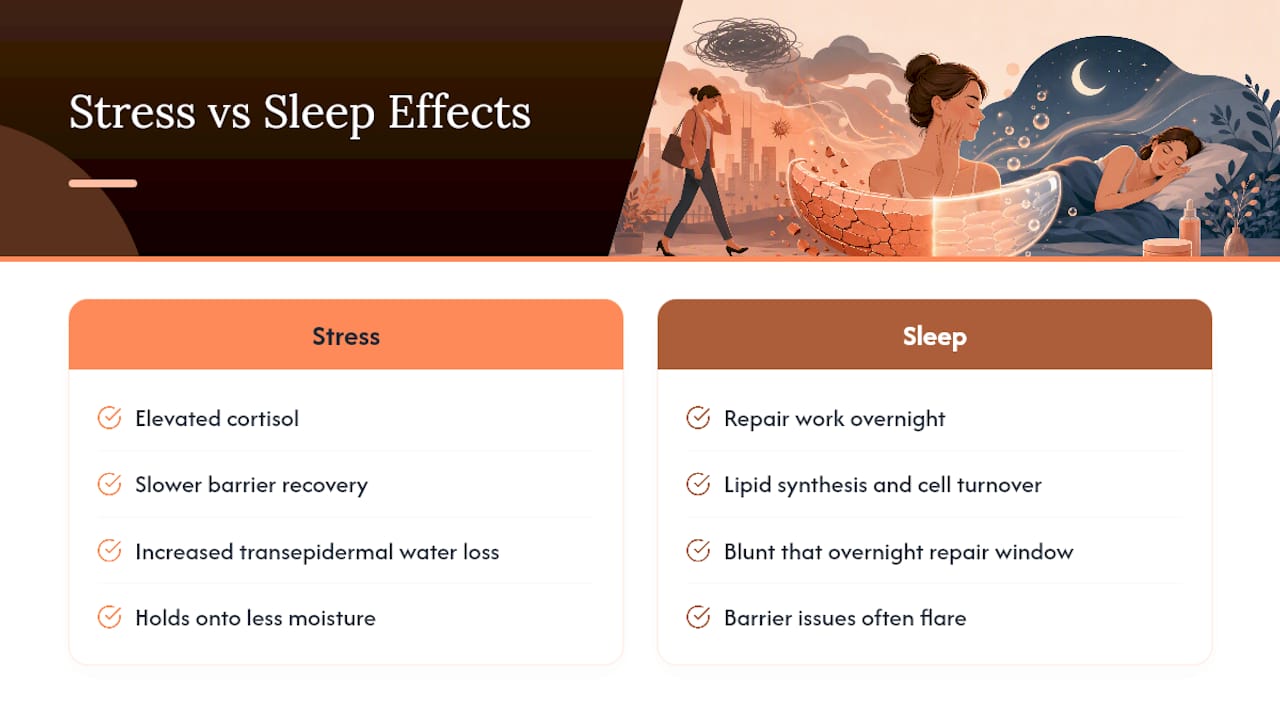
Sleep compounds this. Skin does much of its repair work overnight, including lipid synthesis and cell turnover. Consistently short or poor-quality sleep can blunt that overnight repair window, which partly explains why barrier issues often flare during high-stress periods, exam weeks, demanding work sprints, major life changes, even when your product routine hasn’t changed at all.
None of this means you need to overhaul your life to fix your skin. But if you’ve simplified your routine, removed the usual suspects, and you’re still not seeing the improvement you’d expect by week four or five, it’s worth honestly asking whether stress or sleep debt is the missing variable. Sometimes the most effective addition to a repair routine isn’t a product at all.
Why a minimal, clinical-first approach makes sense
Alloi builds around one idea: skin doesn’t need more products, it needs the right ones, used consistently. Our formulations stay purposeful and timeline-based because that’s what actually rebuilds a barrier.
Where Does Alloi Skin Fit Into a Barrier-Repair Routine?
Once you’ve stopped the aggressors and your skin has calmed down enough to tolerate more than a bare-bones routine, a targeted serum can accelerate the “Connect” phase of repair. Alloi’s VitalCopper Renewal Face Serum uses a copper peptide formulation designed to support skin structure, layered under your ceramide moisturizer rather than replacing it.
Alloi’s approach mirrors the TLC logic this guide walks through: minimal, purposeful ingredients instead of a ten-step regimen that risks reintroducing irritation before your barrier is ready. If your skin still tolerates actives poorly, start with just the serum and a plain moisturizer, then reassess in two to three weeks. Every Alloi formula is built around a documented ingredient list with no filler, so you know exactly what’s contacting compromised skin. Explore the VitalCopper serum and add it to your routine once tolerance returns.
Frequently Asked Questions
How do I fix an over-exfoliated face? Stop all exfoliation and active treatments immediately, switch to a bare-minimum routine of gentle cleanser, ceramide moisturizer, and sunscreen, and avoid reintroducing acids or retinoids until stinging and flaking fully resolve, typically several weeks.
What is acid mantle repair, and how is it different from barrier repair? The acid mantle is the thin, acidic film sitting on top of your skin barrier. Repairing it means restoring proper pH, usually through low-pH cleansers, which supports the enzymatic processes your skin needs for full barrier repair.
Can I use hyaluronic acid on a damaged skin barrier? Yes. Hyaluronic acid is a humectant, not an exfoliant, so it’s generally well tolerated even on compromised skin. Apply it to damp skin and follow with a moisturizer to lock in the hydration it pulls in.
How long does a damaged skin barrier routine take to show results? Most people notice reduced stinging and improved texture within 2 to 4 weeks of consistent care, with more complete recovery over 8 to 12 weeks depending on how much damage occurred.
Is it normal for skin to flake during barrier repair? Mild flaking can be part of normal turnover as damaged cells shed, but persistent or worsening flaking alongside redness and stinging usually means the routine still contains something too aggressive for healing skin.
This article is general information, not a substitute for advice from a qualified doctor. Consult a qualified healthcare professional about your own circumstances before acting on anything here.
Sources
- Skin 101: Understanding the Fundamentals of Skin Barrier Physiology—Why is This Important for Clinicians? - PMC
- Mechanisms and Repair of Skin Barrier Dysfunction: The TLC Strategy
- The Skin Barrier and Moisturization: Function, Disruption, and Mechanisms of Repair
- How Skin-Barrier Repair Actually Works | The Strategist
- Skin Barrier Function and How to Repair and Care for It - Cleveland Clinic


