


If your skin stings when you apply products that never used to bother you, feels tight no matter how much moisturizer you layer on, and has started flaking or breaking out for no clear reason, your barrier is likely compromised. The immediate fix: stop exfoliants, retinoids, and acids, switch to a gentle cleanser and a simple moisturizer, and wear sunscreen daily.
The signs that matter most:
- Persistent dryness or tightness that moisturizer doesn’t fully relieve
- Stinging or burning when you apply products, including ones you’ve used for months
- Sudden intolerance to products that never caused problems before
- Flaking, peeling, or a rough texture that won’t smooth out
- Redness that lingers or spreads
- New breakouts, small bumps, or a rash around the mouth or nose
If any of this comes with pain, pus, or spreading redness, see a dermatologist. Everything else, you can likely address at home, starting today.
Key Takeaways
A damaged skin barrier shows up as persistent dryness, stinging, sudden product intolerance, and unexplained breakouts, and it heals fastest when you simplify your routine rather than add more to it.
| Point | Details |
|---|---|
| Spot the primary signs | Persistent tightness, stinging on application, and sudden product intolerance are the strongest indicators of barrier damage. |
| Trace the trigger | Check the last two to five days for new actives, harsh cleansers, or hot water exposure before assuming the cause. |
| Strip the routine down | Stop exfoliants and actives, switch to a gentle cleanser, and rebuild with ceramides, humectants, and occlusives. |
| Reintroduce actives slowly | Patch-test one product at a time with one to two weeks of spacing to avoid re-triggering damage. |
| Expect weeks, not days | Mild cases improve within two weeks; moderate to severe damage can take several weeks, longer in older skin. |
| Choose dose-aware formulas | Alloi Skin’s VitalCopper Renewal Face Serum pairs studied doses of copper peptides and Matrixyl 3000 with soothing actives for the post-recovery stage. |
Table of Contents
- What the Skin Barrier Actually Does
- What Actually Damages the Barrier
- The Full Signs Checklist: From Mild to Severe
- How to Repair a Damaged Skin Barrier, Step by Step
- How Long Recovery Really Takes
- Protecting Your Barrier Once It’s Healed
- Why Formulation and Dose Decide Whether Repair Actually Works
- The One Habit That Beats Every Product You’ll Buy
- Where VitalCopper Renewal Face Serum Fits Once Symptoms Calm Down
- Sources
- FAQ
What the Skin Barrier Actually Does
The outermost layer of your skin, called the stratum corneum, works like a wall of bricks and mortar. Skin cells are the bricks; lipids like ceramides, cholesterol, and fatty acids are the mortar holding them together. That structure keeps water in and irritants, allergens, and bacteria out.
When the barrier is intact, you lose very little water through the skin. When it’s disrupted, transepidermal water loss climbs, your skin dries out faster than it can recompensate, and irritants that would normally bounce off now penetrate deeper and trigger inflammation. This is why a compromised barrier doesn’t just look dry. It behaves erratically, reacting to products and environments it used to tolerate without issue.
One detail worth knowing: older skin repairs more slowly than younger skin and often needs a gentler, more occlusive approach to recover fully.
What Actually Damages the Barrier
Barrier damage rarely comes from one dramatic event. It’s almost always the result of small habits stacking up until the skin can’t keep pace with repair. Common culprits include:
- Over-exfoliating, or mixing multiple strong actives (retinoids, AHAs, BHAs, vitamin C) in the same routine without spacing them out
- Harsh cleansers, foaming sulfates, denatured alcohol, and added fragrance
- Washing with hot water, which strips lipids faster than warm water
- Environmental stress: wind, low humidity, cold air, or heavy pollution exposure
- Underlying conditions like eczema, psoriasis, or rosacea, which make the barrier inherently more fragile
The American Academy of Dermatology specifically cautions against exfoliating too often or too aggressively, since repeated mechanical or chemical stripping is one of the most common self-inflicted causes of barrier breakdown.
Here’s a useful diagnostic habit: when symptoms appear, think back two to five days. Did you add a new product? Increase frequency on an active? Switch cleansers? Barrier damage usually has a traceable trigger, and finding it is faster than guessing at a fix.
The Full Signs Checklist: From Mild to Severe
Not every symptom carries equal weight. Some point to a barrier under mild stress; others signal something that needs more aggressive intervention.
Primary signs (these are the strongest indicators):
- Persistent dryness or tightness that doesn’t resolve with regular moisturizing
- Stinging or burning immediately after applying products, especially ones previously well tolerated
- Sudden product intolerance, where your usual routine now causes irritation
- Redness that persists for more than a day or spreads across the face
Secondary signs (often present alongside the primary ones):
- Flaking or peeling, particularly around the nose, cheeks, or forehead
- A rough, uneven texture that feels different to the touch, not just dry
- New breakouts or small papules, sometimes clustered around the mouth in a pattern that mimics perioral dermatitis but actually reflects barrier compromise
- Increased susceptibility to minor skin infections, since a weakened barrier lets bacteria and irritants through more easily
That last point about breakouts surprises a lot of people, since the instinct with new blemishes is to reach for something drying or exfoliating. A damaged barrier can alter your skin’s microbiome, and that shift alone is enough to trigger acne-like flares that have nothing to do with clogged pores in the traditional sense.
How do you tell the difference between run-of-the-mill irritation and genuine barrier damage? Duration and response are the two clues that matter. Ordinary irritation from a new product usually fades within a day or two once you stop using it. True barrier compromise tends to linger, and symptoms often intensify before they improve, even after you’ve removed the trigger. If stinging, redness, or flaking persists more than three or four days after you’ve simplified your routine, treat it as barrier damage rather than a passing reaction.
Pro Tip: Keep a simple note on your phone logging what you apply and when symptoms start or ease. There’s no single home test for barrier damage, so tracking the timeline yourself is the most reliable way to catch the actual trigger.
How to Repair a Damaged Skin Barrier, Step by Step
Recovery isn’t complicated, but it does require sequencing. Skipping steps or rushing the reintroduction of actives is the most common reason repair stalls.
Step 1: Stop everything aggressive. Pause exfoliants (physical and chemical), retinoids, vitamin C serums, and any acid-based treatments. Stop using foaming or sulfate-heavy cleansers. This isn’t forever, just until symptoms calm down.
Step 2: Switch to a low-pH, soap-free cleanser. Your skin’s natural pH sits slightly acidic, and harsh alkaline cleansers disrupt that balance further. A gentle, fragrance-free formula is non-negotiable during recovery.
Step 3: Rebuild with supportive ingredients. Look for ceramides to replace lost lipids, glycerin or hyaluronic acid to draw in moisture, and panthenol to calm inflammation. Clinical reviews consistently point to ceramides, humectants, and occlusives as the core trio for restoring barrier lipids and hydration. If your skin is cracking or severely dry, a thin layer of petrolatum overnight can seal in moisture while the barrier heals.
Step 4: Keep the routine minimal, morning and night. Mornings: gentle cleanser (or just water), moisturizer, sunscreen. Evenings: gentle cleanser, moisturizer. That’s it. Resist the urge to add “just one more thing” while your skin is still reactive.
Step 5: Reintroduce actives slowly, once symptoms resolve. Bring back one product at a time, patch-test on your jaw or inner arm first, and wait one to two weeks before adding the next. This spacing matters more than most people realize. Layering a new retinoid on top of a new acid on top of a new vitamin C serum, all in the same week, is exactly how barriers get damaged in the first place.
When shopping for recovery products, three cues make selection easier: fragrance-free labeling, a short ingredient list rather than a 30-item formula, and language indicating the product is formulated “for sensitive skin.”
Pro Tip: If a product stings the moment it touches your skin, that’s information, not something to push through. Stinging on intact, healthy skin is rare. Stinging on compromised skin is your barrier telling you it’s not ready yet.
How Long Recovery Really Takes
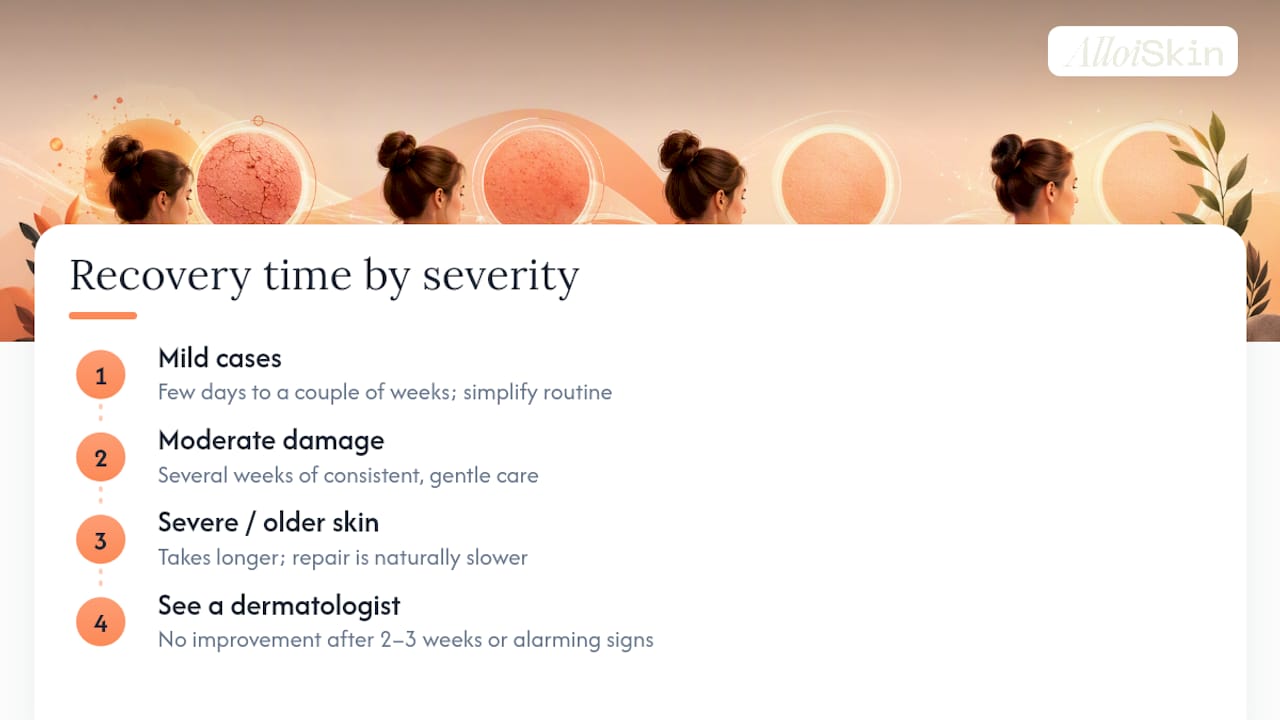
Timelines vary, but mild cases (dryness and occasional stinging) usually improve within a few days to a couple of weeks once you simplify your routine. Moderate damage, with more persistent redness or product intolerance, tends to take several weeks of consistent, gentle care. Severe cases, or barrier damage in older skin where repair is naturally slower, can take longer still.
Track improvement through three markers: less stinging with the same products, better hydration without piling on moisturizer, and redness that fades rather than spreads. If you’ve kept the routine simple for two to three weeks and see no improvement, or if you notice painful cracks, pus, or spreading redness at any point, that’s your signal to see a dermatologist rather than keep waiting it out.
Protecting Your Barrier Once It’s Healed
Repair is only half the job. Keeping the barrier resilient long-term comes down to a handful of consistent habits rather than an elaborate routine.
- Cleanse gently, once or twice daily, with a low-pH formula
- Moisturize consistently, even on days your skin looks fine
- Wear sunscreen every day, since UV exposure is itself a barrier stressor
- Limit exfoliation to a few times a week at most, and never combine multiple strong actives in the same session
- Keep ceramides, humectants, and panthenol in regular rotation rather than only reaching for them during a flare
Most people don’t damage their barrier through one bad product. They damage it through routine creep, adding a new serum here, an extra exfoliating step there, until the skin can’t keep up. A simplified routine is genuinely one of the more effective prevention strategies dermatology sources point to, precisely because it removes the guesswork of layering conflicting actives.
Why Formulation and Dose Decide Whether Repair Actually Works
Not all barrier-repair ingredients are created equal, and dose is where most products fall short. A serum listing ceramides, peptides, and antioxidants means little if each is included at a fraction of the concentration used in published research.
Alloi Skin’s approach starts from one principle: fewer ingredients, dosed at levels that match the studies behind them. Panthenol soothes and supports barrier function. Ceramides help restore the lipid matrix. Copper peptides support the skin’s underlying repair mechanisms. The goal isn’t a long ingredient list. It’s a short one that actually performs. If you’re rebuilding a routine after barrier damage, that distinction between “contains” and “contains enough of” is worth applying to every product you consider.
The One Habit That Beats Every Product You’ll Buy
Most barrier damage I see traced back isn’t caused by one harsh ingredient. It’s caused by impatience: bringing back a retinoid three days after symptoms calmed down, or stacking a new serum on top of a still-healing barrier because the skin “looked okay.” Recovery isn’t linear, and skin that looks fine on day four can still be fragile underneath.
The single habit that outperforms nearly every product decision is consistency: the same gentle moisturizer and sunscreen, every day, without exception. Pair that with simple symptom tracking, and you’ll catch setbacks before they become full flares again.
— Alloi Skin
Where VitalCopper Renewal Face Serum Fits Once Symptoms Calm Down
Once the stinging has stopped and your skin tolerates a basic moisturizer without protest, that’s the window to consider adding a targeted treatment back in, not before. The VitalCopper Renewal Face Serum was built for exactly that stage of recovery.

It pairs copper tripeptide-1 (GHK-Cu) and Matrixyl 3000 at studied concentrations with panthenol, betaine, and hyaluronic acid, the same ingredient categories dermatology sources point to for calming and rehydrating compromised skin, but without the 20-ingredient list that makes it hard to know what’s actually doing the work. Where competitor “barrier repair” serums often list a dozen peptides at doses too low to matter, Alloi Skin sticks to a shorter formula dosed to match the research behind each active.
If you’re introducing it during recovery, patch-test first, use it at night to start, and give your skin the same one to two weeks of spacing you’d give any new active. For readers who want the formulation reasoning behind the dosing decisions, the method page breaks down why fewer, better-dosed ingredients outperform longer lists. Start with a patch test tonight, and add it into your evening routine once stinging and redness have settled.
Sources
- Skin barrier function and how to repair and care for it — Healthline
- How to tell if your skin barrier is damaged — Cleveland Clinic
- Review article on skin barrier and lipids — NCBI PMC5608132
- How to exfoliate safely — American Academy of Dermatology (AAD)
FAQ
How Do You Fix a Damaged Skin Barrier?
Stop exfoliants and strong actives, switch to a gentle low-pH cleanser, and rebuild with ceramides, humectants like hyaluronic acid, and an occlusive if your skin is very dry. Reintroduce actives slowly once stinging and redness resolve.
Does the Skin Barrier Repair Itself?
Yes, given the right conditions. Mild damage often resolves within days to two weeks once you remove triggers and simplify your routine, though moderate to severe cases and older skin typically need several weeks of consistent, gentle care.
What Vitamins Help Repair the Skin Barrier?
Panthenol (provitamin B5) is the most cited topical ingredient for soothing and supporting barrier recovery, and it’s a core active in Alloi Skin’s formulations. Niacinamide is also commonly used to support the lipid barrier, though ceramides and humectants do most of the structural repair work.
What’s the Best Way to Repair the Skin Barrier?
There’s no single “best” product, but the most effective approach combines a stripped-down routine (gentle cleanser, moisturizer, sunscreen) with ingredients proven to restore lipids and hydration, such as ceramides, hyaluronic acid, and dosed peptides like those in the VitalCopper Renewal Face Serum. Consistency matters more than any one product choice.
When Should You See a Dermatologist for Barrier Damage?
See a dermatologist if you notice painful cracks, pus, spreading redness, or no improvement after two to three weeks of a simplified routine. These can signal infection or an underlying condition that needs treatment beyond at-home care.


