


Plain hydrolyzed collagen peptides are generally considered low-risk during pregnancy at modest doses of roughly 5 to 10 grams a day, though no pregnancy-specific randomized controlled trials confirm this. The safer path is a single-ingredient product with no added botanicals, a published Certificate of Analysis, and a conservative approach in the first trimester. Talk to your OB-GYN before starting, especially if you have kidney disease, preeclampsia, or gestational diabetes.
TL;DR:
- Collagen supplements in pregnancy are generally safe at doses of 5 to 10 grams per day, but lack pregnancy-specific randomized controlled trial evidence.
- The primary benefit is supplying amino acids like glycine and proline, which support tissue remodeling and skin elasticity during pregnancy, not targeted delivery to the fetus.
- Use products with straightforward labels, third-party testing, and no added herbs or high-dose vitamins to reduce contamination risks and ensure safety.
- Conservative intake in the first trimester is advisable, especially if dealing with medical conditions like kidney issues or preeclampsia, after consulting your healthcare provider.
- Whole food sources like bone broth and collagen-rich meats, paired with vitamin C, remain safe and effective alternatives for supporting collagen during pregnancy.
Table of Contents
- Collagen and Pregnancy: Why Your Body’s Demand for It Changes
- What the Research Actually Shows, and What It Doesn’t
- Collagen Supplements in Pregnancy: Dosing, Side Effects, and Medical Red Flags
- How to Choose a Safer Collagen Product During Pregnancy
- Natural Collagen Sources and Skin-Support Alternatives
- Alloi Skin’s Approach to Collagen Support During Pregnancy
- The One-Page Checklist for Your Next Prenatal Visit
- Alloi Skin’s Perspective: Why the Safety Conversation Gets Oversimplified
- Try VitalCopper for Skin Support That Doesn’t Ask You to Guess
- Sources
- FAQ
Collagen and Pregnancy: Why Your Body’s Demand for It Changes
Collagen is the structural protein that holds skin, tendons, cartilage, and connective tissue together. It’s the scaffolding, not the paint. During pregnancy, your body is quite literally building new scaffolding: the placenta forms, the uterus expands to roughly 500 times its non-pregnant volume, and the pelvic floor and skin stretch under sustained mechanical load.
Collagen at the maternal-fetal interface isn’t just structural padding. A peer-reviewed review in PMC describes collagen as playing a critical regulatory role in placental tissue remodeling, and the review notes that abnormal collagen expression has been associated with pregnancy complications. That’s a meaningful distinction: collagen isn’t a passive filler here, it’s actively involved in how maternal and fetal tissues interact.
Most collagen supplements on the market are hydrolyzed collagen peptides, not the intact collagen you’d find in gelatin or bone broth. Hydrolysis breaks the large collagen molecule down into short chains and free amino acids, mainly glycine, proline, and hydroxyproline, that your gut absorbs far more efficiently than whole collagen protein.
Here’s the part that surprises most people: once you swallow a collagen peptide, your body doesn’t ship it intact to your skin or your placenta. Digestion breaks it into its component amino acids, which then join your general amino acid pool. Research on collagen metabolism supports this mechanistic pathway: collagen peptides largely function as a source of specific amino acids rather than a targeted delivery system to any one tissue.
That reframes what “taking collagen for pregnancy” actually does. You’re not sending building blocks directly to your baby’s development. You’re supplementing your own amino acid supply, specifically with glycine and proline, two amino acids your body uses heavily during:
- Placental and uterine tissue remodeling
- Skin elasticity support as your abdomen stretches
- Pelvic floor and connective tissue adaptation
- General increased protein turnover in the third trimester
Glycine in particular has a reputation that outpaces most people’s understanding of it. It’s a “non-essential” amino acid technically, meaning your body can make it, but pregnancy’s collagen-synthesis demands can outstrip that internal production. That’s the biological argument for supplementation. It’s a reasonable one. It’s just not the same as a proven one, which is where the evidence picture gets more complicated.
What the Research Actually Shows, and What It Doesn’t
No large randomized controlled trial has tested collagen supplementation specifically in pregnant people. That single fact shapes everything else in this section, and it’s worth sitting with before looking at what data does exist.
The strongest available evidence is mechanistic, not interventional. The PMC review on collagen at the maternal-fetal interface lays out collagen’s structural and regulatory functions in placental and connective tissue during gestation in detail. It explains why collagen matters biologically. It does not test whether taking a collagen supplement changes outcomes for mother or baby. Those are two very different kinds of claims, and conflating them is where a lot of supplement marketing goes wrong.
The evidence gap in one line: Mechanistic plausibility explains why collagen supplementation might help. It does not, on its own, prove that it does.
Beyond the mechanistic review, a handful of small cohort and observational studies have looked at collagen supplementation in late pregnancy and postpartum recovery. Consensus point to reports of good tolerability and some signals of maternal benefit, things like subjective physical comfort and wound healing after delivery. These aren’t anything. They’re also not large, controlled, or powered to detect rare risks, which means they can suggest a direction without confirming a conclusion.
Here’s how clinicians tend to bridge that gap in practice:
- Regulatory status as a floor, not a ceiling. Hydrolyzed collagen carries FDA GRAS (Generally Recognized as Safe) status as a food ingredient, and an evidence summary from GiftedPicks frames this alongside a reassuring general safety profile in non-pregnant adults. GRAS status means the ingredient itself has a long track record of safety in food use. It does not mean anyone has specifically tested pregnancy outcomes.
- Observational tolerability as a soft signal. Small studies showing people tolerated collagen without adverse events during pregnancy build confidence, but tolerability isn’t the same endpoint as efficacy or long-term safety.
- Mechanistic reasoning as the connective tissue between the two. Because collagen peptides break down into common dietary amino acids your body already processes constantly, the theoretical risk profile looks a lot like adding a modest protein source, not like introducing a novel compound.
This is exactly the framing clinical guidance from Genesis OBGYN lands on: a typical supplemental dose in the 5 to 10 gram per day range appears reasonable for many pregnant patients, provided the product is a single-ingredient hydrolyzed collagen with no added extras, and provided a prenatal provider signs off first.
What should you take away from all this? The absence of a definitive RCT doesn’t mean collagen is risky. It means nobody has done the specific study that would let anyone say “proven safe” with full confidence. That’s a real limitation, and it’s one that applies to a long list of supplements pregnant people take every day, not just collagen. The honest position sits between “totally fine, don’t think twice” and “avoid it entirely.” It’s closer to: mechanistically reassuring, practically low-risk for most people at modest doses, and worth a conversation with the person managing your prenatal care before you start.
Collagen Supplements in Pregnancy: Dosing, Side Effects, and Medical Red Flags
The dosing guidance clinicians cite most often lands between 5 and 10 grams of hydrolyzed collagen peptides per day. To put that in context, current pregnancy protein guidance referenced in clinical nutrition literature recommends notably higher total daily protein intake than the standard non-pregnant target, largely to support fetal growth and maternal tissue expansion. A 5 to 10 gram collagen serving is a small fraction of that total protein need. It functions as a supplemental contribution, not a replacement for balanced dietary protein from food.
Many providers suggest a more conservative approach in the first trimester specifically, when morning sickness already complicates supplement tolerance and when some patients prefer to minimize any non-essential additions during the period of highest fetal organ development. Waiting until the second trimester to start, if you decide to start at all, is a common and reasonable middle ground.
Side effects tend to be mild and mechanical rather than dangerous. The most common complaint is straightforward gastrointestinal upset, bloating, or a heavy feeling if you take collagen powder on an empty stomach. Allergic reactions are rare but tied directly to source: bovine collagen carries a different allergen profile than marine (fish-derived) collagen, so anyone with a shellfish or fish allergy should choose bovine, and vice versa for anyone sensitive to beef products. Porcine-sourced collagen exists too and carries its own considerations for anyone avoiding pork for religious or dietary reasons.
The bigger safety concern isn’t the collagen itself. It’s contamination. Collagen is typically derived from animal connective tissue and bone, and depending on sourcing and processing, trace heavy metals can end up in the final powder. This is precisely why third-party testing matters more here than in most supplement categories.
Pro Tip: Before you buy, search the brand name plus “Certificate of Analysis” or check their website directly. A legitimate collagen brand will have a recent, third-party lab COA showing heavy metal testing results, and they won’t make you dig for it.
Certain medical situations call for a direct conversation with your provider before adding any protein supplement, collagen included:
- Kidney disease or impaired kidney function, since added protein load changes how your kidneys process waste
- Preeclampsia or existing hypertension, where your care team may already be managing protein and sodium intake closely
- Gestational diabetes, where flavored or sweetened collagen products can quietly add sugar you’re otherwise tracking carefully
- A history of kidney stones, since some amino acid metabolites factor into stone formation for susceptible people
Two interaction notes are worth flagging. Vitamin C is a required cofactor for your body’s own collagen synthesis, so pairing a collagen supplement with vitamin C rich foods, or understanding how the two nutrients work together, can support the process your supplement is meant to feed. Collagen doesn’t meaningfully block iron absorption the way some plant compounds do, but if you’re taking a separate iron supplement for prenatal anemia, spacing supplements by an hour or two is a reasonable habit regardless. If you’re breastfeeding, the same general low-risk framing applies, since collagen peptides don’t concentrate in breast milk in any way current research flags as concerning, though the same GRAS-based, observation-limited caveat still stands.
How to Choose a Safer Collagen Product During Pregnancy
Not all collagen powders sitting on the same store shelf deserve the same level of trust. The product matters as much as the decision to take collagen at all, and a few label checks separate a conservative choice from a genuinely questionable one.
-
Choose single-ingredient hydrolyzed collagen peptides. The cleanest products list exactly one thing on the Supplement Facts panel: collagen peptides (or hydrolyzed collagen), full stop. Anything else on that label is a variable you don’t need to introduce during pregnancy.
-
Check the source and match it to your allergy history. Bovine (beef-derived) and marine (fish-derived) collagen are the two dominant sources, and marine collagen in particular carries its own research profile worth understanding if that’s your preferred type. If you have a known allergy to either source category, that decision is made for you.
-
Require third-party testing and ask for the COA directly. A Certificate of Analysis from an independent lab is the only real way to confirm a product is tested for heavy metals like lead, mercury, and cadmium, contaminants that can occur naturally in bone and connective tissue sourcing. Reputable brands publish this on their site or send it on request. If a brand can’t produce one, treat that as a hard pass regardless of how clean the marketing looks.
-
Skip anything with added herbs, adaptogens, or high-dose vitamins. Collagen products marketed as “beauty blends” frequently stack in ashwagandha, biotin megadoses, or proprietary herbal complexes that have their own, separate pregnancy safety questions, ones that often have far less data behind them than collagen itself. The safest product on the shelf is often the most boring-looking one.
-
Watch for added sugar and sodium in flavored versions. This matters even more if you’re managing gestational diabetes or blood pressure, where a “delicious” flavored collagen can add meaningfully to your daily counts without you noticing.
-
Do the serving-size math yourself. Don’t assume “one scoop” equals a clinically discussed dose. Check the grams per serving on the label against the 5 to 10 gram range your provider is comfortable with, and adjust your scoop size accordingly rather than guessing.
Powder, capsule, and liquid formats all deliver the same peptides; the difference is mainly convenience and dose control. Powder gives you the most precise control over exact gram amounts, capsules are easiest to travel with but often require several to hit a meaningful dose, and liquid formats vary widely in concentration from brand to brand.
Natural Collagen Sources and Skin-Support Alternatives
Whole foods have supported collagen production for humans throughout pregnancy for a lot longer than powdered supplements have existed, and they remain a completely legitimate route if you’d rather not add a supplement at all.
Bone broth, slow-cooked cuts with connective tissue (oxtail, short rib, chicken thighs with skin on), and gelatin-based dishes all supply intact collagen protein that your gut still breaks down into the same core amino acids as a hydrolyzed powder. The main difference is concentration. You’d need a considerably larger serving of bone broth to match the 5 to 10 grams a scoop of collagen peptides delivers in one go, which is exactly why supplements exist for people who want a more concentrated, measured dose.
Whichever route you take, pairing it with vitamin C rich foods such as citrus, bell peppers, and strawberries gives your body the cofactor it needs to actually synthesize new collagen from those amino acids, rather than just metabolizing them for general protein use.
- Bone broth, two to three times a week, as a base for soups or sipped on its own
- Collagen-rich cuts of meat a few times weekly, prepared low and slow
- A vitamin C source alongside protein-rich meals, not as an afterthought
- Adequate hydration, since collagen-dense connective tissue depends on water content to stay pliable
Skin is one of the tissues under the most visible strain during pregnancy, and oral collagen isn’t the only lever available for supporting it; for example, the Baby Collagen Mask Moisturizing offers a topical way to help maintain skin hydration and resilience. Topical strategies work locally, addressing the skin barrier directly rather than relying on systemic amino acid redistribution. Consistent moisturizing, barrier-supportive ingredients like hyaluronic acid and panthenol, and gentle peptide serums can all support skin resilience during the stretching and hormonal shifts pregnancy brings, without introducing any oral supplementation question at all.
Alloi Skin’s Approach to Collagen Support During Pregnancy
Some skincare brands build products around the principle of using proven actives at studied doses, and skipping unnecessary ingredients. This transparency matters especially when pregnancy leads to closer reading of ingredient labels.
It’s worth being precise about categories here. The VitalCopper Renewal Face Serum is a topical peptide serum, not an oral collagen supplement, and that distinction matters for anyone weighing pregnancy-safety questions. It works locally on skin using copper peptides that support collagen synthesis at the skin barrier, paired with panthenol, betaine, and hyaluronic acid, rather than being digested and redistributed through your bloodstream the way an oral supplement is.
For someone specifically focused on skin support during pregnancy, particularly through the stretching and hormonal shifts of the third trimester, a topical approach sidesteps the oral-dosing questions entirely. It’s a different tool solving a related but distinct problem.
None of this replaces a conversation with your prenatal provider before adding any new topical actives to your routine either. Pregnancy skin sensitivity shifts, and what worked on your skin a year ago may behave differently now.
The One-Page Checklist for Your Next Prenatal Visit
Bring this to your next appointment rather than trying to remember it. The individual decision drivers, your trimester, existing conditions, and current medications matter more than any general recommendation, including this article’s.
Ask your provider to weigh in on:
- The exact product name and brand you’re considering
- The gram amount per serving and how that fits your total daily protein target
- Whether the brand publishes a Certificate of Analysis, and whether you’ve reviewed it together
- The collagen source (bovine, marine, or porcine) against any allergy history
- Which trimester you’re in and whether waiting is advisable
- Any relevant medical history: kidney function, blood pressure, gestational diabetes screening results
Set a simple monitoring plan from there. Note any digestive changes in the first week, recheck in with your provider at your next routine visit, and stop immediately if you notice unusual swelling, digestive distress that doesn’t resolve, or any new allergic symptoms.
Alloi Skin’s Perspective: Why the Safety Conversation Gets Oversimplified
Most collagen-and-pregnancy content online collapses into one of two extremes: a breezy “it’s totally fine, everyone takes it” reassurance, or an anxiety-driven “avoid all supplements” blanket warning. Neither one respects what the evidence actually shows, and both do readers a disservice.
The honest position is less satisfying but more useful: hydrolyzed collagen’s mechanism looks a lot like adding a modest, familiar protein source, and its regulatory GRAS status reflects its approval as safe in typical food uses, and the small observational studies available lean reassuring. None of that adds up to a proven safety trial in pregnant people, because that trial hasn’t been run. Pretending otherwise, in either direction, misrepresents the data.
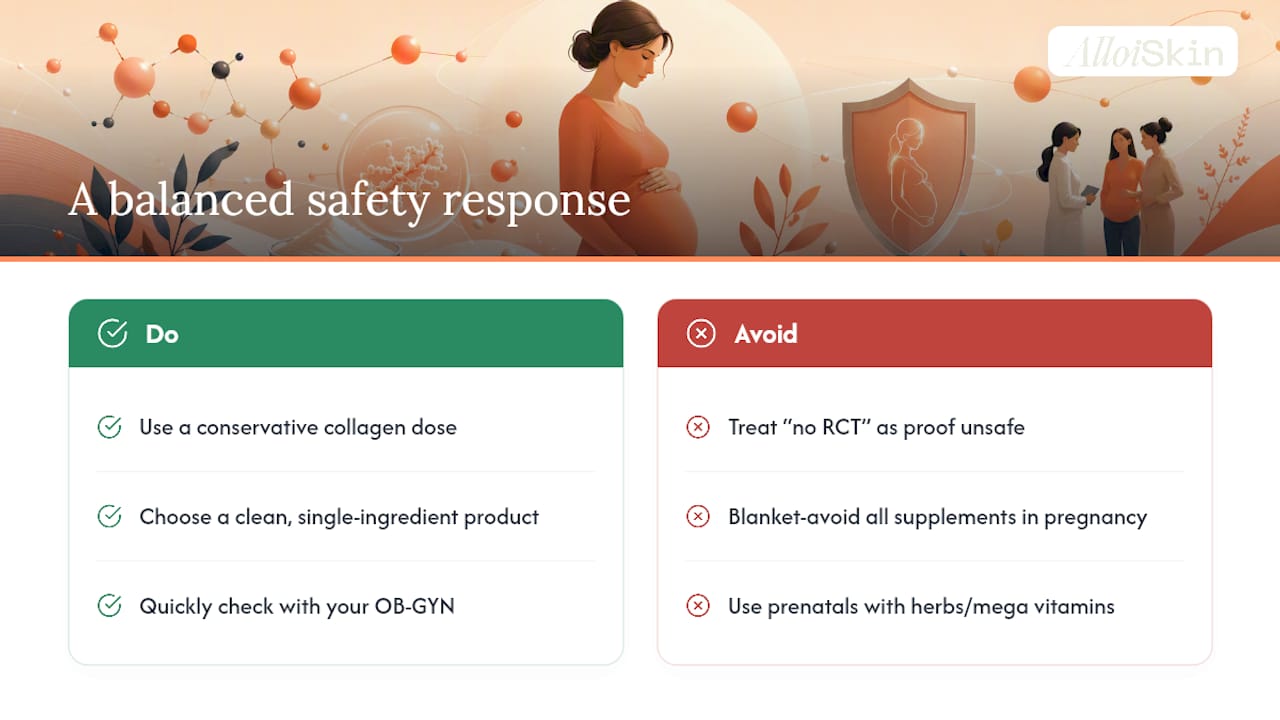
What we’d push back on is the framing that treats “no RCT” as equivalent to “unsafe.” By that same logic, dozens of foods and practices pregnant people rely on daily would fail the same test, because pregnancy-specific RCTs are genuinely hard to run for ethical reasons. The absence of a trial is a gap in certainty, not a red flag in itself. The responsible response to that gap isn’t avoidance or blind confidence. It’s exactly what a conservative dose, a clean single-ingredient product, and a quick check-in with your OB-GYN accomplish together.
Where we’d also push back: the beauty-supplement industry has done pregnant consumers a disservice by burying collagen inside “prenatal glow” blends loaded with herbs and mega-dose vitamins that have far murkier safety profiles than collagen peptides themselves. If you take one thing from this article, let it be that the product’s other ingredients deserve more scrutiny than the collagen line item does.
— Alloi Skin
Try VitalCopper for Skin Support That Doesn’t Ask You to Guess
If you’ve read this far weighing an oral collagen supplement mainly for your skin during pregnancy, there’s a simpler path: skip the digestion-and-redistribution question entirely and work on the skin barrier directly. The VitalCopper Renewal Face Serum delivers copper tripeptide-1 (GHK-Cu) and Matrixyl 3000 at the doses actually studied in published research, alongside panthenol, betaine, and hyaluronic acid to support and calm the barrier while it’s under the most stress.

Some brands offer serums with short, deliberate ingredient lists rather than many actives at low doses, simplifying skincare routines and focusing on purposeful formulation. If you’d rather add a collagen powder to your morning routine instead, the VitalBuild Daily Collagen Powder follows the same single-ingredient, transparent-dosing philosophy this article recommends looking for.
Whichever you’re considering, talk to your OB-GYN first. Then visit the VitalCopper product page to check the full ingredient list and decide if it fits your pregnancy skincare routine.
This article is general information, not a substitute for advice from a qualified doctor. Consult a qualified healthcare professional about your own circumstances before acting on anything here.
Sources
The mechanistic foundation for this article comes from a peer-reviewed review on collagen’s role at the maternal-fetal interface, published through PMC, which details collagen’s structural and regulatory functions during gestation.
For practical clinical guidance on dosing and product selection, Genesis OBGYN’s explainer on collagen safety in pregnancy lays out the commonly cited 5 to 10 gram dosing range. An evidence summary from GiftedPicks covers GRAS status and the current RCT gap in more detail, and Consensus.app’s review of small cohort studies rounds out the observational picture. For background on how collagen peptides differ from tripeptides, Alloi Skin’s ingredient breakdown is a useful technical reference.
- Collagen at the maternal-fetal interface in human pregnancy — PMC
- Is Collagen Safe for Pregnancy? — Genesis OBGYN
- Is Collagen Safe During Pregnancy? (evidence summary) — GiftedPicks
- Consensus
FAQ
Is it safe to take collagen while pregnant?
Plain hydrolyzed collagen peptides at modest doses (5 to 10 grams a day) are generally considered low-risk based on GRAS status and mechanistic safety data, but no pregnancy-specific randomized controlled trials confirm this, so check with your OB-GYN first.
What supplements should I avoid while pregnant?
Avoid supplements with added herbs, adaptogens, or high-dose vitamins with limited pregnancy safety data, and choose single-ingredient products with third-party testing whenever possible, especially for collagen, which is safest in its plain hydrolyzed form.
Can I take collagen while trying to get pregnant?
Yes, hydrolyzed collagen’s safety profile doesn’t specifically change based on conception timing, since it’s metabolized the same way, but the same single-ingredient, third-party-tested approach applies before and during pregnancy alike.
Can I take collagen and prenatal vitamins together?
Yes, collagen peptides don’t have a known interaction with standard prenatal vitamins, and pairing collagen with a vitamin C source can support your body’s own collagen synthesis process.
What collagen can I take during pregnancy?
Look for single-ingredient hydrolyzed collagen peptides, bovine or marine depending on your allergy history, with a published Certificate of Analysis confirming low heavy-metal contamination and no added botanical blends.


