


Skin fasting works as a short-term troubleshooting tool for product overload, not as a detox ritual, and it helps most when irritation or breakouts have you questioning which product is the culprit. It is not appropriate for everyone: sunscreen stays on no matter what, and anyone using prescription topicals or managing eczema or rosacea needs a clinician’s input before pausing anything. Skip ahead to the step-by-step protocol below if you already know it fits your situation.
TL;DR:
- Skin fasting should be limited to 2 to 14 days, depending on the goal, to prevent skin irritation and ensure proper reintroduction of products.
- It is only safe to skip actives while maintaining daily sunscreen, moisturizer, and gentle cleansing, especially for those with sensitive, eczema, or rosacea-prone skin.
- People using prescription topicals or managing skin conditions must consult their healthcare provider before pausing treatments to avoid adverse effects.
- Reintroduction of products after a fast should be gradual, adding one item at a time and observing the skin’s response over 3 to 7 days.
- Skin fasting primarily works by removing irritants, not by flushing toxins, and it is more effective as a short-term troubleshooting step rather than a long-term routine.
Table of Contents
- What Is Skin Fasting, and Where Did the Idea Come From?
- What Benefits Does Skin Fasting Actually Deliver?
- Who Should Never Try a Skin Fast?
- How to Run a Safe Skin Fast, Step by Step
- Skin Fasting vs. Skinimalism: What’s the Real Difference?
- Why We Think Ritual Fasting Misses the Point
- What to Reach for After Your Skin Fast Ends
- Where This Guidance Comes From
- Sources
- FAQ
What Is Skin Fasting, and Where Did the Idea Come From?
Skin fasting means deliberately paring back your routine, sometimes to just water, for a set stretch of days to see how your skin behaves without added products. The term picked up momentum on social media as a reaction to 10-step routines and shelves crowded with actives, and it borrows the language of intermittent fasting to suggest the skin needs a break from constant input.
In practice, “skin fasting” covers a spectrum rather than one fixed ritual:
- Full fast: cleansing with water only, no moisturizer, no sunscreen substitute, for a short window (rarely recommended by dermatologists).
- Active pause: keeping a gentle cleanser, barrier moisturizer, and sunscreen, but stopping actives like retinoids, acids, and vitamin C serums.
- Skinimalism-style simplification: a longer-term shift to fewer, more purposeful products rather than a temporary stop.
Most people try it after a flare of irritation, a new breakout, or a suspicion that their routine has too many actives fighting each other, a problem worth understanding on its own terms.
What Benefits Does Skin Fasting Actually Deliver?
The benefit people report most often is calmer, less reactive skin within a few days of stopping stacked actives, and the mechanism behind it is straightforward: fewer ingredients means fewer chances for irritation, sensitization, or one product canceling out another. Someone layering a retinoid, an acid exfoliant, and a vitamin C serum every night is asking their barrier to tolerate three aggressive inputs at once. Remove two of them, and redness often drops within days.
This is where the “detox” framing falls apart. Skin does not accumulate toxins that a fast flushes out. What actually happens is simpler and less mystical: you stop irritating your skin, and it stops looking irritated. Dermatologists interviewed on the topic consistently frame the improvement as subtraction of a problem, not addition of a benefit, which is a meaningful distinction if you are deciding whether to try this at all.
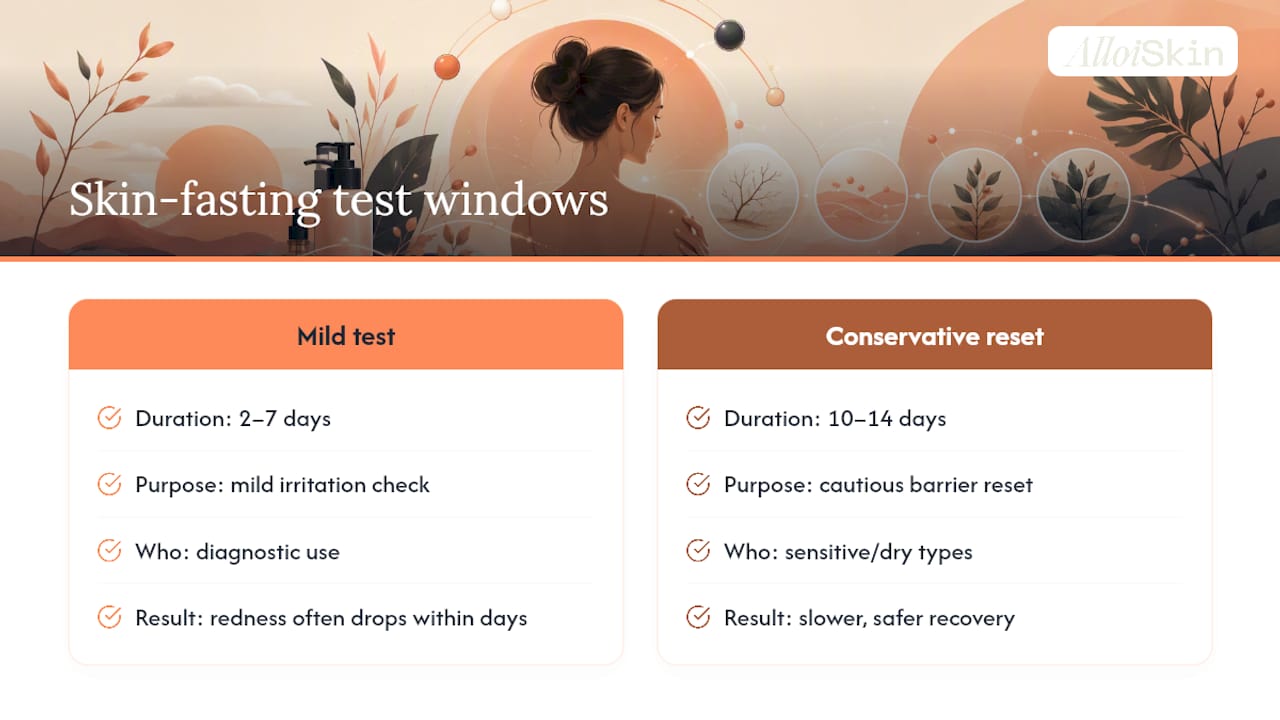
The real number to know: clinical experts recommend a structured window of roughly 2 to 7 days for a mild irritation test, or up to 10 to 14 days for a conservative reset. This window is shorter than the open-ended weeks some social posts suggest. Dry and sensitive skin types tend to see the clearest results because they are usually the ones over-layering actives that a normal barrier could otherwise tolerate.
Who Should Never Try a Skin Fast?
Sunscreen is the one line that never moves. Board-certified dermatologists are blunt about this: broad-spectrum SPF stays in your routine even during a full pause, because cutting sunscreen raises your UV exposure risk with no offsetting benefit. A skin fast is about ingredients that treat or exfoliate, not about the one product that protects.
A few groups should sit this out entirely or only attempt it with medical supervision:
- Anyone using prescription topicals (tretinoin, tazarotene, prescription-strength acne treatments) should talk to their prescriber first, since abruptly stopping supervised treatment can worsen the underlying condition.
- People managing eczema, rosacea, or a compromised barrier often need consistent moisturizer and anti-inflammatory support, not less of it.
- Anyone tempted to swap out real products for unproven home remedies during the fast is trading one risk for another.
Watch for tightness, flaking, or new breakouts that get worse rather than better after 3 or 4 days. That is your signal to stop, not push through.
Pro Tip: Take a phone photo of your skin on day one in the same light and angle you’ll use for follow-up photos. Redness and texture changes are easy to underestimate day to day but obvious side by side.

How to Run a Safe Skin Fast, Step by Step
Pick your goal before you pick your timeline. A 3 to 7 day test works for isolating a suspected irritant. A 10 to 14 day reset suits someone overhauling a routine that has grown too complex, and that upper bound matches what clinical sources consider a conservative, evidence-based window rather than an open-ended cleanse.
Before you start:
- Stop introducing any new actives for at least a week beforehand so you are not fasting from a product you just started.
- Patch-test anything you plan to reintroduce later on your inner arm first.
- If you use a prescription topical, call your prescriber before pausing it, not after.
During the fast, keep these non-negotiable:
- A gentle, non-stripping cleanser, morning and night.
- A barrier-supporting moisturizer, even during a “full” fast.
- Daily broad-spectrum sunscreen, no exceptions, per Mayo Clinic’s basic skin-care guidance.
- Clean pillowcases and clean hands touching your face, since hygiene matters more when your barrier is doing less of the compensating.
- Light, breathable makeup only if necessary, removed thoroughly at night.
Reintroducing products: add one item back at a time, wait 3 to 7 days between additions, and log how your skin responds before adding the next. This is the step people skip, and it is the one that actually tells you which product was the problem.
| Stage | Duration | What to do |
|---|---|---|
| Prep | several days before | Stop new actives, patch-test, consult prescriber if needed |
| Active fast | 3 to 14 days | Cleanser, moisturizer, SPF only |
| Reintroduction | several days per product | Add one item, observe, then add the next |
Stop immediately and see a dermatologist if you notice swelling, blistering, or a rash that spreads rather than fades.
Skin Fasting vs. Skinimalism: What’s the Real Difference?
Skinimalism is the sustainable cousin of skin fasting. Where a fast is a temporary experiment, skinimalism is a permanent shift toward fewer, better-chosen products, and the two overlap heavily in what they cut: redundant actives, decorative ingredients, and steps added out of habit rather than need.
The difference that matters is what never gets cut. A well-built minimalist routine keeps cleanser, moisturizer, and sunscreen as fixed anchors, because removing those, even briefly, undoes any barrier benefit you gained. A skin fast can flirt with removing everything; skinimalism never does.
A sample minimalist routine after a reset might look like:
- Dry or sensitive skin: gentle cleanser, barrier moisturizer, SPF, one targeted treatment serum.
- Oily or acne-prone skin: foaming cleanser, lightweight gel moisturizer, SPF, one active added back at a time.
- Combination or “normal” skin: cream cleanser, barrier-repair moisturizer, SPF, and a single peptide or antioxidant serum.
Why We Think Ritual Fasting Misses the Point
Skin fasting gets credit for a benefit that belongs to something simpler: fewer ingredients fighting for the same job. Once you understand that the improvement people feel comes from removing irritants, the appeal of a temporary fast starts to look less like a strategy and more like a placeholder for a better routine you haven’t built yet.
We built Alloi Skin around the opposite instinct. Instead of stripping everything down and hoping the skin sorts itself out, we ask what a small number of ingredients, dosed at levels actually studied in clinical research, can do for barrier repair on their own. A damaged barrier does not need a break from products. It needs the right ones, at the right concentration, applied consistently. That is a very different bet than hoping a week of doing nothing fixes what months of doing too much created.
— Alloi Skin
What to Reach for After Your Skin Fast Ends
Once your fast or simplification period ends, the temptation is to rebuild the same crowded routine you started with. Resist it. The reintroduction phase is your chance to add back only what earns its place, and that is exactly the gap our VitalCopper Renewal Face Serum is built to fill.

It pairs copper tripeptide-1 (GHK-Cu) and Matrixyl 3000 at the concentrations studied in clinical research with panthenol, betaine, and hyaluronic acid to support barrier recovery, without asking you to layer on five more products to get there. It fits a minimal routine because it is designed to be the one active step, not one of ten. If your skin fast taught you that less works better, the next logical move is choosing the single serum that does more with that “less,” not stacking new ones back in out of habit. Start on the product page to see the full ingredient breakdown and current pricing.
Where This Guidance Comes From
This article draws on clinical and dermatology-reviewed sources rather than social media trends. For continued reading: Mayo Clinic’s skin-care basics, the American Academy of Dermatology’s care guidelines, and Byrdie’s dermatologist-sourced explainer on skin fasting each cover different angles of the same core guidance: simplify carefully, protect always.
This article is general information, not a substitute for advice from a qualified doctor. Consult a qualified healthcare professional about your own circumstances before acting on anything here.
Sources
- Is Skin Fasting the Secret to Clear, Refreshed Skin?
- American Academy of Dermatology — Skin care basics
- Mayo Clinic — Skin care: 5 tips for healthy skin
- Skin Fasting & Skinimalism: Does Doing Less Work? — DermApproved
- Is Skin Fasting the Key to Healthier Skin? — INTEGRIS Health
FAQ
What Is Skin Fasting?
Skin fasting is a temporary reduction of your skincare routine, ranging from water-only cleansing to simply pausing actives, used to see how skin behaves without added products or to troubleshoot irritation.
Will Fasting Improve My Skin?
It can reduce redness and irritation if your routine had too many stacked actives, but the improvement comes from removing irritants, not from any detoxifying effect, according to dermatologist-reviewed reporting.
How Many Days of Fasting Does Skin Need to Recover?
Experts point to roughly 2 to 7 days for a short irritation test and up to 10 to 14 days for a more conservative reset, not weeks of open-ended pausing.
Is There a Connection Between Fasting Practices and Glowing Skin?
Traditional fasting practices affect the whole body through changes in diet and hydration, but there’s no clinical evidence that fasting from food produces a specific “glow.” Any visible change is more likely tied to hydration, sleep, and reduced inflammation than to skin-specific mechanisms.
Should I Stop Using Sunscreen During a Skin Fast?
No. Sunscreen is the one product dermatologists say to keep no matter which version of a skin fast you try, since dropping SPF increases UV exposure risk with no corresponding benefit.


