


Current evidence and regulatory guidance indicate that parabens at typical cosmetic concentrations have not been shown to harm human health, though laboratory studies and some population data raise questions that justify caution in specific situations. Widespread biomonitoring confirms most people carry measurable paraben levels from routine product use. What follows breaks down the science, the regulatory reasoning, and the practical choices worth making.
TL;DR:
- Most people are exposed to parabens regularly through personal care products, with urine levels indicating near-universal but short-lived exposure.
- Longer-chain parabens like propyl and butyl show stronger estrogenic activity in lab studies, but current regulatory guidance remains cautious and does not advise complete avoidance.
- Pregnant individuals, infants, or those with compromised skin should consider limiting paraben exposure, especially from leave-on products that have longer skin contact.
- Replacing paraben-containing products with formulated alternatives can reduce exposure within days, as parabens are metabolized and excreted quickly.
- The overall risk from parabens appears low for most people, and formulation quality with purposeful ingredients should take priority over ingredient avoidance alone.
Table of Contents
- What parabens are and why cosmetic formulas use them
- What the research says about hormone effects and human exposure
- How regulators and expert panels weigh the evidence
- Who might reasonably take extra precautions
- How to cut paraben exposure without cutting corners on safety
- Why Alloi Skin formulates the way it does
- Common myths about parabens, corrected
- Where the evidence leaves us, and what actually matters
- If you want a transparently formulated alternative
- Sources
- FAQ
What parabens are and why cosmetic formulas use them
Parabens are esters of p-hydroxybenzoic acid, added to personal care products to stop bacteria, yeast, and mold from growing once a jar or bottle is opened and exposed to air, water, and repeated hand contact. Without an effective preservative, a lotion or serum becomes a growth medium within weeks. This is a more immediate risk to skin than any theoretical hormonal effect.
You will find parabens on ingredient lists under several names:
- Methylparaben, the shortest-chain and most commonly used variant.
- Ethylparaben, chemically similar and used at low concentrations.
- Propylparaben and butylparaben, longer-chain versions that appear more often in the endocrine research.
- Isopropylparaben, isobutylparaben, and benzylparaben, less common variants sometimes blended with the others.
The tradeoff is straightforward: preservatives introduce a chemical readers may want to limit, but their absence introduces a contamination risk that is well established rather than theoretical.
What the research says about hormone effects and human exposure
Laboratory and animal studies have found that some parabens bind weakly to estrogen receptors, and this activity tends to strengthen as the carbon chain gets longer. Propyl and butyl parabens show more estrogenic activity in these models than methyl or ethyl parabens, a pattern that shows up consistently across SCCS assessments.
Human epidemiology tells a messier story. Studies looking at reproductive outcomes, thyroid function, and body composition have produced inconsistent associations, and most rely on a single urine sample collected at one point in time. That design cannot establish whether paraben exposure caused an outcome or simply co-occurred with it, since a single spot sample reflects recent product use rather than a lasting exposure pattern.
Methyl and propyl paraben were detected in a very high proportion of U.S. urine samples tested, according to CDC biomonitoring data from NHANES, confirming that exposure through daily products is close to universal rather than a niche concern. This detection reflects how routinely parabens appear in personal care formulas, not a measure of harm.
The most useful biomarker for tracking this exposure is the parent paraben compound itself, measured as free and conjugated forms in urine, since a related nonspecific metabolite can come from other sources and muddy the picture, as CDC researchers note.
Detection is not proof of harm. It means a compound is present and measurable, which is expected given how many rinse-off and leave-on products contain parabens. The strongest available human evidence right now points to a real, chain-length-dependent hormonal signal in cell and animal models, an inconsistent and inconclusive signal in people, and exposure that is common but appears to be short-lived.

How regulators and expert panels weigh the evidence
Regulatory bodies have reviewed this same evidence and reached a measured conclusion rather than a dramatic one.
- The FDA states it does not have information showing that parabens as used in cosmetics affect human health, a position current as of November 2025.
- The SCCS in the European Union treats methyl and ethyl paraben as lower concern at permitted levels, while propyl and butyl paraben have faced more restrictive concentration limits.
- Expert panels including the Cosmetic Ingredient Review have repeatedly reassessed parabens as new data emerged, adjusting guidance for longer-chain variants rather than issuing a blanket ban.
This reasoning reflects a genuine tradeoff. Regulators weigh the documented benefit of microbial protection against a hormonal signal that remains theoretical in humans, and at current permitted concentrations, that balance has not tipped toward removal.
Who might reasonably take extra precautions
Most people using parabens in normal amounts, in normal products, are unlikely to see any measurable effect. A few groups have a plausible reason to be more selective:
- Pregnant people, since fetal development involves hormone-sensitive windows where even a weak signal warrants a cautious approach.
- Infants and very young children, whose skin barrier and metabolic systems are still maturing.
- Anyone with broken, eczema-prone, or otherwise compromised skin, since damaged barrier tissue absorbs more of what sits on it.
- People applying many leave-on products daily, where paraben exposure from several sources can add up rather than coming from a single item.
Damaged skin loses its usual barrier function, so a compound that would normally stay on the surface can penetrate more readily. That is a mechanical, physical reason for caution, separate from the hormonal question. The human data suggesting reproductive or developmental concerns remains limited and inconsistent, which is exactly why selective precaution makes more sense than blanket avoidance for someone in one of these groups.
Pro Tip: If you are pregnant or treating a skin condition that compromises the barrier, it is reasonable to choose paraben-free leave-on products for that period and save the question for rinse-off items, which have far shorter skin contact time.
How to cut paraben exposure without cutting corners on safety
Reducing exposure is manageable once you know what to look for and what tradeoffs matter; for more on paraben-free benefits, see Waarom zonder parabenen – Voordelen voor huid en milieu.
- Read the ingredient list for methylparaben, ethylparaben, propylparaben, butylparaben, and their isopropyl, isobutyl, or benzyl variants, usually listed near the end of the formula.
- Prioritize paraben-free options for leave-on products like face serums and moisturizers, where skin contact time is longest.
- Treat rinse-off products, such as shampoo and body wash, as a lower priority since contact time is brief and dilution is high.
- Choose products with a documented, tested preservative system rather than unpreserved or home-blended alternatives, since inadequate preservation risks microbial contamination that is a more immediate hazard.
- Avoid stretching product shelf life past its intended window, since preservatives are dosed for a specific use period, not indefinite storage.
Pro Tip: Switching away from paraben-containing products tends to work fast: small studies have shown urinary paraben levels dropping substantially within days of the switch, since the body clears these compounds quickly rather than storing them long term, according to the Cleveland Clinic. For a deeper look at how to evaluate these tradeoffs on any label, see this breakdown of evidence-based skincare claims.
Why Alloi Skin formulates the way it does
Effective preservation is not optional in a product designed to sit in a bathroom for months, and cutting it without a vetted alternative preservative system creates a real risk rather than a smaller one. Alloi Skin’s formulation method starts from the same principle this article follows: include only what earns its place, at a dose backed by evidence, and be transparent about why.
That same discipline shapes the VitalCopper Renewal Face Serum, which pairs copper tripeptide-1 (GHK-Cu) and Matrixyl 3000 at studied concentrations with panthenol, betaine, and hyaluronic acid to support the skin barrier, rather than stacking in dozens of actives at doses too low to matter. Fewer, purposeful ingredients mean fewer unnecessary exposures of any kind, paraben or otherwise.
Common myths about parabens, corrected
A few claims about parabens circulate widely and deserve a direct correction.
“Parabens found in breast tumors prove they cause cancer.” Detection in tissue shows presence, not causation, and the studies behind this claim did not compare tumor tissue to healthy tissue from the same patients, so no causal link has been established.
“Natural preservatives are automatically safer.” Alternatives like phenoxyethanol or certain organic acids carry their own safety profiles and allergy considerations; “natural” describes origin, not a guaranteed safety advantage.
“Paraben-free means no risk of any kind.” Removing parabens without a properly tested substitute preservative can leave a product vulnerable to microbial growth, which is a documented and immediate hazard rather than a theoretical one.
“All parabens carry the same risk.” Methyl and ethyl paraben show markedly weaker estrogenic activity in lab models than propyl and butyl paraben, so lumping every variant together overstates the concern for the shorter-chain types most commonly used.
“If it’s detectable in urine, it’s accumulating in the body.” Parabens are metabolized and excreted quickly, so a urine detection generally reflects recent product use that day, not a buildup.
Where the evidence leaves us, and what actually matters
The honest reading of this evidence is that parabens are a low-priority risk for most people and a legitimate one to manage for a few. The conventional advice online tends to collapse into two extremes: parabens are fine, full stop, or parabens are dangerous, full stop. Neither matches what the FDA, SCCS, and CDC data actually show.

What gets underrated is how much the chain length matters. Treating methylparaben the same as butylparaben ignores a distinction the regulatory science itself draws. What gets overrated is the idea that avoiding parabens is the highest-leverage decision in a skincare routine. A well-preserved product with a handful of properly dosed actives will do more for your skin than a paraben-free product with a long, unfocused ingredient list.
If you take one thing from this, prioritize formulation quality overall: purposeful ingredients, real concentrations, transparent labeling. Paraben avoidance belongs in that conversation, but it is not the whole conversation.
— Alloi Skin
If you want a transparently formulated alternative
The verdict here is not that parabens are something to fear, it is that formulation choices matter more broadly than any single ingredient. That is the standard we build every product around at Alloi Skin.
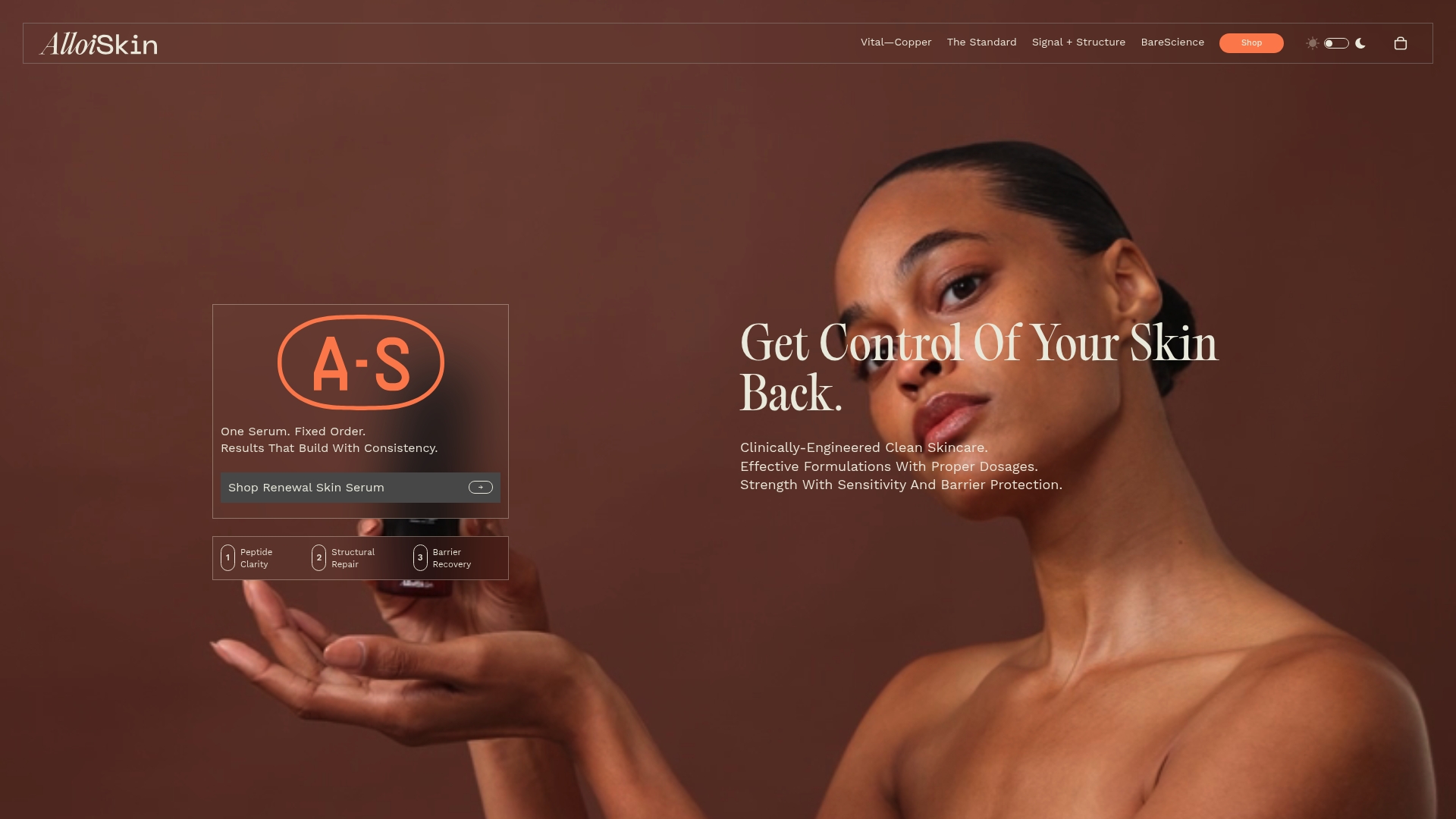
The VitalCopper Renewal Face Serum reflects that approach directly:
- Copper tripeptide-1 (GHK-Cu) and Matrixyl 3000, both dosed at levels used in the studies behind them.
- Panthenol and hyaluronic acid included to support barrier function, not to pad the label.
- Full formulation transparency on our method page, so you can see exactly why each ingredient is there.
This article is general information, not a substitute for advice from a qualified doctor. Consult a qualified healthcare professional about your own circumstances before acting on anything here.
Sources
- Parabens in cosmetics
- Parabens as urinary biomarkers of exposure in humans (NHANES analysis)
- Parabens: citizen summary and SCCS findings
- What You Should Know About Parabens
FAQ
Which is worse, parabens or sulfates?
They raise different concerns and are not directly comparable: parabens are preservatives with a debated but unproven hormonal signal, while sulfates are cleansing agents mainly linked to skin and eye irritation or dryness. Neither has been shown to cause serious harm at typical cosmetic concentrations, according to the FDA.
What parabens should be avoided?
Propylparaben and butylparaben carry more regulatory scrutiny than methylparaben or ethylparaben, since lab studies show stronger estrogenic activity as the carbon chain lengthens, per SCCS assessments. People in higher-risk categories, like pregnant individuals, may reasonably prioritize avoiding these longer-chain variants in leave-on products.
Why avoid parabens in shampoo?
Shampoo is a rinse-off product with brief skin contact, so avoiding parabens here matters less than in leave-on products like serums or lotions. Most people can prioritize leave-on formulas first if they want to reduce overall exposure.
Are parabens considered endocrine disruptors?
Lab and animal studies show some parabens, especially longer-chain types, bind weakly to estrogen receptors, but human evidence remains inconsistent and has not established a causal link to endocrine disruption at typical cosmetic use levels. The FDA currently states it has no data showing parabens as used in cosmetics affect human health.


