


There is no single federal definition of “clean beauty.” The FDA restricts only a short list of substances, so most of what gets excluded from clean beauty shelves comes from state law or individual retailer standards instead. If you’re shopping by ingredient safety, the classes worth watching most closely are PFAS, ortho-phthalates, select parabens, formaldehyde and its releasers, heavy metals, and certain banned dyes.
TL;DR:
- Washington’s core restrictions and California’s phased bans began January 1, 2025; Washington phases in 25 formaldehyde releasers by January 1, 2027, for intentionally added chemicals.
- Look for fluoro or perfluoro in ingredient names, but fragrance or parfum can conceal phthalates, so request disclosure when brands leave blends unspecified.
- A recent analysis found PFAS in 52% of tested personal care products; heavy metals and some dyes can enter as contaminants, making label checks harder.
- Compare full ingredient lists with state laws and retailer restrictions; standards range from dozens to thousands of substances, and restricted lists may allow trace impurities.
Table of Contents
- What the FDA actually regulates in cosmetics
- State laws are rewriting what’s legal to sell
- The ingredient classes behind most clean beauty exclusions
- Why retailer “clean” lists don’t agree with each other
- How to read a label and verify a banned-ingredient claim
- A minimal-ingredient approach to lowering banned-ingredient exposure
- How other countries handle these ingredient classes
- What gets left out when a formula avoids banned ingredients
- Chemicals regulators are watching next
- Our take: regulation protects you more than marketing does
- Where VitalCopper fits if you want clean and proven
- FAQ
- Sources
What the FDA actually regulates in cosmetics
Many shoppers assume the FDA approves cosmetic ingredients before they reach store shelves. It doesn’t, with one narrow exception. The FDA regulates cosmetics for safety and labeling but does not require premarket approval for most ingredients, except color additives, which do go through a formal approval process.
That doesn’t mean anything goes. The agency can still act against a product after the fact, and it prohibits a small, specific list of substances outright. Those federally banned ingredients include:
- Bithionol, an antimicrobial agent linked to skin sensitization.
- Mercury compounds, outside of trace limits in specific eye-area products.
- Vinyl chloride, once used as a propellant in aerosol products.
- Chlorofluorocarbon propellants, largely phased out for environmental reasons.
- Certain hazardous color additives not cleared for cosmetic use.
Beyond this short list, the FDA’s main enforcement tool is the concept of a cosmetic being “adulterated” or “misbranded.” A product is adulterated if it contains a harmful substance under ordinary use, and misbranded if its labeling is false or misleading. The agency can seize products or pursue action under these provisions, but this happens after a product reaches the market, not before.
This gap explains why most of the real restriction activity has moved to two other places: state legislatures and private retailer standards. Both move faster and go further than federal rulemaking, and both are where the term “clean” actually gets defined in practice.
State laws are rewriting what’s legal to sell
While federal rules stay narrow, a handful of states have passed laws that function as de facto national standards, since brands rarely formulate different products for different states.
Washington’s Toxic-Free Cosmetics Act restricts a wide list of intentionally added chemicals, including PFAS, ortho-phthalates, formaldehyde, and certain dyes. Key dates:
- Core restrictions took effect January 1, 2025.
- Formaldehyde releasers, a separate list of 25 specific chemicals, face a later phase-in by January 1, 2027.
- The law covers chemicals added intentionally, not trace contamination, and applies to products sold within the state regardless of where they’re manufactured.
California’s Health and Safety Code section 108980 runs on a similar track. The statute enumerates intentionally added chemicals, including certain phthalates, parabens, PFAS, and formaldehyde-related substances, with phased prohibition dates beginning January 1, 2025 and extending through later years for additional compounds.
Washington’s formaldehyde releaser list covers a specific list of named chemicals, phased in on a later timeline than the law’s other restricted classes, which is why a product can be compliant with one part of the TFCA and still be working toward compliance on another, according to state guidance.
Neither law works like a simple on/off switch. Both include sell-through provisions that let existing inventory clear before full enforcement, and both apply to online retailers shipping into the state, not just physical stores. For practical purposes, that means a national e-commerce brand has to meet the strictest state’s rules if it wants to sell everywhere, which is part of why these two laws have outsized influence on formulation decisions well beyond their borders.
The ingredient classes behind most clean beauty exclusions
Once you understand the legal backdrop, the ingredient classes themselves become easier to recognize on a label. Here’s what shows up most often on banned or restricted lists, and why:
- PFAS (per- and polyfluoroalkyl substances) turn up in long-wear foundations, waterproof mascara, and some lip products for their slip and water resistance. Look for ingredient names containing “fluoro” or “perfluoro,” since these compounds rarely announce themselves plainly.
- Ortho-phthalates often hide inside fragrance formulas as solvents and fixatives. The ingredient list may just say “fragrance” or “parfum,” which is exactly the loophole that makes phthalates hard to screen out by eye.
- Parabens, particularly butylparaben and propylparaben, are the varieties most frequently restricted by state law and retailer lists, more so than methylparaben or ethylparaben.
- Formaldehyde and formaldehyde releasers (names like DMDM hydantoin, quaternium-15, and diazolidinyl urea) appear mainly in hair-straightening treatments and nail products, where they act as preservatives or texture agents.
- Heavy metals and certain azo dyes show up as contamination in pigments and colorants rather than as deliberately added ingredients, which makes them harder to spot from a label alone.
A recent analysis found PFAS in 52% of tested personal-care products, a prevalence rate that helps explain why these chemicals show up so consistently on state and retailer restricted lists even when they aren’t listed on the label at all.
Peer-reviewed literature adds weight to why regulators target these specific classes. Reviews summarizing cosmetic ingredient research note that formaldehyde is classified as a carcinogen by the International Agency for Research on Cancer, and that certain preservatives and heavy metals carry documented endocrine disruption concerns, which is the scientific basis most state laws point back to.
Why retailer “clean” lists don’t agree with each other
Once you move past legal restrictions, you enter a much messier space: retailer standards. Each major beauty retailer maintains its own restricted-substance list, and these lists differ enormously in scope. Some restrict a few dozen chemicals; others restrict several thousand. Neither number is inherently better, but the mismatch means a product labeled “clean” at one retailer might not qualify under another’s criteria at all.
A few practical habits make these lists more useful:
- Check the exact ingredient name against the retailer’s published list rather than trusting a badge alone, since product pages sometimes misapply labels.
- Understand that most lists set threshold limits and allow trace impurities, so “restricted” rarely means zero tolerance.
- Favor brands that publish full ingredient lists with CAS numbers or link to lab test reports, since that level of detail is what makes a claim verifiable rather than just asserted.
Pro Tip: Cross-check a product against at least one retailer’s restricted list and the relevant state law before trusting a “clean” badge on its own; the two sources often disagree.
How to read a label and verify a banned-ingredient claim
Verifying a clean beauty claim takes a few minutes on the product page, and the process doesn’t require a chemistry background.
- Pull up the full INCI ingredient list and scan for substrings like “fluoro,” “phthalate,” or “paraben,” which flag entire chemical families rather than single compounds.
- Treat “fragrance” or “parfum” as a potential hiding place. These umbrella terms can legally contain dozens of unlisted compounds, including phthalates, so when a brand won’t disclose what’s inside its fragrance blend, that itself is useful information.
- Cross-reference against a retailer’s restricted list and your state’s law, and when something is ambiguous, ask the brand directly for a certificate of analysis or lab report rather than relying on marketing copy.
- Prioritize brands that publish complete INCI lists with CAS numbers or third-party test documentation, since that’s the difference between a claim you can check and one you simply have to trust.
A minimal-ingredient approach to lowering banned-ingredient exposure
Our formulations are built around a simple idea: every ingredient on the list should be doing a specific job, and nothing goes in just to pad the label. That approach has a direct side effect on banned-ingredient risk. The fewer total ingredients a formula contains, the fewer places a hidden phthalate, filler preservative, or undisclosed fragrance component has to hide.
Our ingredient transparency page lists every component in each formula by name, so you can check it against any state law or retailer restricted list without guessing what’s behind a catch-all term like “fragrance.” That’s the same verification habit we outlined above, just applied to our own products as an example of what a transparent label looks like in practice.
- Full ingredient lists are published rather than relying on “clean” badges alone.
- Our formulas use clinically studied actives at the concentrations tested in research, not trace amounts added for a marketing claim, a principle we lay out on the standard we build to.
- Fewer ingredients means fewer unknowns, which is the same logic covered in our piece on why fewer ingredients build better skin.
How other countries handle these ingredient classes
The United States isn’t alone in restricting PFAS, phthalates, and formaldehyde releasers, and international rules often set a stricter baseline than American federal law, even if they don’t always match state-by-state American restrictions exactly.
The European Union’s cosmetics framework has long prohibited a much longer list of substances than the FDA’s short federal list, including broader restrictions on formaldehyde-releasing preservatives and several phthalates banned outright rather than merely restricted by concentration. Canada maintains its own “Cosmetic Ingredient Hotlist,” a non-regulatory but closely followed list that flags ingredients regulators consider may violate its Food and Drugs Act, covering many of the same classes, PFAS, certain dyes, and formaldehyde, that appear in the American state laws discussed above.
The pattern across these frameworks is consistent even when the specific chemical lists differ: formaldehyde, certain phthalates, and PFAS show up as priority concerns almost everywhere ingredient safety gets legislated, which is part of why these three classes anchor most clean beauty standards regardless of which country or retailer wrote them. For a shopper, the practical takeaway doesn’t change much by geography: the same label-reading habits, checking INCI names, watching for fragrance as a catch-all, and favoring published ingredient transparency, apply whether you’re buying from a brand based in the United States or elsewhere.
What gets left out when a formula avoids banned ingredients
Removing a restricted ingredient class is rarely as simple as deleting a line from a formula. Many banned substances were doing real work: phthalates helped fragrance last longer on skin, certain parabens offered broad-spectrum preservation at low cost, and some formaldehyde releasers provided texture and shelf stability in hair and nail products.
Reformulating around these constraints usually means one of two things: finding a functional substitute, which can raise cost or change texture, or simplifying the formula so the missing ingredient’s job becomes unnecessary. A fragrance-free or low-fragrance product, for example, sidesteps the phthalate-in-fragrance problem entirely rather than hunting for a phthalate-free fragrance substitute.

This is part of why we lean toward formulas built around a small number of proven actives at studied concentrations, an approach covered in more detail in our breakdown of why typical skincare routines underdeliver, rather than toward complex, multi-ingredient formulas that need more preservative and stabilizer support to begin with. Fewer supporting ingredients means fewer places where a banned or soon-to-be-restricted substance can quietly sit in a formula that still works. It also means fewer trade-offs to manage when a new restriction takes effect, since there’s less in the formula that depends on the restricted class in the first place.
Chemicals regulators are watching next
Lawmakers and retailers rarely stop adding to restricted lists once the first wave of bans takes effect. A few categories are already drawing scrutiny beyond the classes covered above.
Short-chain PFAS variants, developed partly as substitutes for the long-chain compounds already restricted, are under review in several state proposals since early research suggests similar persistence concerns. Certain UV filters used in sunscreen and some color cosmetics face growing attention over environmental persistence and potential hormone activity, an area regulators in multiple countries are actively studying. Microplastic ingredients, including some exfoliating beads and film-forming polymers, are drawing proposed restrictions tied to environmental rather than direct health concerns, following a pattern similar to how PFAS moved from obscure to banned.
None of these are settled the way formaldehyde or ortho-phthalates are today, and a cautious shopper should treat “proposed” or “under review” differently from “restricted by law.” The practical lesson is that the list of concerning ingredient classes tends to grow over time rather than shrink, which is another argument for favoring brands that build formulas around fewer, well-studied ingredients rather than chasing every new trend compound as it appears.
Our take: regulation protects you more than marketing does
The most reliable protection against banned ingredients isn’t a shelf badge. It’s a law with an enforcement date, or a brand that publishes its full ingredient list with enough detail to check yourself. Marketing claims fill the space where regulation hasn’t caught up yet, and that space is where greenwashing lives.
At the point of purchase, three checks matter more than any label: whether the product violates a known legal restriction, whether the INCI list matches what the brand claims, and whether the active ingredients are dosed at levels supported by actual research rather than listed in trace amounts for show. Scrutinize transparency pages and lab reports before marketing copy. Laws like Washington’s TFCA and California’s HSC 108980, paired with brands willing to show their full formula, remain the two most dependable signals you have.
— Alloi Skin
Where VitalCopper fits if you want clean and proven
We built the VitalCopper Renewal Face Serum around the same minimal-ingredient logic covered throughout this piece: a short list of purposeful actives, each dosed at the concentration studied in research, rather than a long list of ingredients added mostly for the label. The formula centers on copper tripeptide-1 (GHK-Cu) and Matrixyl 3000, paired with panthenol, betaine, and hyaluronic acid to support the skin barrier while those peptides work.
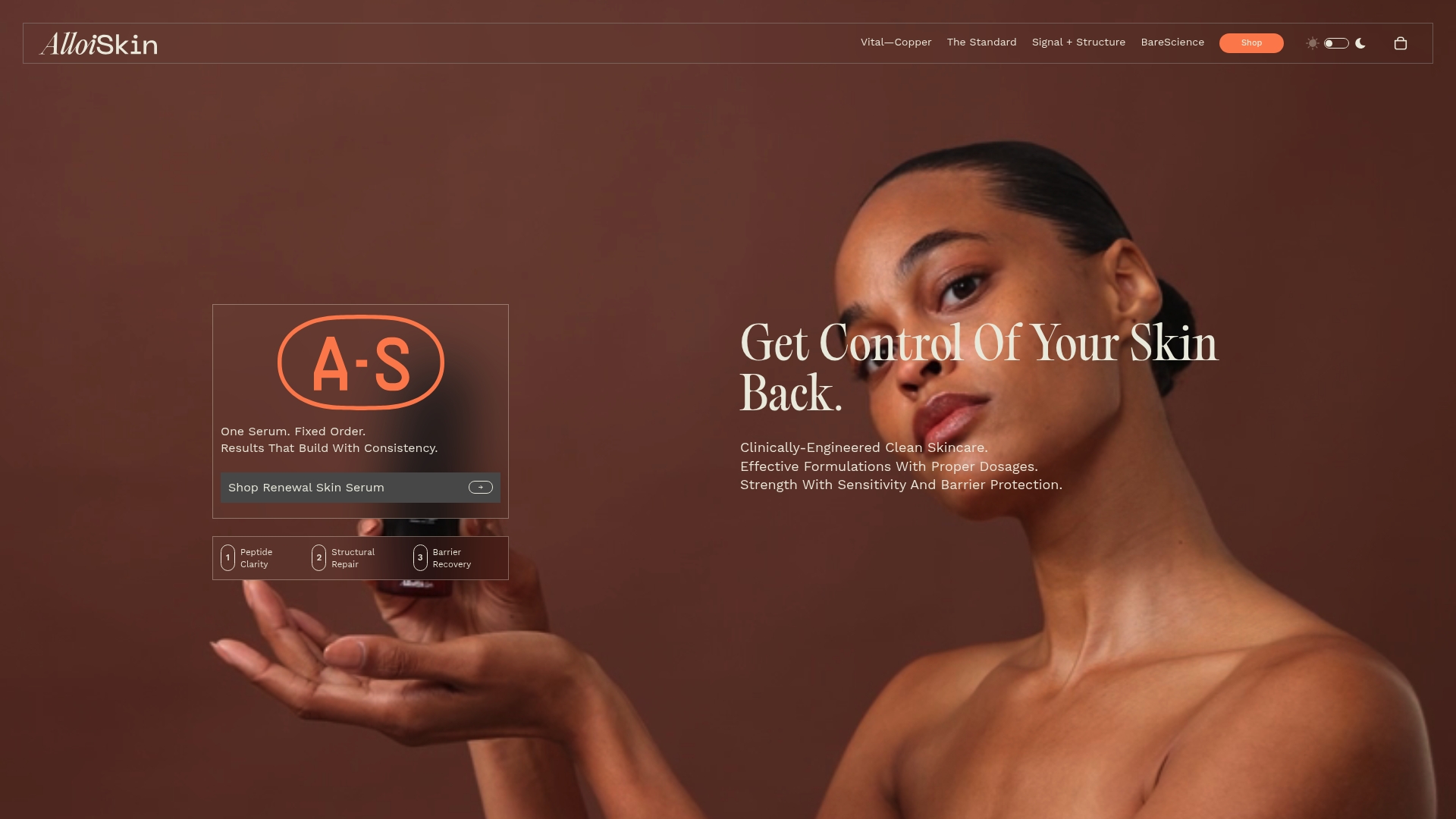
That approach has a practical upside beyond performance. A shorter formula means fewer places for a restricted fragrance component, filler preservative, or undisclosed compound to hide, and it means you can actually check our full list against any state law or retailer standard in a few minutes.
- Core actives: copper tripeptide-1 (GHK-Cu) and Matrixyl 3000, both studied peptides, documented on our ingredient pages.
- Supporting ingredients: panthenol, betaine, and hyaluronic acid, chosen to protect the skin barrier rather than pad the label.
- Full formula transparency published on our ingredients page, so you can verify it yourself against any restricted-substance list.
| What you’re checking | Where to look |
|---|---|
| Full ingredient list | Alloi |
| Formulation rationale and dosing | Alloi |
| Product details and purchase | Alloi |
Pro Tip: Before buying any serum marketed as clean, pull up its full ingredient list the same way you’d check ours, and see if the brand makes that just as easy.
If you want a serum built on that principle rather than asked to take it on faith, the VitalCopper product page has the full formula, the dosing rationale, and what to expect over time.
FAQ
What is the cleanest, most non-toxic makeup brand?
There’s no single verified “cleanest” brand, since no federal agency certifies products this way and retailer standards vary widely in scope. The most reliable approach is checking a brand’s published ingredient list against your state’s restricted-substance law, such as Washington’s TFCA, rather than trusting a marketing label alone.
What are the top ingredients to avoid in skincare products?
The classes with the most consistent legal and retailer restrictions are PFAS, ortho-phthalates, certain parabens (especially butylparaben and propylparaben), formaldehyde and formaldehyde releasers, and some heavy metals or azo dyes found as contaminants in colorants. These appear repeatedly across state laws and major retailer restricted lists for documented safety concerns, as summarized by peer-reviewed cosmetic ingredient research.
Is clean beauty greenwashing?
It can be, since “clean” has no legal definition and retailers set their own standards, which vary enormously in what they actually restrict. The gap between marketing language and enforceable restriction is real, which is why checking a product against an actual state law or a detailed restricted-substance list matters more than trusting a shelf badge.
What did the Sephora “Clean at Sephora” lawsuit rule on?
Litigation around retailer clean beauty labeling has centered on whether badges like “Clean at Sephora” mislead shoppers about ingredient safety, since the standard is set by the retailer rather than any government body. Outcomes in this type of case tend to turn on specific label language rather than banning the practice of using in-house clean standards altogether, so the underlying lesson stands: a retailer badge reflects that retailer’s own criteria, not a government certification.
Sources
- FDA — FDA authority over cosmetics: How cosmetics are not FDA-approved, but are FDA-regulated
- Washington Department of Ecology — Toxic-Free Cosmetics Act (TFCA)
- California Code — HSC 108980
- News-Medical — Study: Nearly all personal care and cleaning products contain undisclosed chemicals (press summary)
- PMC — Review article on toxic chemicals in cosmetics


