


A two-step skincare routine means cleansing, then applying one purposeful follow-up product, whether that’s a moisturizer, a moisturizer with SPF, or a treatment serum. Sunscreen still counts as a non-negotiable daily habit, even when you’re treating it as a separate step rather than one of your official two. Stick with this pairing consistently and you should see visible improvement in your skin’s texture and tone within a month or more.
TL;DR:
- Using a gentle, pH-balanced cleanser suited to your skin type prevents barrier disruption and supports long-term skin health.
- Choose your second product based on your main skin goal, whether hydration, clarity, or repair, rather than layering multiple active ingredients.
- Refrain from reapplying moisturizer or serum more often than every two hours outdoors, and always reapply SPF when exposed to sunlight for lasting sun protection.
- Patience is essential: expect four to six weeks for general improvements and three to six months for significant changes in hyperpigmentation or deep lines.
- Simplifying your routine to two well-chosen products enhances adherence and ensures consistent progress toward healthier skin.
Table of Contents
- What Does a Two-Step Skincare Routine Actually Look Like?
- How Do You Choose the Right Cleanser?
- Which Second Product Delivers the Most Benefit?
- How Long Until You See Results?
- Why Clinically Dosed, Minimal Formulas Make the Two-Step Model Work
- Recommendations for Morning vs. Evening Two-Step Routines
- How to Adjust a Two-Step Routine for Different Skin Types
- How to Introduce New Products Without Irritating Your Skin
- Ingredient Awareness: What to Actually Read on the Label
- Common Mistakes That Undermine a Two-Step Routine
- Why Fewer Products Beat More Discipline
- Where VitalCopper Fits as Your Second Step
- Sources
- FAQ
What Does a Two-Step Skincare Routine Actually Look Like?
Most people who try to simplify their routine get stuck at the same fork: which second product actually earns its spot? The answer depends entirely on what your skin needs most right now, not on what’s trending.
Variant A: Cleanser + Moisturizer. This is the safest starting point for dry, sensitive, or reactive skin. It rebuilds the barrier without introducing active ingredients that could cause irritation.
Variant B: Cleanser + Treatment Serum. Best for people with a specific concern (dullness, fine lines, uneven texture) who already have their hydration under control, either through the serum itself or a heavier moisturizer applied separately at night.
Variant C: Cleanser + Moisturizer-with-SPF. The morning shortcut for people who want speed without skipping sun protection. The trade-off is that multifunctional SPF moisturizers often deliver less hydration and less sun protection than using two dedicated products, and you still need to reapply sunscreen if you’re outside for long stretches.
The decision flow is simple: pick your single biggest skin goal first (hydration, clarity, repair, or anti-aging), then choose the variant that addresses it directly instead of layering products to cover every possible concern at once.
How Do You Choose the Right Cleanser?
A cleanser that strips your skin does more damage than a routine that skips a step entirely. The priority is a gentle, pH-balanced formula that removes oil, sweat, and makeup without disrupting the barrier, and Geisinger’s dermatology guidance confirms this is the cornerstone of any beginner routine, minimal or not.
- Check the texture against your skin type. Gel and foaming cleansers suit oily or acne-prone skin because they cut through excess sebum. Cream and lotion cleansers suit dry or sensitive skin because they clean without stripping lipids.
- Skip anything that leaves your skin tight or squeaky. That sensation means the surfactants are too aggressive for daily use, and you’re better off switching before your barrier pays the price.
- Consider a morning water rinse. If your skin looks balanced when you wake up, a splash of water is sometimes enough, saving the actual cleanser for evening when it’s clearing the day’s buildup.
- Double-cleanse only when needed. Heavy makeup, sunscreen, or SPF that’s water-resistant benefits from an oil-based first cleanse followed by your regular one. Otherwise, one pass is enough.
Pro Tip: Keep a travel-size version of your cleanser in your gym bag or desk drawer. The biggest threat to a two-step routine isn’t the wrong product, it’s simply forgetting to do it when you’re away from your bathroom counter.
Which Second Product Delivers the Most Benefit?
Once your cleanser is locked in, the second product decision comes down to matching ingredients to your actual goal, not to whatever has the longest ingredient list.
- Choose a moisturizer when hydration and barrier support are the priority. Look for a mix of humectants (hyaluronic acid, glycerin) to pull in water, emollients (fatty acids, ceramides) to smooth and repair, and occlusives (petrolatum, dimethicone) to lock everything in.
- Choose a multifunctional moisturizer-with-SPF for mornings when speed matters more than maximum hydration. Its limitation is reapplication. The American Academy of Dermatology recommends reapplying broad-spectrum SPF 30 or higher every two hours outdoors, and few people reapply a full-face moisturizer that often.
- Choose a treatment serum when your primary goal is clarity, repair, or visible aging. Peptides, retinoids, and vitamin C each target different concerns, and introducing one at a time lets you track what’s actually working.
Layering order matters regardless of which path you pick: apply thinnest textures first, thickest last. Retinoids work best at night because they can increase sun sensitivity, vitamin C performs well in the morning as an antioxidant layer, and sunscreen always goes last, on top of everything else. Sun exposure is responsible for roughly 90% of visible skin aging, which is the single biggest reason that last step can’t be optional, no matter how minimal the rest of your routine gets.
How Long Until You See Results?
Patience is the part of a two-step routine most people underestimate. Harvard Health’s dermatology guidance puts the baseline timeline at 4 to 6 weeks for general improvements in texture and tone. Larger concerns like hyperpigmentation or deep-set fine lines take longer, typically 3 to 6 months of consistent use before you see a meaningful shift.
A few rules keep that timeline honest:
- If irritation shows up (redness, stinging, flaking) after adding something new, stop and give your skin a break before reintroducing anything.
- If there’s no progress after 6 to 8 weeks and irritation isn’t the issue, that’s the point to talk to a dermatologist rather than keep guessing.
- Add only one new product at a time, and give it a full 4 to 6 weeks before judging whether it’s working, a pattern confirmed by Ulta Beauty’s beginner routine guidance.
- Sunscreen reapplication isn’t optional at any stage of the timeline: SPF 30 or higher, broad-spectrum, reapplied every two hours if you’re outdoors.
Rushing past this window is the most common reason people believe a product “doesn’t work” when it simply never got the time it needed.
Why Clinically Dosed, Minimal Formulas Make the Two-Step Model Work
Some skincare brands believe routines fail because products are formulated with too many ingredients at doses too low to do anything measurable. A two-step routine only works long term if the second product is actually engineered to earn its place.
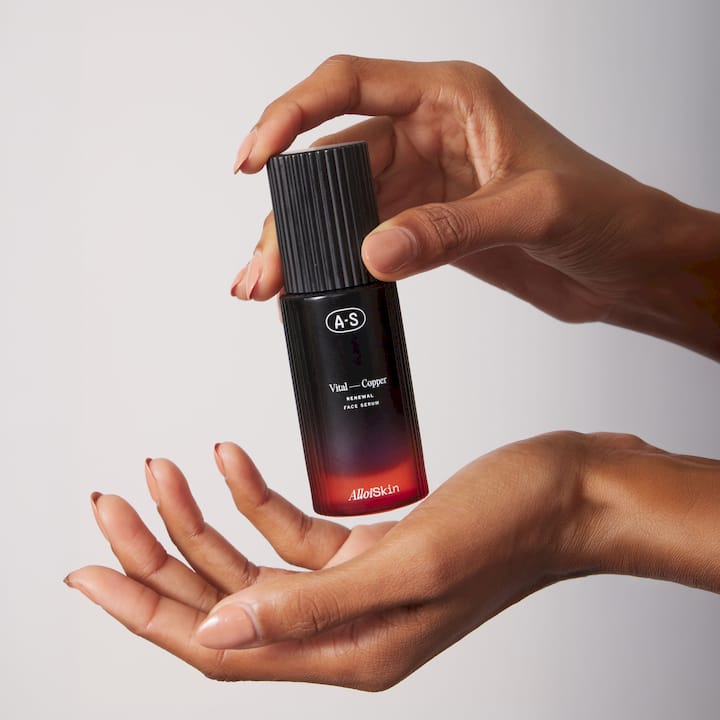
One such approach uses a serum that pairs copper peptides and Matrixyl 3000 with panthenol, betaine, and hyaluronic acid, aiming at barrier repair and visible clarity within 4 to 6 weeks.
For readers building a two-step routine around barrier recovery, a peptide-rich serum like this can function as both your treatment and your hydration layer:
- Apply it directly after cleansing, while skin is still slightly damp.
- Follow with sunscreen in the morning, as the final step, never skipped.
- At night, it can stand alone as your only follow-up product if your skin doesn’t need additional occlusive moisturizer.
Recommendations for Morning vs. Evening Two-Step Routines
Morning and evening routines serve different jobs, even when both stick to two steps. In the morning, your priority is protection: a gentle cleanse (or a water rinse if your skin looks balanced) followed by a product that either includes SPF or is immediately followed by a separate sunscreen application. Speed matters here because most people are getting ready for the day, so a multifunctional moisturizer-with-SPF often makes more sense in the morning than at night.
Evening is where repair happens. Skin cell turnover and repair processes are more active overnight, which is why treatment serums (peptides, retinoids, vitamin C alternatives like alpha-arbutin) tend to work better as the evening’s second step. Cleansing at night also matters more than in the morning, since it’s clearing away sunscreen, pollution, and the day’s oil buildup before anything else gets applied.
If you’re only willing to commit to two steps total across the entire day, morning and evening should still look slightly different: a lighter touch in the morning focused on protection, a slightly richer or more targeted approach at night focused on recovery. Trying to use the identical product twice a day works for basic moisturizers, but it under-delivers if your evening goal is genuinely different from your morning one, like treating fine lines versus simply protecting skin from UV exposure.
Consistency between the two matters more than complexity in either one. A simple morning-evening split, repeated daily, outperforms an elaborate routine followed sporadically.
How to Adjust a Two-Step Routine for Different Skin Types
Skin type changes which second product does the most good, even though the two-step structure stays the same across the board.
Oily and acne-prone skin benefits from a gel or foaming cleanser paired with a lightweight, non-comedogenic moisturizer or a clarity-focused serum. Skipping moisturizer entirely because skin feels oily is a common mistake. Under-hydrated skin often overproduces oil to compensate, which can make breakouts worse, not better.
Dry skin does best with a cream or lotion cleanser and a moisturizer built around ceramides and occlusives to seal in water. If a treatment serum is the second step instead, a separate nighttime moisturizer may need to return to the routine, technically making it a three-step approach on the nights dryness peaks.
Sensitive skin calls for the mildest cleanser available and a barrier-focused second product with minimal fragrance and a short ingredient list. Products built around panthenol, betaine, and hyaluronic acid tend to soothe rather than provoke a reaction, which matters more here than chasing an aggressive active ingredient.
Combination skin often does fine with a single gentle cleanser and a balanced moisturizer that hydrates without overwhelming oilier zones like the forehead and nose. If breakouts concentrate in one area, a targeted spot treatment can supplement the routine without turning it into a full multi-step regimen.
How to Introduce New Products Without Irritating Your Skin
Adding a new product to an established two-step routine is where most irritation actually starts, not from the routine itself. The safest approach is a patch test: apply a small amount to your inner forearm or behind your ear for 2 to 3 days before putting it anywhere near your face.
Once a product passes that test, introduce it alone, without swapping out anything else in the same week. If you change your cleanser and your serum simultaneously and a reaction shows up, you have no way to know which product caused it. Give each new addition 4 to 6 weeks of consistent use before deciding whether it’s working, the same window recommended for judging overall routine results.
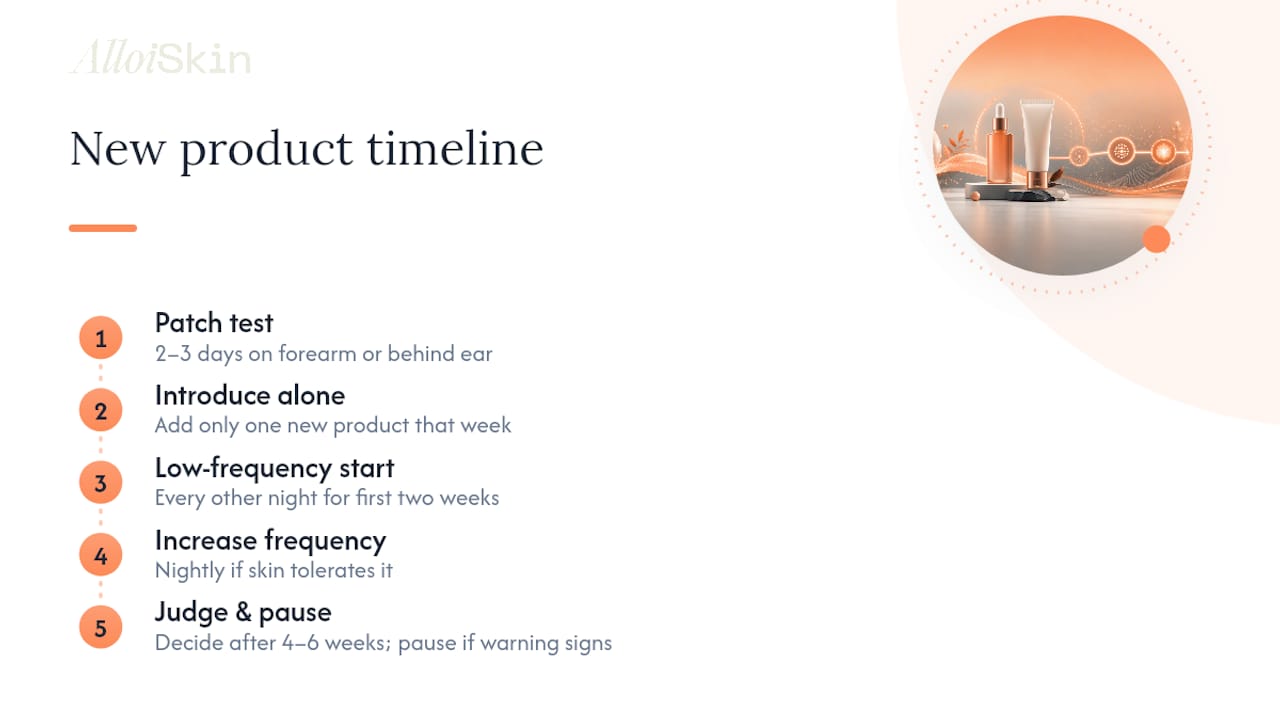
Start with a lower frequency than the label suggests, especially for actives like retinoids or high-percentage vitamin C. Every other night for the first two weeks, then nightly if skin tolerates it well, is a common approach that reduces the odds of redness or peeling.
Watch for early warning signs: persistent redness, stinging that doesn’t fade within a few minutes, or flaking that wasn’t there before. Any of those means it’s time to pause the new product, not push through it hoping your skin adjusts.
Ingredient Awareness: What to Actually Read on the Label
Most ingredient lists are longer than they need to be, and knowing what to scan for saves you from buying products that promise everything and deliver very little of it.
Look for the active ingredient’s position on the list. Ingredients are listed by concentration, so if a peptide or vitamin C is buried near the bottom, it’s likely present at a dose too low to do much. This is the exact problem Alloi Skin’s formulation philosophy is built to avoid, favoring fewer ingredients at doses that match published research over long lists designed to look impressive on packaging.
Certain ingredient pairings genuinely conflict and shouldn’t be layered together. Retinoids and high-percentage exfoliating acids (like glycolic or salicylic acid) can compound irritation when used at the same time, which is why most dermatologists recommend alternating them on different nights rather than stacking them. Benzoyl peroxide can also destabilize certain forms of vitamin C, reducing its effectiveness if applied in the same layer.
A barrier-supporting essence, like BYOMA’s Barrier Boost formula, is a useful example of a product built around a short list of functional humectants rather than a long roster of trending actives, the same logic worth applying to your own label-reading habit.
Common Mistakes That Undermine a Two-Step Routine
The biggest mistake isn’t picking the wrong products, it’s treating sunscreen as optional because the routine already feels complete after cleansing and moisturizing. Sunscreen isn’t a bonus step. It’s the one most responsible for preventing the visible aging a moisturizer alone can’t undo.
Layering order is the second common error. Applying a thick moisturizer before a thinner serum blocks the serum from absorbing properly, wasting whatever active ingredient you paid for. Thin-to-thick, every time.
Switching products too frequently is a quieter mistake with the same result: never seeing whether anything actually worked. Give each combination its full 4 to 6 weeks before deciding to change course, because judging a serum after five days tells you nothing about its real effect.
Finally, watch for the impulse to add a third or fourth product the moment progress feels slow. One additional item, tested alone and given time, beats three added simultaneously in a moment of frustration. That approach almost always makes it harder to tell what’s actually helping your skin.
Why Fewer Products Beat More Discipline
Simplicity isn’t a compromise. It’s the reason a routine actually gets followed. A Guardian piece on minimal skincare makes the point well: the 10-step routine was never a clinical standard, it was a marketing idea that outpaced what most people can realistically sustain.
Pick one primary goal before you simplify anything. Trying to fix hydration, clarity, and fine lines all at once with two products is how people end up disappointed in a routine that was never built to do five jobs.
A few habits make consistency easier: keep both products visible on your counter rather than in a drawer, and set a phone reminder for sunscreen reapplication if you’re outdoors past the two hour mark. The routine that survives a busy Tuesday morning is the one that actually changes your skin, not the one that looked best on a shelf.
— Alloi Skin
Where VitalCopper Fits as Your Second Step
If barrier repair and visible clarity are your primary goal, the VitalCopper Renewal Face Serum is built to serve as that second product without asking you to add anything else to your counter.
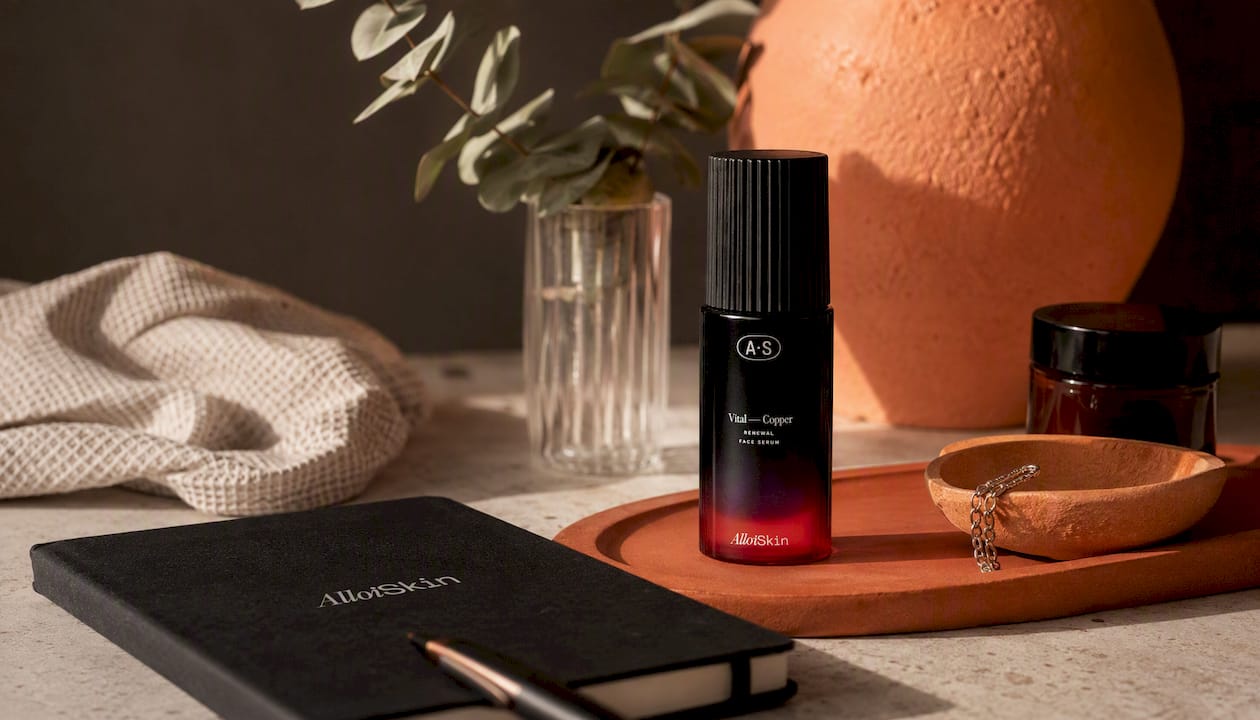
The formula centers on copper tripeptide-1 (GHK-Cu) and Matrixyl 3000 at doses that match published research, supported by panthenol, betaine, and hyaluronic acid to soothe skin while the peptides work. Apply it directly after cleansing, morning or night, while skin is still slightly damp so the hyaluronic acid has moisture to hold onto. In the morning, follow it with sunscreen as your final step. At night, it can stand alone if your skin doesn’t need an additional occlusive layer on top.
Unlike serums packed with a long list of trending actives at doses too low to register, VitalCopper keeps the formula focused: fewer ingredients, studied concentrations, and a role that’s easy to explain in one sentence. That’s the entire point of a two-step routine, and it’s why this serum was built to fit inside one rather than compete with it.
Sources
- How to build a skincare routine for beginners | Geisinger
- Skin Care Routine for Beginners | Ulta Beauty
FAQ
Which Two Serums Should You Never Layer Together?
Retinoids and high-percentage exfoliating acids (glycolic or salicylic) shouldn’t be applied in the same routine, since combining them significantly raises the risk of irritation and peeling. Alternate them on different nights instead.
What Is the 4-2-4 Rule in Skincare?
Definitions of this rule vary across sources and it isn’t a standard dermatological framework, so treat any specific version you encounter with caution rather than as clinical guidance.
What Does a 3-Step Skincare Routine Look Like?
A common version adds a moisturizer between cleansing and sunscreen: cleanse, moisturize, then apply SPF in the morning, which is essentially a two-step routine with sunscreen counted as its own dedicated step.
What Skincare Step Should You Never Skip?
Sunscreen. It’s responsible for preventing the majority of visible skin aging caused by sun exposure, and no cleanser or serum can undo that damage after the fact.
Can a Serum Like VitalCopper Replace a Moisturizer in a Two-Step Routine?
For many skin types, yes. VitalCopper’s peptide blend is paired with hyaluronic acid and panthenol specifically so it can function as both the treatment and hydration layer, though very dry skin may still benefit from a separate moisturizer at night.


