


In topical skincare, signal peptides are small lipid-conjugated peptides, like the Matrixyl family, that tell fibroblasts to build new collagen, while carrier peptides such as copper tripeptide-1 (GHK-Cu) deliver copper that enzymes need to crosslink and repair tissue. Together they cover two different jobs: instructing skin cells to rebuild, and equipping that rebuild with the mineral cofactor it requires. Knowing which one you’re looking at changes how you read an ingredient list.
TL;DR:
- Signal peptides like Matrixyl stimulate collagen production by mimicking extracellular matrix fragments, primarily targeting fine lines and early aging signs.
- Copper peptides such as GHK-Cu deliver copper to enzymes that crosslink and reinforce new collagen fibers, enhancing tissue resilience.
- Effective peptide formulations require lipidation for skin penetration and stable packaging to prevent degradation from light and air exposure.
- Consistent use over four to six weeks is necessary to observe visible improvements, with results typically being more modest than retinoids.
- Combining copper peptides with vitamin C should be avoided in the same routine, as they can destabilize each other and reduce efficacy.
Table of Contents
- What Are Signal Peptides and How Do They Differ From Carrier Peptides?
- Which Peptides Matter Most: Matrixyl and Copper Tripeptide-1
- How Do Signal Peptides Work, and What Does the Evidence Show?
- Why Formulation and Delivery Determine Whether Peptides Actually Work
- How Should You Layer Signal Peptides Into a Skincare Routine?
- How Do You Evaluate a Peptide Product Before Buying?
- Alloi Skin’s Formulation Perspective
- Where VitalCopper Fits Into This
- Sources
- FAQ
What Are Signal Peptides and How Do They Differ From Carrier Peptides?
Signal peptides work on a principle called the matrikine effect. A matrikine is a small fragment of extracellular matrix protein, collagen or elastin broken down by normal turnover, that your skin reads as a distress signal. Fibroblasts encounter these fragments and respond as though damage occurred, ramping up production of new collagen and elastin to compensate. Matrixyl-class peptides are synthetic mimics of these fragments. They don’t repair anything directly; they trick fibroblasts into thinking repair is needed, which triggers the real work.
Carrier peptides operate on a completely different mechanism. GHK-Cu doesn’t mimic a damage signal. It binds copper and escorts it into skin cells, where copper acts as a cofactor for enzymes like lysyl oxidase, which crosslinks collagen fibers into strong, organized structures, and superoxide dismutase, which neutralizes oxidative stress.
That distinction has real consequences for how you build a routine:
- Signal peptides increase the raw material your skin produces.
- Carrier peptides help that material become structurally sound and resist breakdown.
- Using only one class means you’re solving half the problem.
- Products that pair both categories are targeting synthesis and reinforcement at once.
Which Peptides Matter Most: Matrixyl and Copper Tripeptide-1
Two names dominate the legitimate peptide conversation, and everything else is largely variation on these themes.
Matrixyl refers to palmitoyl pentapeptide-4, commercially known as pal-KTTKS, the original signal peptide with the most direct human trial data behind it. Matrixyl 3000 is a two-peptide blend, palmitoyl tripeptide-1 and palmitoyl tetrapeptide-7, marketed as a broader matrikine complex that stimulates production of multiple ECM components rather than collagen alone, according to Matrixyl 3000’s manufacturer summary.
GHK-Cu, or copper tripeptide-1, has one of the longer track records in wound-healing research, originally isolated from human plasma and studied for decades in tissue regeneration contexts, per a review of GHK and GHK-Cu’s regenerative properties.
Pro Tip: Check where a peptide sits in the INCI list, not just whether it’s present. A peptide named fifth or sixth among a short ingredient list carries far more weight than the same peptide buried after twenty fillers.
A few practical notes on what these ingredients actually do:
- Matrixyl targets fine lines and early collagen depletion.
- Matrixyl 3000 broadens that action to elastin and glycosaminoglycans.
- GHK-Cu supports tissue remodeling, improving how organized new collagen becomes rather than just how much exists.
How Do Signal Peptides Work, and What Does the Evidence Show?
Mechanistically, Matrixyl-class peptides trigger fibroblast signaling cascades, including TGF-beta pathway activation, that push cells toward increased collagen synthesis. GHK-Cu works downstream of that process. Once collagen fibers exist, copper delivered by GHK-Cu fuels lysyl oxidase, the enzyme responsible for crosslinking those fibers into tensile, resilient structures. Without adequate copper, new collagen can end up loosely organized and less durable.
The evidence quality differs sharply between the two. Pal-KTTKS has actual human trial data: a 12-week double-blind, split-face randomized controlled trial with 93 participants showed statistically significant reductions in fine lines and wrinkle depth compared to a vehicle control, according to a summary of peptide clinical evidence. GHK-Cu’s strongest evidence is mechanistic rather than clinical. It modulates gene expression at low nanomole concentrations, a compelling signal at the molecular level, but standardized split-face RCTs specific to topical GHK-Cu are less common in the public literature.
Reviews synthesizing this evidence generally describe topical peptides as producing modest but measurable improvement, often in the range of 12 to 20 percent in short trials, meaningfully less dramatic than retinoids or in-office procedures but achievable without the irritation or downtime those interventions bring.
Set your expectations accordingly. Peptides are a maintenance and prevention strategy, not a substitute for stronger interventions when you need dramatic change fast.
Why Formulation and Delivery Determine Whether Peptides Actually Work
A peptide’s structure on paper means nothing if it never reaches living skin cells. This is where palmitoylation, the process of attaching a fatty acid chain to a peptide, becomes the detail that separates a functional product from an expensive placebo.
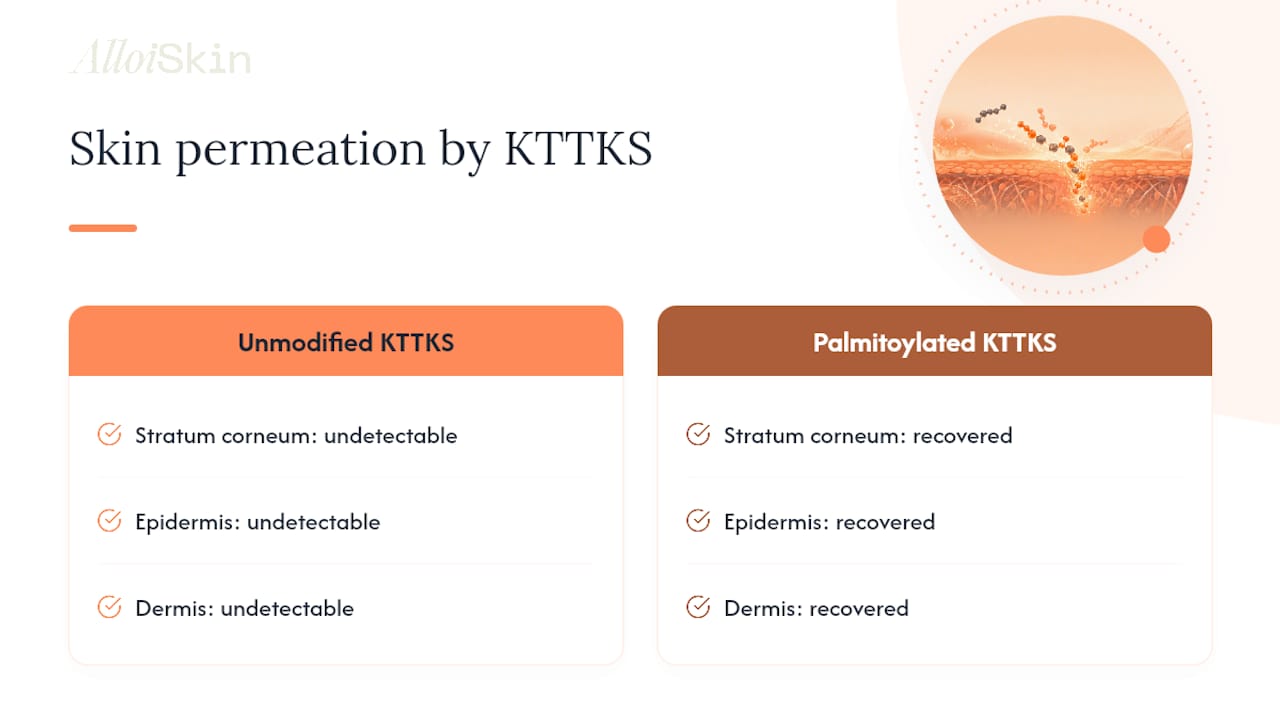
Unmodified KTTKS peptide, without the palmitoyl group, was undetectable in skin layers during in vitro permeation testing. The palmitoylated version, by contrast, was recovered across the stratum corneum, epidermis, and dermis, according to permeation data on peptide lipidation. That fatty acid tail raises the peptide’s lipophilicity enough to cross the skin barrier, a finding echoed in formulation research on peptide lipidation and permeability. This is exactly why Matrixyl is sold in lipid-conjugated form commercially rather than as a bare peptide sequence.
GHK-Cu carries its own stability challenge: it can react badly with L-ascorbic acid and some acidic formulas, potentially releasing free copper ions and creating pro-oxidative conditions instead of the antioxidant benefit you’re after.
Pro Tip: Look for airless pump packaging and opaque containers on copper peptide serums. Both light and repeated air exposure degrade peptide stability, and a jar that lets you scoop product with your fingers accelerates that breakdown every time you open it.
Formulators manage the copper-vitamin C conflict through careful pH control or by keeping the two actives in physically separate products rather than a single bottle.
How Should You Layer Signal Peptides Into a Skincare Routine?
Peptides belong at the serum step, applied to clean, slightly damp skin before heavier creams or oils seal everything in. Either morning or evening works, though many people prefer peptides at night, when skin’s repair processes are naturally more active.
- Cleanse and apply any water-based toner first.
- Apply your peptide serum, whether signal, carrier, or a combined formula, and let it absorb for a minute or two.
- Follow with moisturizer or an occlusive if your skin runs dry.
- If you use vitamin C, don’t apply it in the same session as a copper peptide serum. Use one in the morning and the other at night, or alternate them by day.
- If you’re adding a retinoid, introduce it gradually on separate nights at first. Our guide on layering copper peptides with retinol walks through a tolerance-building schedule that avoids the redness and flaking that come from stacking active ingredients too fast.
Give any new peptide routine at least four to six weeks before judging results. Fibroblast signaling and collagen remodeling are slow biological processes, not overnight fixes.
How Do You Evaluate a Peptide Product Before Buying?
Reading an ingredient label critically is the single most useful skill in this category, because marketing language and actual formulation rarely match up.
Run through this checklist before buying:
- The specific peptide name appears, Matrixyl 3000, palmitoyl pentapeptide-4, or copper tripeptide-1, rather than a vague “peptide complex” with no disclosed components.
- The peptide sits within the first half of the ingredient list, not buried near the end after a dozen fillers.
- The packaging is opaque and ideally airless, protecting light- and air-sensitive actives like GHK-Cu.
- If both copper peptides and vitamin C appear, the brand explains how it manages that formulation conflict.
| What to check | Good sign | Red flag |
|---|---|---|
| Ingredient naming | Named peptide (e.g., palmitoyl tripeptide-1) | “Peptide complex” with no specifics |
| List position | Within top half of INCI | Listed near the very end |
| Packaging | Opaque, airless pump | Clear jar, wide mouth |
| Active pairing | Separated or pH-managed vitamin C and copper peptide | Both combined with no explanation |
Alloi Skin’s Formulation Perspective
We built VitalCopper around a simple frustration: most peptide serums list a dozen actives at doses too low to matter. Our approach is the opposite. GHK-Cu and Matrixyl 3000 at studied concentrations, paired only with panthenol, betaine, and hyaluronic acid to support the barrier while the peptides work. This article’s job, understanding what signal and carrier peptides actually do, is precisely the job VitalCopper is formulated to solve: collagen synthesis paired with the copper delivery that makes new collagen durable, not just present.
— Alloi Skin
Where VitalCopper Fits Into This
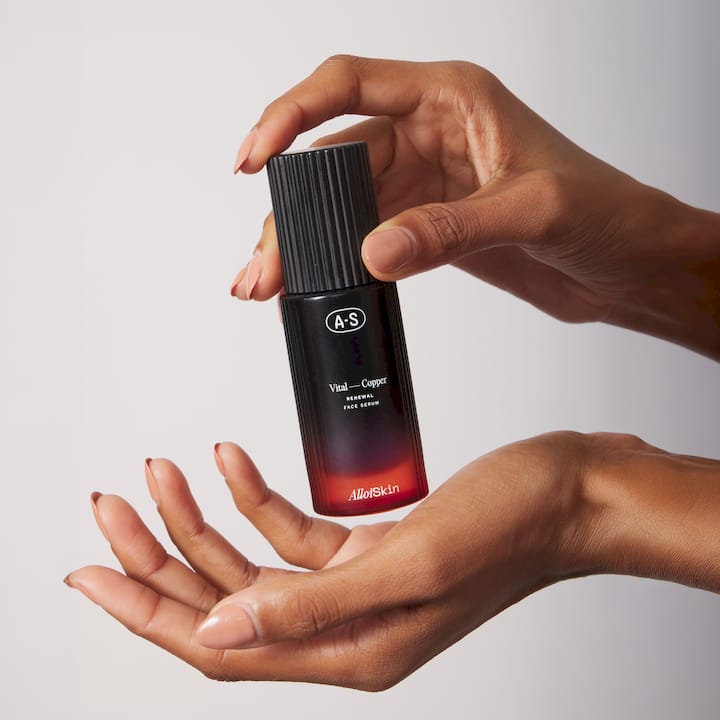
Everything covered above, matrikine signaling, copper-driven crosslinking, palmitoylation for penetration, points toward one practical question: does a given serum deliver these mechanisms at doses that matter? The VitalCopper Renewal Face Serum combines copper tripeptide-1 and Matrixyl 3000 at their studied concentrations, without a long list of diluted extras competing for shelf space in the formula.

The serum pairs those two peptides with panthenol, betaine, and hyaluronic acid, ingredients chosen to soothe and protect the barrier while collagen remodeling happens underneath. If you want the ingredient-level detail behind the copper peptide component specifically, our copper tripeptide-1 evidence page breaks down the research the same way this article has. Apply it once daily at the serum step, and give it the four to six week window this class of ingredient genuinely needs before judging results.
Sources
- Review describing GHK and GHK‑Cu wound healing and regenerative properties
- Polypeptides in skincare: Science and evidence — Superpower
- Matrixyl 3000 ingredient guide (industry/manufacturer summary)
FAQ
What Is the Difference Between Signal Peptides and Copper Peptides?
Signal peptides like Matrixyl mimic broken-down collagen fragments to tell fibroblasts to produce more collagen. Copper peptides like GHK-Cu instead deliver copper that enzymes need to crosslink that collagen into strong, organized fiber, making the two mechanisms complementary rather than interchangeable.
How Long Does It Take to See Results From Peptide Serums?
Most peptide serums need four to six weeks of consistent use before visible change, since collagen remodeling is a gradual cellular process. The pal-KTTKS split-face trial measured its results at 12 weeks, which is a reasonable benchmark for judging any signal peptide product.
Can I Use Copper Peptides With Vitamin C?
Copper peptides and L-ascorbic acid can destabilize each other and should not be applied in the same session. Use vitamin C in the morning and a copper peptide serum at night, or alternate them by day, to get the benefit of both without the conflict.
Do Signal Peptides Work as Well as Retinoids?
No. Topical peptides typically produce more modest improvement than retinoids or in-office procedures, but they also come with far less irritation and no downtime, making them a reasonable maintenance strategy rather than a replacement for stronger treatments.
How Much Does VitalCopper Cost?
Current pricing for the VitalCopper Renewal Face Serum is listed on the Alloi Skin site.


