


Hydrolyzed collagen peptides do work, based on randomized trials and meta-analyses covering skin, joint, and bone outcomes, but the benefit depends entirely on dose and duration. Skin studies typically use 2.5 to 5 grams daily, while joint and bone research often runs 10 to 12 grams daily. Most trials show measurable change only after several weeks of consistent use, and formulation quality (peptide size, source, purity) influences whether a product can plausibly deliver expected benefits.
TL;DR:
- Doses of 2.5 to 5 grams daily support skin improvements after 8 to 12 weeks, while higher doses of around 10 grams are needed for joint and bone benefits.
- The peptide size and purity, especially di- and tripeptide content and hydroxyproline levels, determine how effectively collagen reaches and signals fibroblasts.
- Clinical evidence shows durable skin benefits that persist after stopping supplementation, provided the formulation characteristics match those used in studies.
- Marine collagen may have smaller peptide fragments but offers no proven advantage over well-processed bovine collagen in real-world outcomes.
- Always verify product labels for peptide molecular weight, branded ingredients, and third-party testing, tailoring doses to your specific skin or joint goals.
Table of Contents
- What Are Hydrolyzed Collagen Peptides, Exactly?
- How Do Collagen Peptides Actually Get Absorbed and Used?
- What Does the Clinical Evidence Actually Show?
- Why Does Collagen Source Change What You’re Buying?
- How Do You Choose a Hydrolyzed Collagen Supplement That Actually Works?
- Is Hydrolyzed Collagen Safe, and Who Should Ask a Doctor First?
- How Alloi Skin Thinks About Peptide Science in Formulation
- What Should You Expect in the First Few Months?
- Pairing VitalCopper and VitalBuild in a Peptide-Forward Routine
- Sources
- FAQ
What Are Hydrolyzed Collagen Peptides, Exactly?
Hydrolyzed collagen peptides, also labeled as collagen hydrolysate or collagen peptides on most supplement packaging, are collagen proteins broken down through enzymatic hydrolysis into shorter chains. Whole collagen protein is a large, tightly wound triple helix that the digestive system struggles to absorb intact. Hydrolysis cuts that structure into fragments small enough to cross the gut lining efficiently, which is the entire point of taking a “hydrolyzed” version instead of gelatin or bone broth.
The size of those fragments matters more than most labels admit. Hydrolyzed collagen typically falls in the 2 to 6 kilodalton range, a molecular-weight window enzymatic processing is specifically designed to hit. Smaller peptides dissolve more easily in water, absorb faster, and appear to reach the bloodstream in forms the body can actually use at the tissue level. A protein powder that lists “collagen” without specifying hydrolysis or molecular weight is not offering the same thing, even if the ingredient panel looks similar on paper.
Sourcing also shapes what you are buying:
- Bovine collagen comes from cowhide and bone, and it is rich in Type I and Type III collagen, the types most associated with skin structure.
- Marine collagen comes from fish skin and scales, skews almost entirely Type I, and tends to have a smaller average peptide size, which some formulators market as a bioavailability advantage.
- Porcine collagen is another Type I and Type III source, chemically similar to bovine but sometimes preferred for religious or dietary reasons when bovine is restricted.
- Chicken collagen is the standard source for Type II collagen, the type concentrated in cartilage and most relevant to joint-focused formulas.
Reading a label well means looking past the word “collagen” entirely. Look for peptide molecular-weight disclosures, branded ingredients like Verisol or Peptan (which correspond to specific clinical trial materials), and hydroxyproline content, an amino acid marker that indicates how much of the powder is genuinely collagen derived rather than filler protein. Two products can both say “10,000 mg collagen peptides” on the front and differ enormously in what actually reaches your skin or joints.
How Do Collagen Peptides Actually Get Absorbed and Used?
Collagen peptides do not get broken down all the way to individual amino acids before absorption, which is the detail most marketing copy skips entirely. Digestive enzymes cleave hydrolyzed collagen into di- and tripeptides, chains of two or three amino acids, and a transporter called PepT1 in the small intestine carries many of these short chains directly into the bloodstream intact. That matters because certain di- and tripeptides carry biological signals that free amino acids do not.
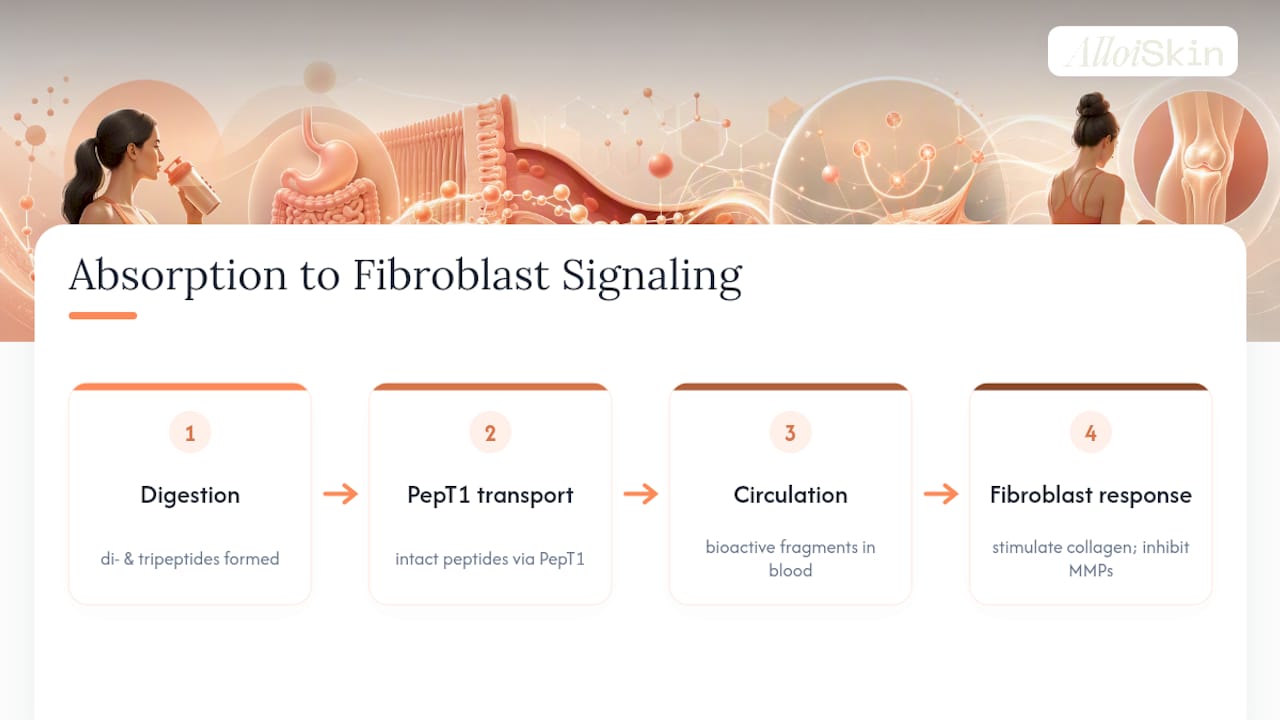
The most studied of these fragments are Pro-Hyp, Hyp-Gly, and Gly-Pro-Hyp, sequences built around hydroxyproline, an amino acid almost unique to collagen. Once these bioactive fragments circulate in the blood, research links them to signaling activity in fibroblasts, the cells responsible for producing new collagen and elastin in the dermis. Fibroblasts exposed to these peptide fragments appear to upregulate their own collagen production and increase synthesis of hyaluronic acid, the molecule primarily responsible for skin’s water retention and plumpness.
There is a second mechanism worth understanding: reduced matrix breakdown. Skin aging is not only a story of declining collagen production, it is also a story of enzymes like matrix metalloproteinases chewing through existing collagen faster than it gets replaced. Some peptide fragments appear to interfere with that breakdown process, which means part of the visible benefit from supplementation may come from slowing degradation rather than purely stimulating new synthesis.
This is why molecular-weight distribution and hydroxyproline content function as practical efficacy markers rather than just technical trivia. A hydrolysate loaded with intact di- and tripeptides in the right size range has a plausible route to reach fibroblasts and signal them. A hydrolysate that has been broken down too far, into single amino acids, or not far enough, into large fragments PepT1 cannot transport, is far less likely to produce the same effect, regardless of how much “collagen” sits on the label. Alloi Skin’s own explainer on collagen tripeptides breaks down how peptide size changes what a formula can realistically deliver.
What Does the Clinical Evidence Actually Show?
The strongest evidence for hydrolyzed collagen peptides sits in skin outcomes, where multiple randomized controlled trials and meta-analyses converge on similar findings using similar doses. A randomized, double-blind, placebo-controlled trial found that 5,000 milligrams of bioactive collagen peptides daily for 12 weeks produced statistically significant improvements in skin hydration, elasticity, and dermal density compared to placebo. Notably, those improvements held up even after a 4-week washout period with no supplementation, suggesting the effect is not purely a hydration bump that vanishes the moment you stop taking the powder.
That persistence shows up again in a related trial using a peptide sample characterized by unusually high hydroxyproline content and more than 40 percent of peptides under 1 kilodalton. That formulation produced durable increases in dermal thickness and density that were still measurable at week 16, four weeks after supplementation stopped. The pattern across these studies points to a consistent conclusion: formulation characteristics, not just total collagen grams, predict how long benefits last after you stop taking the product.
Broader meta-analyses pooling multiple RCTs reinforce the same window. Skin improvements in hydration and elasticity tend to emerge somewhere between 8 and 12 weeks of consistent daily use, rarely sooner. Anyone expecting a visible difference after two weeks is working against the biology of how long fibroblast activity takes to translate into measurable dermal change.
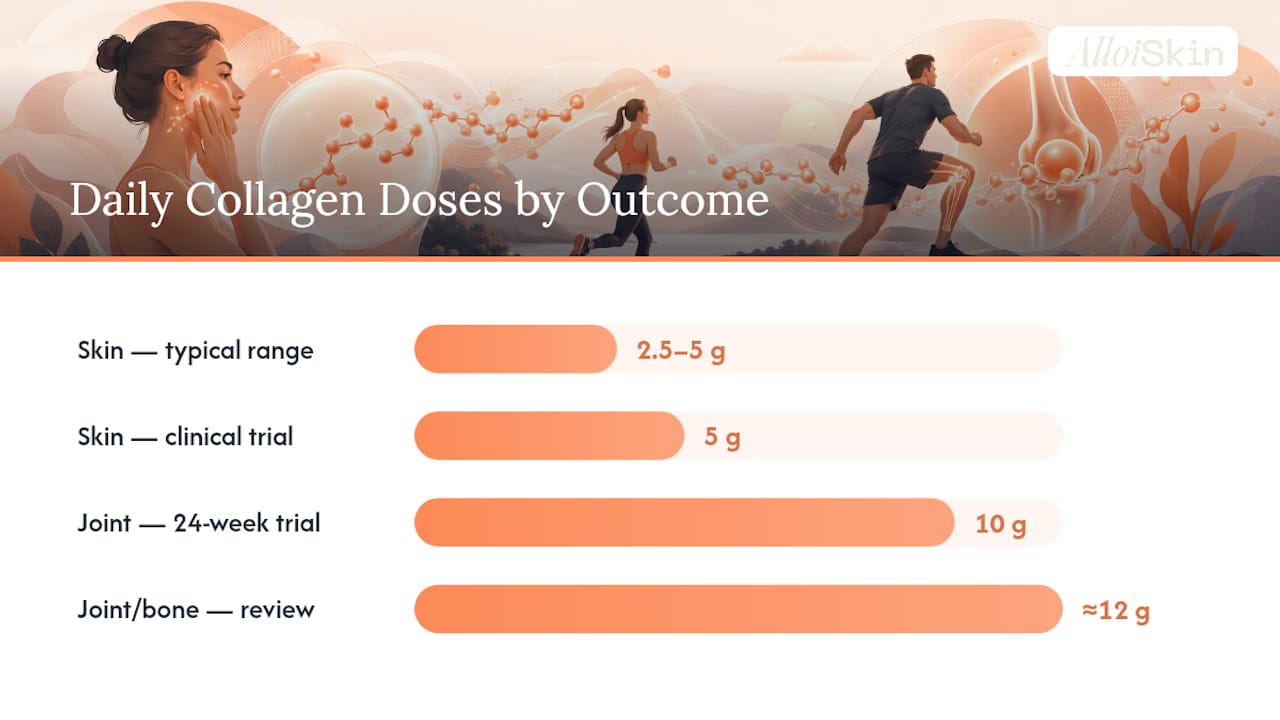
Joint and bone outcomes tell a related but distinct story, generally requiring higher doses. A randomized controlled trial in physically active adults found that 10 grams of collagen hydrolysate daily reduced activity-related joint pain over a 24-week intervention, a considerably longer trial window than most skin studies. A broader review covering hydrolyzed collagen’s role in joint and bone health cites daily doses around 12 grams improving pain symptoms, supporting bone mineral density, and offering some protective effect for articular cartilage in osteoarthritis contexts.
Key clinical evidence at a glance:
- Skin hydration and elasticity: 2.5 to 5 g/day, 8 to 12+ weeks, benefits sometimes persisting through a 4-week washout.
- Joint pain in active adults: 10 g/day over 24 weeks showed measurable pain reduction.
- Joint and bone health in broader review contexts: higher daily doses are associated with improved pain and bone mineral density outcomes.
Statistic to note: In the 12-week bioactive collagen peptide trial, improvements in skin hydration, elasticity, and dermal density reached statistical significance versus placebo at p < 0.05, and those gains did not fully reverse during a 4-week washout period, a detail that separates a genuinely structural effect from a temporary hydration bump.
A few caveats matter when reading this evidence. Sample sizes in most collagen trials are modest by pharmaceutical standards, and many of the strongest results come from studies using branded, well-characterized peptide materials rather than generic bulk hydrolysate. That is not a reason to dismiss the findings, but it is a reason to check whether a supplement’s peptide profile resembles what was actually tested. A powder that never discloses molecular weight or hydroxyproline content is asking you to trust an assumption the clinical literature does not support unconditionally.
Why Does Collagen Source Change What You’re Buying?
Source determines both the collagen type you’re getting and, often, the peptide characteristics of the final powder. Type I collagen, the dominant structural protein in skin, tendons, and bone, comes primarily from bovine, marine, and porcine sources. Type II collagen, concentrated in cartilage, is the type most relevant to joint-support formulas and typically comes from chicken sternum cartilage. Type III collagen, which works alongside Type I in skin and blood vessels, is present in bovine and porcine sources as well.
Marine collagen has developed a reputation for producing smaller average peptide sizes after hydrolysis, which some manufacturers frame as a bioavailability edge, though the clinical evidence supporting a meaningful real-world advantage over well-processed bovine peptides is still limited. What is clearer is that low molecular-weight fractions, generally under 2 kilodaltons and sometimes under 1 kilodalton, along with a high concentration of hydroxyproline-rich sequences, are the formulation traits most consistently linked to durable results in trials.
Label literacy comes down to a short checklist:
- Does the label specify a molecular-weight range, or just say “hydrolyzed”?
- Is there a named, clinically studied branded peptide (such as those referenced in published trials), or a generic ingredient description?
- Is hydroxyproline content disclosed anywhere, even on a certificate of analysis available on request?
Practical considerations extend beyond biochemistry. Marine collagen carries allergen risk for anyone with fish or shellfish sensitivities, and it tends to have a stronger inherent taste that flavoring has to work harder to mask. Bovine collagen is off the table for some readers on religious or ethical grounds, and porcine collagen faces similar restrictions for others. Sustainability considerations also differ: marine collagen sourcing depends heavily on fishing industry byproducts, while bovine and porcine sourcing ties to the cattle and pork supply chains. None of these factors change whether a peptide works biologically, but they absolutely affect whether a specific product fits your life. Alloi Skin’s overview of marine collagen peptides walks through what the marine-specific research actually supports, separate from the marketing claims built around it.
How Do You Choose a Hydrolyzed Collagen Supplement That Actually Works?
Choosing well means matching a product’s specifications to the clinical evidence, not to whichever claim sounds most impressive on the front of the bottle. Here is a practical sequence for evaluating any collagen supplement before you buy it.
- Match the dose to your goal. If skin hydration and elasticity are the priority, look for a daily serving in the 2.5 to 5 gram range demonstrated in trials. If joint comfort or bone support is the goal, expect to need a higher daily dose, often in the 10 to 12 gram range used in the relevant research.
- Check the serving size math. A “two scoops” serving that only adds up to 3 grams of actual collagen peptides, once fillers and flavoring are subtracted, will not replicate a 10-gram joint study, no matter what the front label implies.
- Look for peptide characterization. Prioritize products that disclose molecular-weight distribution or use a named, clinically studied peptide material over those that simply say “premium hydrolyzed collagen” with no specifics.
- Confirm third-party testing. A certificate of analysis (COA) covering heavy metals, microbial contaminants, and purity is a meaningful signal, particularly for marine-sourced products, which carry a higher baseline risk of heavy metal accumulation.
- Read the allergen statement carefully. Marine collagen requires a clear fish or shellfish disclosure; bovine and porcine sources should be labeled plainly for anyone avoiding them for dietary or religious reasons.
- Consider form factor and compliance. Powders make it easier to hit clinically relevant gram doses in a single serving; capsules or tablets often require six or more pills to match the same dose, which hurts long-term adherence.
- Check for vitamin C. Vitamin C is a required cofactor for the body’s own collagen synthesis pathway, and many trial formulations include it or recommend co-administration for that reason.
- Avoid unnecessary fillers. Added sugars, artificial thickeners, and proprietary blends that hide the actual collagen dose behind a combined ingredient weight are red flags, not selling points.
Pro Tip: Do the serving-size math yourself before buying. Divide the listed collagen peptide weight by the number of servings per container, then compare that number directly against the 2.5 to 5 gram (skin) or 10 to 12 gram (joint/bone) ranges used in actual trials. If the math doesn’t clear the bar for your goal, the product likely won’t either.
Vitamin C deserves a closer look here, since it rarely gets explained well on packaging. Collagen synthesis inside your own body depends on vitamin C as an enzymatic cofactor, without it, the enzymes that stabilize new collagen structures can’t finish the job properly. That is a separate mechanism from the peptide signaling discussed earlier, but the two work in tandem: peptides can signal fibroblasts to produce more collagen, and vitamin C helps ensure what gets produced is structurally sound. Alloi Skin’s piece on collagen and vitamin C covers why the two rarely deliver full results in isolation from each other.
Is Hydrolyzed Collagen Safe, and Who Should Ask a Doctor First?
Hydrolyzed collagen carries Generally Recognized as Safe (GRAS) status, and pooled safety data across human trials using doses from 2.5 to 15 grams daily, some running as long as 12 months, has not turned up serious adverse events. The most commonly reported side effects are mild gastrointestinal complaints: bloating, fullness, or mild digestive discomfort, particularly when starting at a higher dose without building up gradually.
Allergen risk is the main safety consideration that varies by source. Marine collagen carries genuine cross-reactivity concerns for anyone with fish or shellfish allergies, since the proteins involved can trigger a similar immune response even after hydrolysis. Bovine and porcine sources carry lower but not zero allergen risk, and anyone with a known sensitivity to those proteins should read sourcing disclosures carefully rather than assuming hydrolysis eliminates allergenic potential entirely.
Certain groups should talk to a clinician before starting a collagen supplement rather than relying on general safety data alone. That includes anyone who is pregnant or breastfeeding, has an autoimmune condition (since collagen supplementation’s interaction with autoimmune processes affecting connective tissue is not fully mapped), takes anticoagulant medication, or has upcoming surgery where any supplement’s effect on healing or clotting deserves a direct conversation with a provider. These are not reasons to avoid collagen outright, they are reasons to loop in someone who knows your full medical picture before adding a new daily supplement.
One regulatory note worth flagging: any product claiming to “treat,” “cure,” or “reverse” a medical condition through collagen supplementation is overstepping what the evidence supports and, in most cases, what regulations allow a supplement to claim. The legitimate evidence supports improved hydration, elasticity, joint comfort, and bone density markers, not disease treatment.
How Alloi Skin Thinks About Peptide Science in Formulation
Formulating around peptide science means starting with the dose used in the trial, not the dose that fits a marketing budget. That principle guides how Alloi Skin approaches every active ingredient, including the copper peptide (GHK-Cu) and Matrixyl 3000 combination at the core of the VitalCopper Renewal Face Serum, and it applies the same way to collagen peptide formulation: match the clinical dose, characterize the peptide profile, and skip ingredients included at a dose too low to plausibly do anything.
The practitioner logic here is straightforward. Two products can both list “collagen peptides” on the label and behave completely differently in the body, depending on molecular-weight distribution, hydroxyproline content, and the bioactive fraction that survives digestion intact. Alloi Skin’s method page lays out this reasoning in more depth: formulation choices should map to what was measured in a trial, not to what sounds impressive printed on a bottle.
That same discipline shapes how complementary actives get chosen. Vitamin C sits alongside collagen-supporting ingredients because it is a required cofactor for collagen synthesis, not because it is trendy. Hyaluronic acid and panthenol get included at doses meant to support the skin barrier while peptide signaling does its slower work over 8 to 12 weeks. Readers who want the mechanistic detail behind how peptides interact with skin structure can find it in Alloi Skin’s breakdown of how copper peptides support collagen synthesis, which covers the same fibroblast signaling logic discussed earlier in this article, applied specifically to topical peptide delivery.
What Should You Expect in the First Few Months?
Skin benefits from hydrolyzed collagen peptides generally take 8 to 12 weeks or longer to become noticeable, and joint benefits often take several months at an adequate dose before pain or function measurably improves. Track progress with consistent, well-lit photos taken every two weeks, a simple hydration or skin-feel journal, and, for joint use, a basic pain or function log rated weekly.
If nothing has shifted by week 12, check three things before giving up on the category entirely: whether your daily dose actually matches trial-level amounts, whether the product discloses peptide characteristics consistent with tested materials, and whether you took it consistently every day. If all three check out and you still see no change, that’s a reasonable point to consult a clinician or try a differently formulated peptide product before concluding collagen supplementation isn’t for you.
— Alloi Skin
Pairing VitalCopper and VitalBuild in a Peptide-Forward Routine
Skin benefits from collagen peptides build from the inside out over weeks, and Alloi Skin’s approach pairs that internal timeline with topical support built on the same evidence standard. The VitalCopper Renewal Face Serum delivers copper tripeptide-1 (GHK-Cu) and Matrixyl 3000 at studied concentrations, alongside panthenol, betaine, and hyaluronic acid to support the skin barrier while those peptides go to work on visible structure and clarity.

VitalBuild Daily Collagen Powder targets the same fibroblast signaling and hydration pathways discussed throughout this article, but from an oral, systemic angle rather than a topical one. Used together, the two approaches address skin structure from both directions: VitalCopper working at the surface where GHK-Cu and Matrixyl 3000 support visible repair, and a daily collagen peptide routine supporting the dermal density and hydration changes documented in the 8 to 12 week clinical window covered earlier.
A realistic trial period mirrors the evidence: give either product, or both together, a minimum of 8 to 12 weeks before judging results, since that is the window where the underlying clinical trials actually detected change. Alloi Skin’s formulation method explains the dosing philosophy behind both products in more detail, and the VitalBuild Daily Collagen Powder product page has full ingredient and serving information for anyone ready to start.
This article is general information, not a substitute for advice from a qualified doctor. Consult a qualified healthcare professional about your own circumstances before acting on anything here.
Sources
- The Sustained Effects of Bioactive Collagen Peptides on Skin Health: A Randomized, Double‐Blind, Placebo‐Controlled Clinical Study
- Hydrolyzed collagen: Exploring its applications in the food and beverage industries and assessing its impact on human health - A comprehensive review
- Hydrolyzed Collagen—Sources and Applications
FAQ
What Is the Best Dose of Hydrolyzed Collagen for Skin?
Most clinical trials showing improved skin hydration, elasticity, and dermal density use 5,000 milligrams (5 grams) daily, typically over 12 weeks. Doses as low as 2.5 grams appear in some studies, but 5 grams daily has the strongest and most consistent supporting evidence.
How Long Does It Take to See Results From Collagen Peptides?
Skin improvements generally take 8 to 12 weeks of daily use to become measurable, based on pooled results from multiple randomized trials. Joint benefits can take even longer, often several months, since the relevant trials typically ran up to 24 weeks.
Is Marine Collagen Better Than Bovine Collagen for Skin?
Neither source has demonstrated a clearly superior real-world outcome in head-to-head clinical evidence. Marine collagen often yields smaller peptide fractions after hydrolysis, but bovine collagen formulated to a low molecular weight with high hydroxyproline content has produced comparably strong results in trials.
Can I Take Hydrolyzed Collagen if I Have a Fish Allergy?
Avoid marine-sourced collagen if you have a fish or shellfish allergy, since cross-reactivity is a genuine risk even after hydrolysis. Bovine, porcine, or chicken-sourced collagen peptides are safer alternatives, though anyone with known protein sensitivities should still check the label.
Does Alloi Skin Sell a Collagen Supplement?
Yes, Alloi Skin offers VitalBuild Daily Collagen Powder alongside its VitalCopper Renewal Face Serum, which uses copper tripeptide-1 and Matrixyl 3000 at studied concentrations for topical skin repair. Pricing details are available on the product pages directly.


