


Hydrolyzed collagen peptides hold up fine in coffee. The proteins denature at temperatures far higher than any coffee brewing method reaches, and a recent crossover trial found the peptides absorb about as well in coffee as they do in water. The realistic upside is modest: better skin hydration and elasticity, and some joint comfort, at the doses used in clinical trials. Stick with hydrolyzed peptides, not gelatin, and dose within the studied range.
TL;DR:
- Collagen peptides survive coffee’s brewing temperature because they are already broken down during production, keeping their molecular integrity intact.
- Absorption of bioactive collagen fragments occurs similarly in coffee and water, with minimal interference from coffee polyphenols, supporting their benefits for skin and joints.
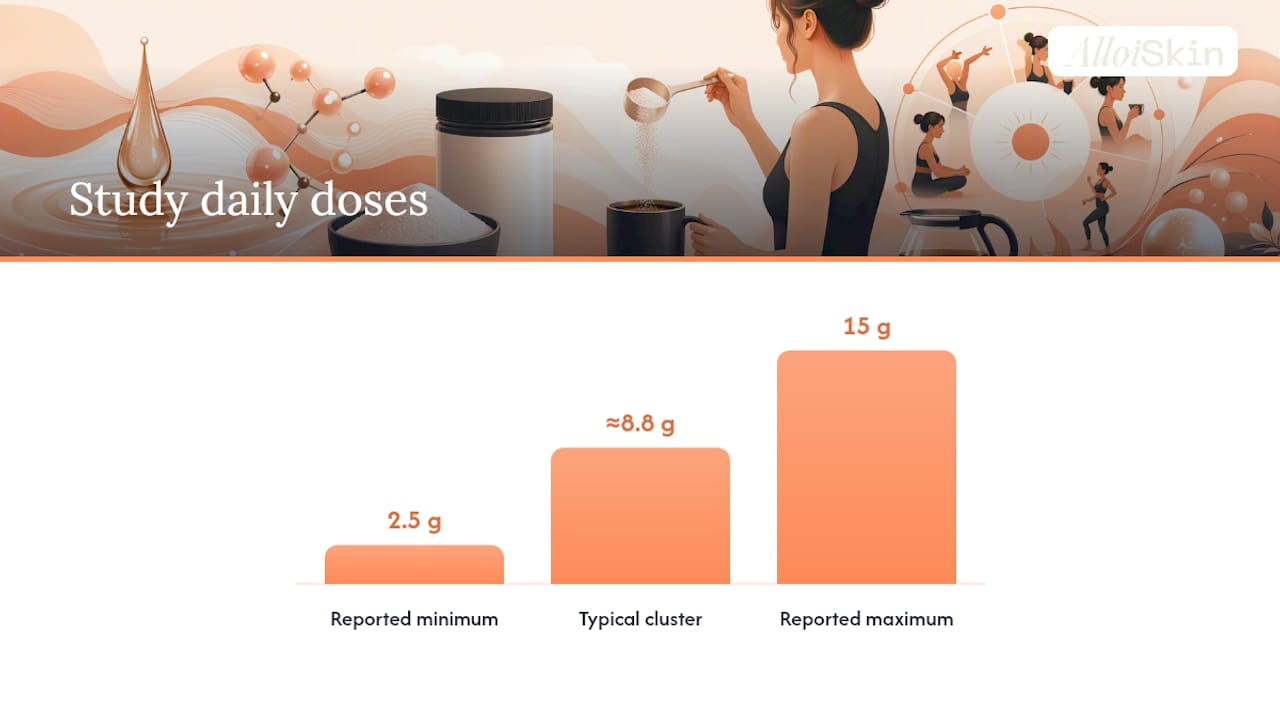
- Doses between 2.5 g and 15 g daily are supported by research, with 5 g to 10 g being sufficient for beginners, and consistency often matters more than the dose size.
- Hydrolyzed collagen dissolves easily in hot and cold coffee when mixed properly, such as stirring immediately or creating a paste with warm water first.
- Collagen is not a complete protein—pairing it with other protein sources and vitamin C enhances collagen synthesis, but topical peptides are necessary for targeted skin repair.
Table of Contents
- What The Science Says About Heat, Digestion, And Results
- Does Coffee Affect Collagen Absorption?
- How To Mix Collagen Powder Into Coffee Without Clumps
- How Much Collagen Powder Should You Add To Coffee?
- Side Effects, Allergies, And When To Check With A Doctor
- How Oral Collagen Complements A Topical Peptide Routine
- Collagen Powder Vs. Other Protein Supplements In Coffee
- The Real Takeaway On Collagen And Coffee
- A Simple Next Step For Your Skin Routine
- Sources
- FAQ
What The Science Says About Heat, Digestion, And Results
Collagen denatures, meaning its triple helix structure unwinds, at roughly 302 to 393°F. Coffee brews between 195 and 205°F, well under that threshold. That gap is why hydrolyzed collagen peptides survive the pour without losing their molecular integrity, according to Bulletproof’s breakdown of the chemistry. The peptides were already broken down during manufacturing, long before they ever meet your cup.
What happens after you drink it is the more interesting question. A peer-reviewed review of randomized trials found consistent, if modest, improvements in skin elasticity, hydration, and joint comfort among participants taking oral collagen daily.
The evidence in brief:
- Study doses ranged from about 2.5 g to 15 g per day, depending on the outcome measured.
- Skin hydration and elasticity improvements showed up most reliably in trials lasting eight weeks or longer.
- Joint comfort benefits were smaller and more variable across different collagen sources and populations.
Statistic to know: Trials reviewed in the PMC systematic analysis used doses between 2.5 g and 15 g daily, with most measurable skin benefits clustering toward the middle and higher end of that range.
The honest caveat: effect sizes are real but not dramatic, and results vary by collagen source, participant age, and study design. Nobody is reversing a decade of sun damage with a scoop in their latte. Think steady, cumulative support, not a quick fix.
Does Coffee Affect Collagen Absorption?
This is the question that stops a lot of people before they ever try it. Coffee is loaded with polyphenols, and polyphenols are known to bind certain amino acids in a test tube. The worry makes sense on paper.
It doesn’t hold up in practice, though. A randomized crossover trial dissolved collagen hydrolysate in either coffee or water and tracked how the bioactive peptide fragments showed up in participants’ blood afterward.
The trial found that bioactive collagen peptide fragments, the specific fragments researchers believe drive the skin and joint benefits, were absorbed at similar rates whether mixed with coffee or water. Some individual free amino acids showed minor differences in absorption, but the intact bioactive peptides performed comparably across both drinks.
That distinction between free amino acids and bioactive peptide fragments matters. Free amino acids are the small, individual building blocks; bioactive peptides are short chains that appear to signal the body to produce more of its own collagen. The pharmacokinetic data suggests coffee’s polyphenols don’t meaningfully interfere with the fragments that matter most.
Timing with food seems to play a smaller role than people assume. Individual digestion speed, gut health, and the specific collagen source you’re using likely matter more than whether your stomach is empty when you drink it.
How To Mix Collagen Powder Into Coffee Without Clumps
Hydrolyzed collagen peptides dissolve more easily in hot liquid than gelatin or indentured collagen ever will, which is one reason they’re the standard form used in most clinical research. Getting a smooth cup still takes a little technique.
For hot coffee:
- Add the collagen powder to your empty mug first, then pour the hot coffee directly over it.
- Stir immediately and thoroughly for 20 to 30 seconds before the powder has a chance to settle.
- For a creamier texture, run a handheld milk frother through the mix for a few seconds.
For cold coffee or cold brew:
- Mix your collagen powder with a splash of warm water first to form a smooth paste.
- Stir that paste into your cold coffee, or shake both together in a small blender or shaker bottle.
- Never dump powder straight into cold liquid. It clumps almost instantly and won’t fully break down.
Pro Tip: A $15 to $20 handheld electric frother creates enough vortex shear to disperse collagen peptides in seconds, no blender required, and it gives cold coffee a noticeably creamier mouthfeel too.
How Much Collagen Powder Should You Add To Coffee?
Clinical trials supporting skin and joint benefits used doses between 2.5 g and 15 g daily, according to the PMC review. Most people adding collagen powder to coffee at home use a dose somewhat above the typical studied ranges or within the upper end of those ranges.
Worth noting: Starting at the lower end of the studied range, around 5 g to 10 g, is a reasonable approach if you’re new to collagen supplementation, since higher intakes haven’t shown proportionally bigger benefits in most trials.
A few dosing notes worth keeping in mind:
- Taking your full dose once daily with your morning coffee tends to produce better long-term consistency than splitting it, mostly because it piggybacks on a habit you already have.
- Collagen lacks certain essential amino acids that make up a complete protein profile, so it works best alongside other protein sources, not as a replacement for them.
- Pairing collagen with vitamin C supports the body’s own collagen synthesis process, since vitamin C is a required cofactor for that reaction.
- If you’re combining collagen with other supplements like creatine, or you have a chronic kidney or liver condition, check with a clinician before adding a daily dose.
Side Effects, Allergies, And When To Check With A Doctor
Collagen powder is generally well tolerated. The most common complaints are mild: bloating, a feeling of fullness, or minor digestive discomfort, particularly at higher doses, according to consumer safety summaries and MedlinePlus.
Before you add a scoop to your daily routine, keep a few things in mind:
- Collagen sources vary: marine, bovine, and porcine are the most common, and each carries its own allergy risk.
- Read labels carefully if you have a known fish or shellfish allergy, since marine collagen is a frequent ingredient in popular powders.
- Allergic reactions are uncommon but possible, and they tend to track back to the source animal rather than the collagen protein itself.
- If you’re pregnant, nursing, or managing a chronic health condition, talk to your provider before starting any new supplement, collagen included.
How Oral Collagen Complements A Topical Peptide Routine
Oral collagen supplies raw amino acid building blocks, glycine, proline, and hydroxyproline, that your body can use during its own collagen production. What it doesn’t do is target a specific patch of skin or repair a damaged barrier directly. That’s a job for topical actives.
This is where topical copper peptides come in. Copper tripeptide-1 works at the skin surface to support structural repair in ways an oral supplement simply can’t reach. Alloi Skin built its entire formulation approach around this distinction: use ingestible collagen for systemic support, and use clinically-dosed topical peptides for targeted skin structure repair. No overlap, no guesswork, no filler actives diluting either one.
Collagen Powder Vs. Other Protein Supplements In Coffee
Whey and plant-based proteins dominate the coffee-additive space for a reason: they’re complete proteins, meaning they contain all nine essential amino acids your body can’t produce on its own. Collagen isn’t. It’s rich in glycine, proline, and hydroxyproline, the amino acids most relevant to skin, joint, and connective tissue support, but light on others your body needs for muscle repair.
That difference shapes how each one behaves in a cup of coffee. Whey protein tends to foam and can curdle slightly in hot, acidic coffee, and it carries a noticeably stronger flavor that fights with coffee’s natural bitterness. Plant proteins, like pea or rice blends, often bring a chalky texture that’s hard to mask even with a frother. Hydrolyzed collagen peptides, by contrast, are nearly flavorless and dissolve cleanly, which is part of why they’ve become the default choice for people who want a functional add-in without changing how their coffee tastes.
The calorie and macro impact differs too. A typical 10 g to 20 g serving of collagen powder adds roughly 35 to 70 calories and 9 to 18 g of protein, with essentially zero fat or carbs. Whey and plant proteins usually run higher in calories per serving and often include added flavoring or sweeteners that collagen powders typically skip.
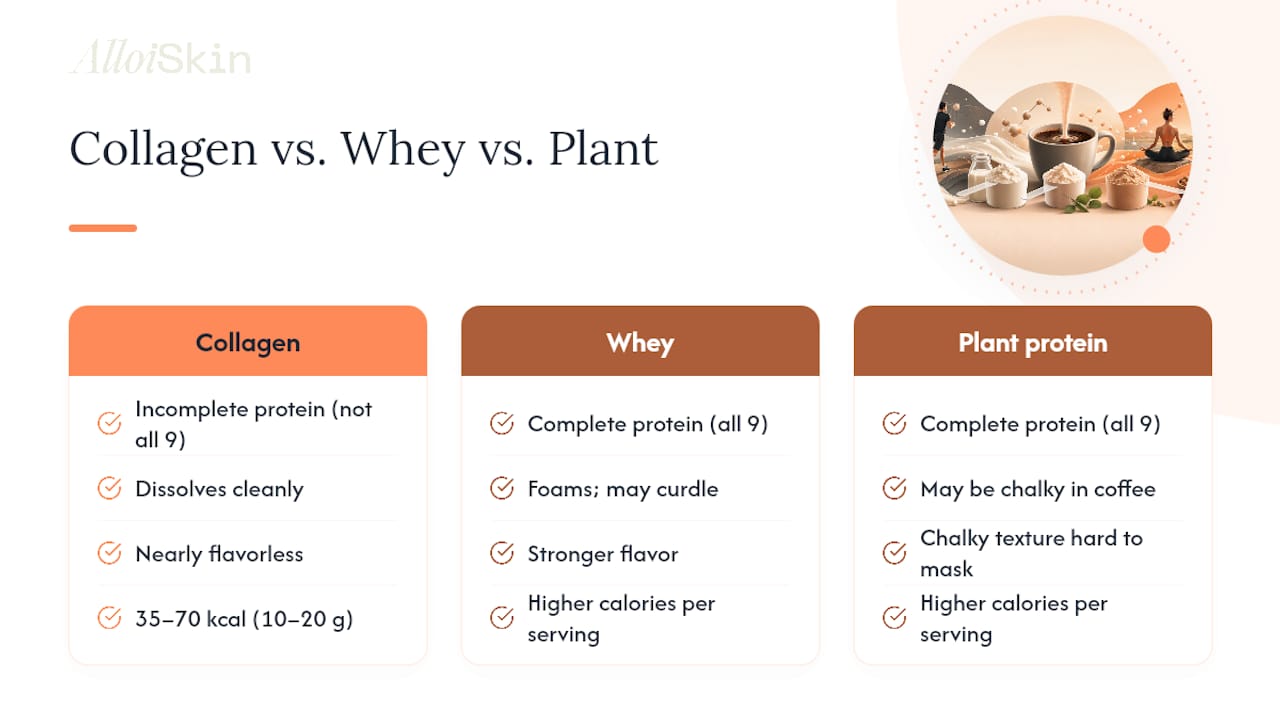
If your goal is muscle building, a complete protein still does more work. If your goal is skin, joint, and connective tissue support, collagen is the more targeted choice, and it’s the one backed by the specific clinical trials discussed earlier in this piece.
The Real Takeaway On Collagen And Coffee
The conventional wisdom on this topic tends to swing between two extremes: either collagen in coffee is a wellness fad with no substance, or it’s treated like a guaranteed fix for aging skin. Neither holds up. The clinical picture is narrower and more useful than either extreme suggests. Hydrolyzed collagen peptides survive coffee’s heat, absorb comparably whether mixed with coffee or water, and produce measurable, modest improvements in skin hydration and elasticity at doses most people can realistically sustain.
Where people go wrong is expecting oral collagen to do a topical product’s job. It won’t rebuild a compromised skin barrier or repair visible structural damage on its own; it supplies materials your body uses elsewhere. If skin repair is your actual goal, prioritize a properly dosed topical peptide alongside your morning routine, not instead of it. Consistency with a reasonable dose matters more than chasing the highest number on a label.
— Alloi Skin
A Simple Next Step For Your Skin Routine
Oral collagen builds materials. It doesn’t rebuild structure. If you’re already adding collagen powder to your coffee for hydration and joint support, the missing piece is a topical product that actually targets skin repair at the surface, where oral supplements can’t reach.
The VitalCopper Renewal Face Serum pairs copper tripeptide-1 (GHK-Cu) and Matrixyl 3000 at studied doses, alongside panthenol, betaine, and hyaluronic acid to support the skin barrier while those peptides work. Alloi Skin built it around one rule: only ingredients that earn their place, at doses that actually match the research behind them, no filler actives padding the label. That’s the same standard behind our formulation method. If your coffee routine already covers the inside, visit the product page and see whether VitalCopper is the piece your skin routine is missing on the outside.
This article is general information, not a substitute for advice from a qualified doctor. Consult a qualified healthcare professional about your own circumstances before acting on anything here.
Sources
- MedlinePlus: Collagen
- Peer-reviewed review article (PMC6213755)
- Does Mixing Collagen With Coffee Reduce Its Absorption? (RethinkPeptides summary of clinical trial)
FAQ
Does Collagen Get Destroyed In Hot Coffee?
No. Hydrolyzed collagen peptides remain stable at coffee brewing temperatures of 195 to 205°F, far below the 302 to 393°F range needed to denature collagen’s structure. The peptides are already broken down during processing, so hot coffee doesn’t damage them further.
What Should Not Be Taken Together With Collagen?
There’s no established supplement that collagen dangerously interacts with, though anyone on chronic medication or managing kidney or liver conditions should check with a provider first, per MedlinePlus. Collagen also isn’t a complete protein, so it shouldn’t replace other protein sources in your diet.
What Is The Best Drink To Put Collagen Powder In?
Coffee works well because absorption of bioactive peptides is similar whether it’s mixed with coffee or water. Smoothies and warm water also dissolve collagen easily, but coffee has the advantage of piggybacking on a habit most people already have daily.
What Is The Best Collagen Powder To Use With Coffee?
Hydrolyzed collagen peptides are the form to look for, since they dissolve more readily than gelatin and are the form used in most clinical studies. Check the label for source (marine, bovine, or porcine) if you have any related allergies, and aim for a dose within the 2.5 g to 15 g range studies have tested.


