


Yes, you can use copper peptides and vitamin C, just not in the same breath. The safest, most effective approach is time separation: vitamin C in the morning, copper peptides at night, or alternating days if your skin runs sensitive. The reason comes down to pH. Acidic vitamin C formulas can pull copper away from the peptide that carries it, which weakens both ingredients. A few neutral-pH vitamin C derivatives and dermatologist-guided exceptions exist, but the split routine remains the standard for good reason.
TL;DR:
- Layer vitamin C and copper peptides separately, with at least 20 to 30 minutes between applications to prevent pH-related ingredient destabilization.
- Use vitamin C in the morning under sunscreen to maximize photoprotection, and apply copper peptides at night to support collagen remodeling.
- Avoid combining copper peptides with low-pH vitamin C formulas or strong acids, as this can cause copper dissociation and reduce ingredient efficacy.
- Opt for neutral-pH vitamin C derivatives if you want to use both in the same session, though they are less potent than L-ascorbic acid.
- Store both ingredients in cool, dark places and replace oxidized vitamin C serums promptly to ensure active benefits.
Table of Contents
- Copper Peptides and Vitamin C: What Each One Actually Does
- What Are Copper Peptides (GHK-Cu) and How Do They Work?
- What Is Vitamin C in Skincare, and Why Does the Form Matter?
- Why the Chemistry Actually Conflicts
- Can You Actually Combine Them? The Practical Verdict
- How to Layer Copper Peptides and Vitamin C Without Wrecking Either
- The Bottom Line on Building This Routine
- What the Research Actually Shows About Using Both
- Getting the Concentration Right for Both Ingredients
- Side Effects and Contraindications Worth Knowing
- How to Choose Quality Copper Peptide and Vitamin C Products
- Storing These Actives to Keep Them Working
- Why Alloi Skin Builds Around This Exact Chemistry
- Where VitalCopper Fits Into Your Night Routine
- Sources
- FAQ
Copper Peptides and Vitamin C: What Each One Actually Does
Before deciding how to combine copper peptides and vitamin C, it helps to know why skincare enthusiasts want both in the first place. These two ingredients solve different problems, and that difference is exactly what makes them worth pairing when the timing is right.
Vitamin C works primarily as an antioxidant. It neutralizes free radicals generated by UV exposure and pollution, and it acts as a required cofactor for the enzymes that build collagen. Copper peptides, particularly GHK-Cu, work more like a repair signal. They tell skin cells to ramp up collagen remodeling, recruit growth factors, and reinforce a compromised barrier.
- Vitamin C: brightens tone, supports collagen synthesis, boosts photoprotection alongside sunscreen.
- Copper peptides: support wound-healing pathways, remodel existing collagen and elastin, calm barrier disruption.
- Together: one protects against daily oxidative damage, the other drives structural repair. Used at the right times, they cover more ground than either does alone.
That complementary relationship is precisely why so many routines try to include both. It’s also why timing, not exclusion, is the real skill to master.
What Are Copper Peptides (GHK-Cu) and How Do They Work?
GHK-Cu is a naturally occurring tripeptide bound to a copper ion. It was first identified in human plasma decades ago, and researchers noticed it triggers tissue repair responses, including upregulation of genes involved in collagen and glycosaminoglycan production. In topical formulas, this translates into gradual improvements in texture, fine lines, and barrier resilience over consistent use.
Stability is where copper peptides get particular. GHK-Cu performs best in a pH range of roughly 5 to 7, close to skin’s own surface pH. Push it into a more acidic environment and the copper ion can dissociate from the peptide backbone, which reduces the compound’s ability to signal repair.
- Works through cell-signaling, not exfoliation or acid-based turnover.
- Backed by mechanistic lab data and smaller human trials rather than large-scale clinical trials.
- Pairs well with humectants like hyaluronic acid and soothing agents like panthenol.
- Best kept away from strong acids, high-frequency exfoliants, and low-pH vitamin C.
Pro Tip: If a copper peptide serum feels tacky or slightly metallic when first applied, that’s normal. It’s the copper complex, not a sign of a bad formula.
What Is Vitamin C in Skincare, and Why Does the Form Matter?
“Vitamin C” on a label can mean several different molecules, and they don’t behave the same way. L-ascorbic acid is the most researched and bioactive form. It penetrates skin best at a low pH, generally in the 2.5 to 3.5 range, a finding tied back to the landmark Pinnell et al. formulation work on ascorbic acid penetration. That acidity is what makes it effective, and also what makes it chemically reactive around other ingredients.
Derivatives like ascorbyl glucoside or tetrahexyldecyl ascorbate trade some of that potency for stability and a gentler, closer-to-neutral pH. They convert to active ascorbic acid in skin, more slowly and less completely, but with far less irritation risk.
- L-ascorbic acid: strongest antioxidant effect, best photoprotection support, most irritating.
- Derivatives: gentler, more compatible with sensitive skin and other actives, less potent per use.
- Both forms show real evidence for brightening and reducing UV-induced oxidative stress when formulated and stored properly.
- Irritation risk climbs with concentration and drops with proper stabilization and packaging.
Why the Chemistry Actually Conflicts
Here’s the mechanism that turns “can I combine these” into “should I combine these.” Vitamin C and copper peptides can antagonize each other at the molecular level, and it isn’t a myth invented by skincare bloggers.
Low pH is the trigger. Acidic vitamin C formulas, especially L-ascorbic acid at its effective pH, can force the copper ion to dissociate from its peptide carrier. Once that copper is free, it doesn’t sit quietly. Free copper ions catalyze oxidation reactions similar to Fenton chemistry, which speeds up the breakdown of vitamin C itself and can generate reactive byproducts on skin.
Ascorbic acid can reduce Cu(II) to Cu(I), and in the presence of trace peroxides, that copper can cycle through reactions that accelerate ascorbate degradation and generate hydroxyl radicals. The result is a formulation feedback loop where each ingredient degrades the other faster than either would alone.
The practical risk is twofold: reduced efficacy from both ingredients, and a small chance of pro-oxidant activity where you wanted antioxidant protection. It’s worth being precise about the evidence here. The pH-driven copper dissociation and the resulting oxidation chemistry are well documented at the formulation level. What’s inferred, not directly proven in skin studies, is exactly how much clinical benefit is lost when you layer them in one application. That gap is why the standard advice leans conservative. Separating by time costs you nothing and removes the variable entirely.
Can You Actually Combine Them? The Practical Verdict
The default rule holds: separate copper peptides and vitamin C by time. Vitamin C in the morning under sunscreen, copper peptides at night, or alternate them by day if you want to keep the routine simple. This isn’t overcaution. It’s the most direct way to sidestep a pH conflict that’s well understood at the chemistry level.
There are exceptions worth knowing. Neutral-pH vitamin C derivatives are gentler on copper peptides because they don’t force the same ion dissociation, though you’re accepting a slower, less potent form of vitamin C in exchange.
- Sensitive or barrier-compromised skin should stick to strict AM/PM separation, no exceptions.
- Avoid stacking either ingredient with retinoids or acid exfoliants on the same night.
- After procedures like microneedling or peels, wait for your provider’s clearance before reintroducing either active.
- Stop and reassess if you notice stinging, persistent redness, or flaking that lasts more than a day.
When in doubt, especially with post-procedure skin or diagnosed sensitivities, a quick check with a dermatologist beats guessing.
How to Layer Copper Peptides and Vitamin C Without Wrecking Either
If you want a routine that just works, here’s how to structure it.
- Morning: Apply vitamin C serum to clean, dry skin. Follow with a moisturizer, then sunscreen. This order matters because vitamin C’s photoprotective benefit only holds up when UV protection follows it.
- Evening: Cleanse, apply your copper peptide serum, then seal with moisturizer. This is when repair signaling has the most uninterrupted time to work, since you’re not layering it against an acidic antioxidant.
- If you must use both in one session: Apply vitamin C first, if it’s an L-ascorbic acid formula, and wait 20 to 30 minutes before applying your copper peptide serum. This gives the vitamin C time to normalize toward skin’s pH before the copper peptide reaches the surface. For same-session use, a neutral-pH vitamin C derivative is the lower-risk choice.
- Alternate-day scheduling: Vitamin C on odd days, copper peptides on even days. This works well if you’re also using a retinoid or an acid exfoliant, since it keeps your active load manageable and easier to troubleshoot.
- Patch test first: Apply a small amount of each new product to your inner forearm for two to three nights before adding it to your face. Watch for redness, itching, or bumps.
- Scale up slowly: Start copper peptides three to four nights a week, then increase to nightly once your skin tolerates it. Do the same with vitamin C if you’re new to it.
Pro Tip: If your skin barrier already feels compromised, whether from over-exfoliation, weather, or a new retinoid, skip both actives for a week and rebuild with just a barrier-support serum and moisturizer before reintroducing either one.
Watch for signs you’ve overloaded your routine: persistent tightness, small red bumps, or a serum that starts stinging when it never did before. Any of those mean it’s time to pull back to the simplest possible version of this routine.
The Bottom Line on Building This Routine
If you take one thing from all of this, take the schedule: vitamin C in the morning, copper peptides at night, or alternate days if your skin needs a lighter touch. That single habit resolves the pH conflict without sacrificing either ingredient’s benefits.
Keep the rest of your routine simple. Add new actives one at a time, patch test before committing your whole face to something new, and loop in a dermatologist if you’re managing sensitive skin or stacking multiple treatments. And never skip sunscreen after morning vitamin C. It’s the step that makes the antioxidant work harder, not an optional add-on.
What the Research Actually Shows About Using Both
Here’s the honest state of the evidence: there’s no large randomized trial that puts copper peptides and vitamin C head-to-head, or one that directly measures outcomes from combined use versus separated use on the same faces. What exists instead is a combination of mechanistic formulation chemistry and smaller human studies on each ingredient individually.
Vitamin C’s evidence base is deep. Decades of research support its role in collagen synthesis and its antioxidant, photoprotective effects when formulated at an effective concentration and stable pH. Copper peptides have a thinner but genuine research trail: gene expression studies showing upregulation of matrix proteins, plus smaller trials showing improvements in skin texture and the appearance of fine lines with consistent use.
What connects the two ingredients isn’t a clinical trial. It’s formulation chemistry documenting how acidic vitamin C interacts with copper-bound peptides. That’s a meaningfully different kind of evidence than a skin study, and it’s worth being clear about the distinction. The chemistry tells you the ingredients can degrade each other under specific conditions. It doesn’t tell you exactly how much visible benefit that costs you day to day. Given that uncertainty, expert consensus favors the conservative option: separate them by time, and you remove the variable rather than gambling on how much damage layering actually does.
Getting the Concentration Right for Both Ingredients
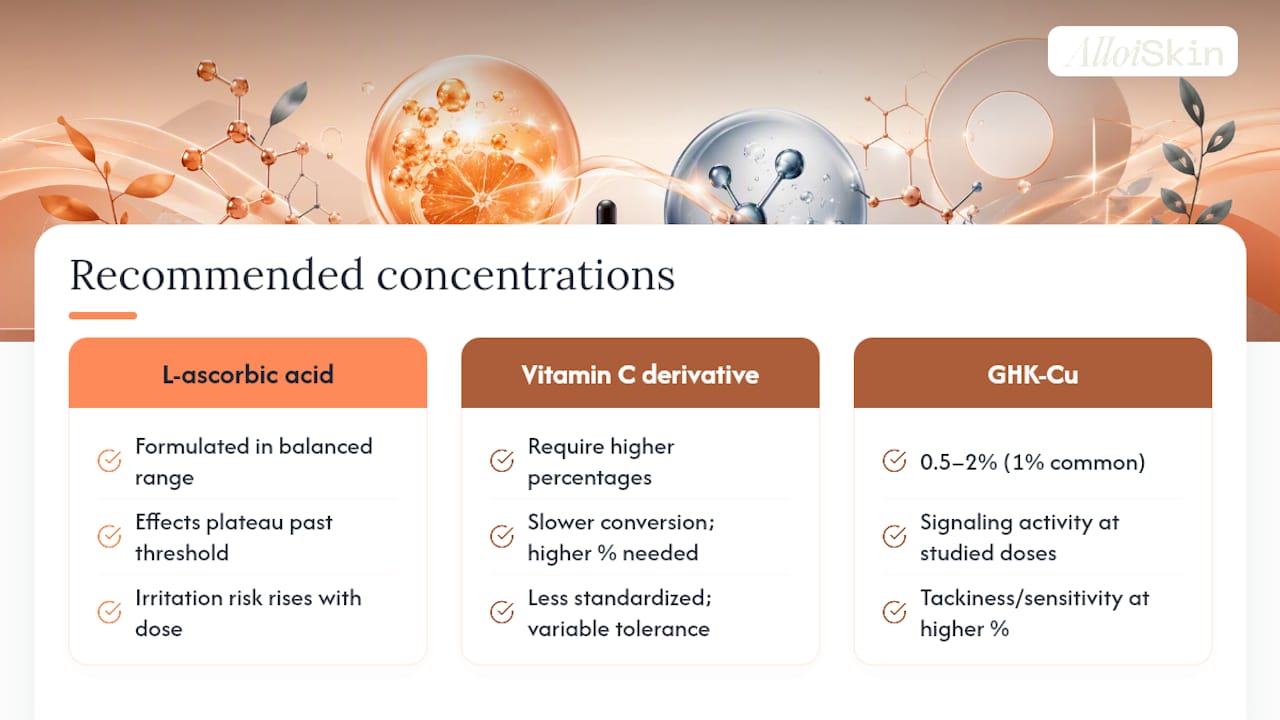
Concentration is where a lot of routines go wrong, often in ways that have nothing to do with combining ingredients at all. Too little vitamin C or too little copper peptide, and you’re paying for a product that isn’t doing much of anything.
For vitamin C, L-ascorbic acid formulas are commonly formulated within a range that balances antioxidant and collagen-support effects with skin tolerance. Higher concentrations do not necessarily yield better results and may increase irritation risk, as absorption tends to plateau beyond an effective threshold. Derivative forms are less standardized, but effective formulas generally use higher percentages of the derivative to compensate for its slower conversion rate.
For copper peptides, GHK-Cu is typically formulated between 0.5% and 2% in leave-on serums, with 1% being a common, well-studied middle ground that balances signaling activity against the metallic tackiness and potential sensitivity that show up at higher concentrations. Products that list “copper peptides” without a percentage, or bury the ingredient far down an inactive-heavy list, are harder to trust simply because you can’t verify you’re getting a dose that matches what’s been studied.
This is one of the most overlooked parts of ingredient shopping. A serum can have the right ingredient and still underperform because it’s dosed too low to do anything measurable.
Side Effects and Contraindications Worth Knowing
Beyond general irritation, both ingredients carry a few specific considerations that deserve attention before you commit to daily use.
Vitamin C, especially at higher L-ascorbic acid concentrations, can cause a temporary stinging or tingling sensation on application, which is usually harmless but can be a sign to dilute frequency if it’s paired with sensitivity elsewhere in your routine. It can also oxidize with light and air exposure, turning a serum yellow to brown; oxidized vitamin C is not just less effective, it can actually be mildly irritating and should be discarded.
Copper peptides carry a lower general irritation profile, but people with copper sensitivities, or those on medications that affect copper metabolism, such as certain chelation therapies, should check with a doctor before regular topical use. Pregnant or breastfeeding individuals should run any new active, vitamin C and copper peptides included, past their physician, since topical peptide research in that population specifically is limited.
Anyone using strong retinoids, benzoyl peroxide, or frequent chemical exfoliants should be cautious layering either ingredient into an already active-heavy routine. Dermatologists commonly advise keeping copper peptides separate from strong acids altogether, not just vitamin C, because the same pH sensitivity applies across the board. If you’re on a prescription topical for acne or rosacea, mention any new antioxidant or peptide serum at your next appointment rather than assuming it’s automatically compatible.
How to Choose Quality Copper Peptide and Vitamin C Products
Not all products labeled with these ingredients deliver what the label implies. A few checks separate a serum worth buying from one riding on ingredient-list optics.
Look for a stated concentration, or at minimum, a placement high on the ingredient list, which signals the active is present at a meaningful dose rather than a token amount added for marketing. Packaging matters more than most people realize: vitamin C needs an opaque, airless pump or a dark glass bottle to resist oxidation, and copper peptides benefit from similar protection against light and air exposure that can degrade the peptide structure over time.
Check the pH claim where it’s listed. A vitamin C product marketed as “gentle” and copper-compatible should specify a near-neutral pH, not just imply it. For copper peptides, a shorter, more purposeful ingredient list is often a better sign than a crowded one; a formula packed with a dozen different peptides at unlisted percentages usually means none of them are dosed at a level that’s actually been studied. Reviewing what copper tripeptide-1 actually does at a study-backed dose is a useful way to calibrate expectations before comparing products.
Finally, be skeptical of any single serum claiming to deliver both high-potency vitamin C and copper peptides together in one bottle at effective doses. Given the pH conflict, a well-formulated product usually picks a lane rather than promising both without addressing the chemistry.
Storing These Actives to Keep Them Working
Both ingredients degrade with exposure to light, air, and heat, and how you store them at home affects how much active ingredient actually reaches your skin months after purchase.
Keep vitamin C serums in a cool, dark spot, away from bathroom humidity and direct sunlight on a windowsill. A color shift toward yellow or brown is your clearest sign of oxidation; once that happens, the product is losing potency and it’s time to replace it rather than use it up. Airless pump packaging slows this process significantly compared to open jars or droppers that introduce air with every use.
Copper peptide serums are somewhat more stable but still benefit from a cool, dark environment and a tightly sealed container. Avoid leaving either product in a hot car or a steamy shower caddy, since heat accelerates the same degradation reactions that light and air trigger. Most well-formulated serums list a shelf life of 6 to 12 months after opening. Writing the open date on the bottle is a small habit that prevents you from unknowingly applying a serum well past its effective window.
Why Alloi Skin Builds Around This Exact Chemistry
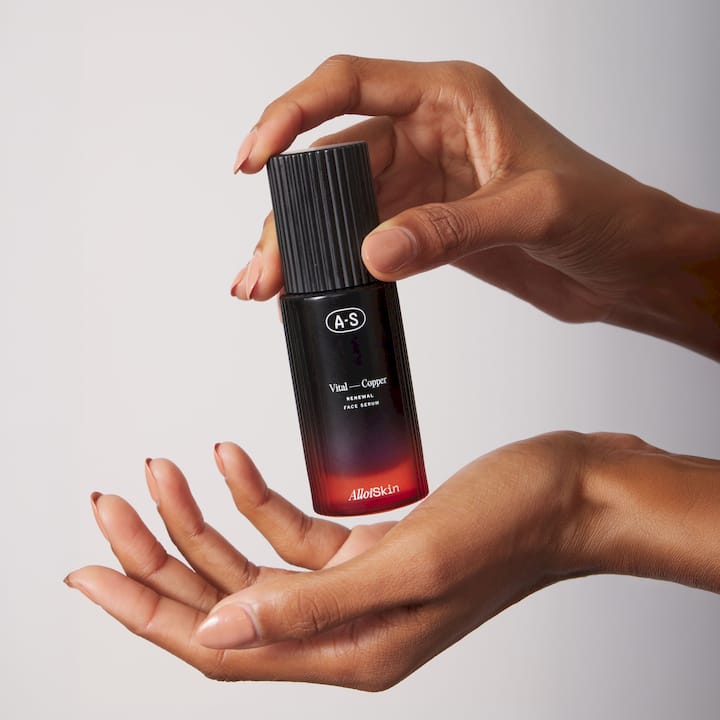
We formulate to avoid this conflict entirely, not work around it after the fact. VitalCopper is built for PM placement, keeping copper tripeptide-1 stable and active rather than competing with an acidic antioxidant. That’s the same minimal, purposeful-ingredient philosophy behind everything we make, and it’s detailed further in our 12-week results timeline.
— Alloi Skin
Where VitalCopper Fits Into Your Night Routine
If you’ve made it this far, you already understand why a copper peptide serum needs a clean, uncrowded pH environment to do its job. VitalCopper is built around that exact requirement. It’s formulated with copper tripeptide-1 (GHK-Cu) and Matrixyl 3000 at doses tied to published research, paired with panthenol, betaine, and hyaluronic acid to support the barrier while repair signaling does its work.
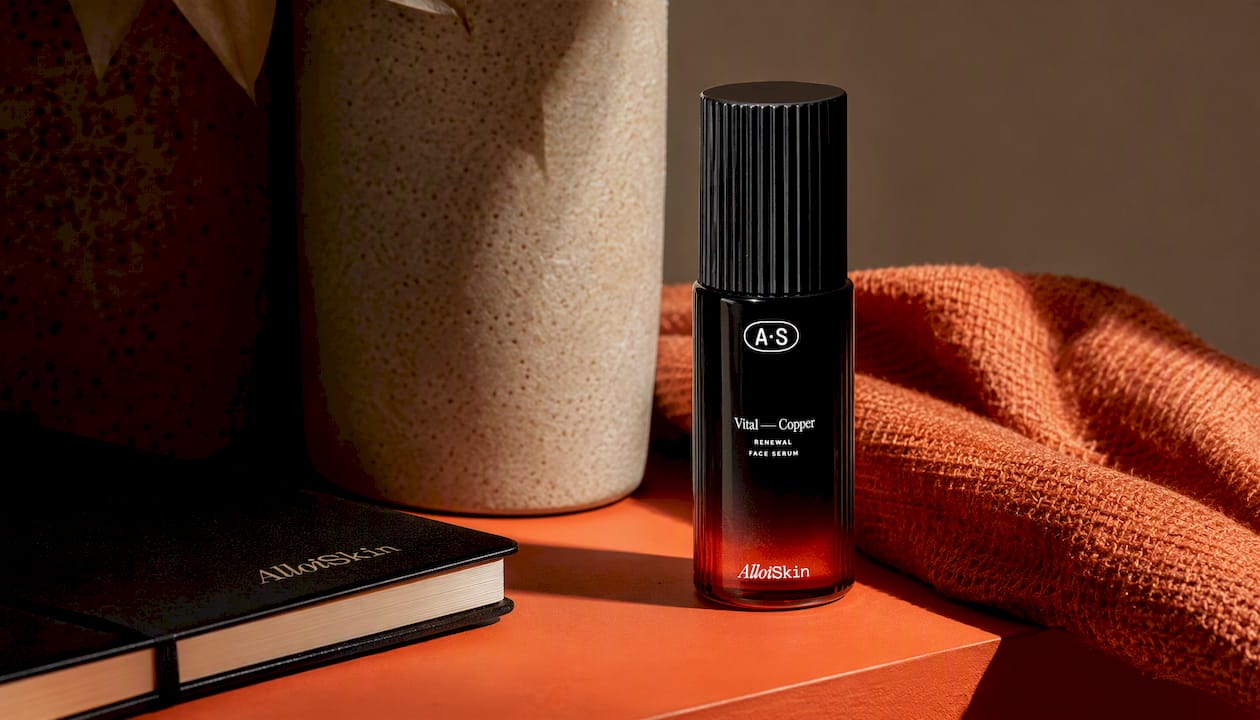
VitalCopper is designed specifically for nightly use, which sidesteps the pH conflict discussed above by never asking you to layer it against an acidic vitamin C. No proprietary blends with a dozen peptides at unlisted percentages, just the two studied actives at doses that match the research behind them, plus the humectants and soothing agents that keep skin comfortable while it repairs. If your current routine has you guessing whether your serum is doing anything, that’s the exact problem this formulation was built to solve. Add the VitalCopper Renewal Face Serum to your evening routine and pair it with a separate morning vitamin C step for the full benefit of both ingredients, done safely.
Sources
- Can You Use Copper Peptides With Vitamin C? What the Research Shows
- Copper Peptides vs Vitamin C: Which Actually Wins for Skin? | FormBlends
- Copper Peptides + Acids: Why pH Matters
- Byrdie: Copper peptides guidance
FAQ
Can I use copper peptides with vitamin C?
Yes, but not layered together in the same application. Use vitamin C in the morning and copper peptides at night, or alternate days, to avoid the pH conflict between them.
What can you not mix with copper peptides?
Avoid mixing copper peptides directly with low-pH L-ascorbic acid vitamin C, strong chemical exfoliants like glycolic or salicylic acid, and benzoyl peroxide, since all of these can destabilize the copper-peptide bond.
How long should I wait between vitamin C and copper peptides?
If you need to use both in one session, wait 20 to 30 minutes after applying vitamin C before applying your copper peptide serum, and consider a neutral-pH vitamin C derivative for same-session use.
What vitamins should I not take with copper?
High-dose vitamin C supplements taken orally can interfere with copper absorption over time, so if you’re on a copper supplement, space them apart and check with a doctor about your specific dosing needs.
Is copper peptides or vitamin C better for anti-aging?
Neither replaces the other. Vitamin C protects against oxidative damage and supports collagen synthesis, while copper peptides drive repair signaling and collagen remodeling, which is why many routines use both on a separated schedule.


